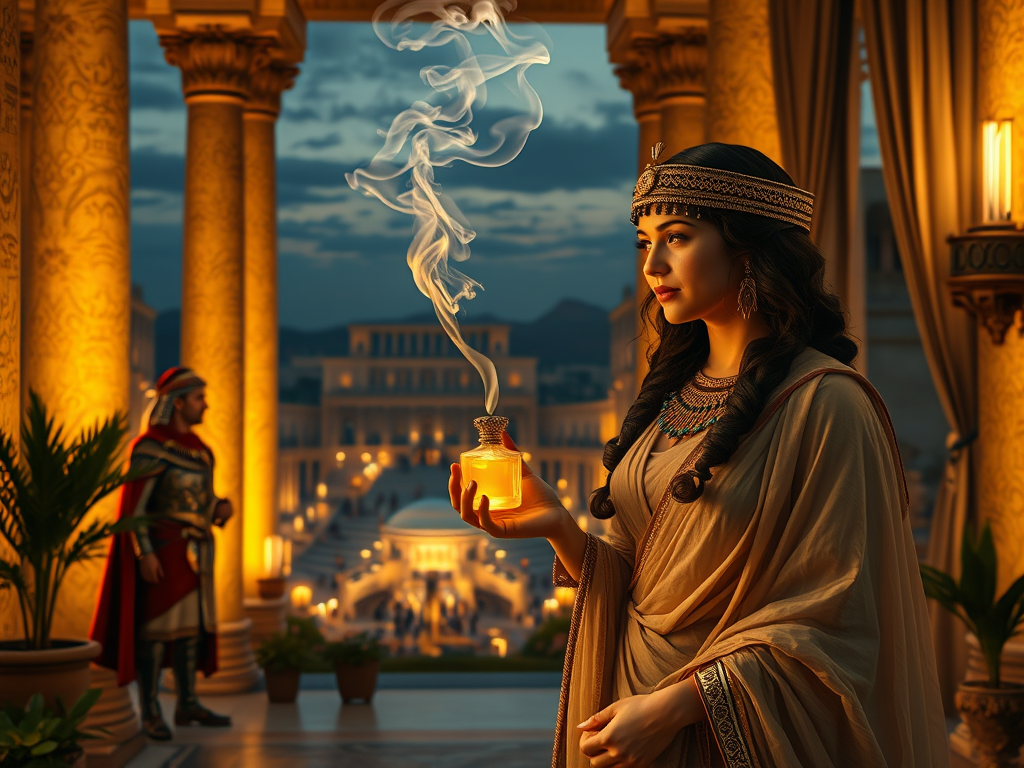

Bhola’s Quip and the Question of Scent
“Give me a drop of Cleopatra’s perfume,” I muttered to Bhola as he swept the living room with the enthusiasm of a man hoping to escape any further lectures. “So I can finally understand why even the mighty Roman generals lost their heads—and occasionally their empires—over one whiff.”
Bhola looked up, unimpressed. “Sir, that lady’s perfume can’t be found in the market. Maybe Amazon has it?” he suggested with a smirk that might have made Cleopatra herself smile. But jokes aside, it’s a question that’s haunted historians and romantics alike: What was it about Cleopatra’s perfume that made even Julius Caesar and Mark Antony swoon like lovesick teenagers?
Cleopatra’s Scented Strategy
Ah, Cleopatra—history’s favorite seductress and the last Pharaoh of Egypt. The mere mention of her name conjures up images of luxurious feasts, gilded barges floating down the Nile, and eyes painted so artfully they could launch a thousand ships. But let’s skip the kohl and head straight to the nose—because Cleopatra’s scent wasn’t just a cosmetic afterthought; it was a weapon of power, politics, and—dare I say—perfumed intrigue.
Alexandria’s Fragrant World
Let’s set the stage: Alexandria, the dazzling, cosmopolitan city of the ancient world, where Greek philosophers argued in the streets, merchants hawked spices from India, and the air carried the heady fragrance of imported resins and local blossoms. Cleopatra’s palace was a sensory feast—a place where rose petals carpeted the floors and the scent of incense clung to every silken robe. A Roman visitor would have been overwhelmed, assaulted by perfumes more potent than any battle strategy.
Power Worn on the Skin
And it was no accident. Cleopatra was a master strategist who understood that power wasn’t just wielded on the battlefield; it was worn on the skin. According to Plutarch, Cleopatra first captured Mark Antony’s attention by sailing up the Nile on a barge with sails soaked in perfume so intense that the scent reached the shore before she did. Imagine the spectacle: a barge of gold, silken sails billowing in the breeze, and a perfume so luxurious it carried her presence ahead of her, like an olfactory fanfare.
What’s in the Perfume?
So, what was in this magical elixir that made grown men crumble? Historians and archaeologists have long debated the contents of Cleopatra’s perfume. Sadly, she didn’t leave behind a recipe card—no “Cleopatra’s Signature Scent” neatly written in a papyrus scroll. But thanks to archaeological digs in Egypt, we’re beginning to get a whiff—quite literally—of what that perfume might have been.
Unearthing Cleopatra’s Scent
In 2012, archaeologists excavating the ancient Egyptian city of Thmuis unearthed a perfume factory that dates back to Cleopatra’s time. Remnants of clay perfume bottles—some still carrying traces of their ancient contents—revealed that Egyptian perfumes of the period were thick, almost like a balm, and made from ingredients like myrrh, cardamom, cinnamon, and henna, steeped in oil. These weren’t light, airy fragrances; they were intense, spicy, and meant to last for days.
The Roman Reaction
Imagine Caesar, fresh from the dry, dusty streets of Rome, stepping into Cleopatra’s palace and being enveloped by this warm, intoxicating aroma—a blend of sweet myrrh, earthy cinnamon, and a hint of floral notes. No wonder he stayed. It’s the kind of scent that clings to your clothes, your skin, and your mind, the way a good story refuses to let go.
Scent as Strategy
Of course, some skeptics might say that even the best perfume wouldn’t have been enough to snare the likes of Caesar and Antony. True enough—Cleopatra was famously intelligent, witty, and politically shrewd. But in a world where appearances were everything, scent was part of the royal arsenal. In fact, according to ancient sources, perfume was so important in Egypt that entire industries flourished around it. Temples even had dedicated perfume labs where priests concocted fragrances for gods and royalty alike. Cleopatra, ever the strategist, would have known how to harness this power.
Pliny’s Gossip and Cleopatra’s Reputation
But let’s not just take my word for it. The Roman historian Pliny the Elder—whose fondness for gossip sometimes rivaled even Bhola’s—wrote that Cleopatra’s perfume was so strong it announced her presence before she even appeared. “The very air,” he wrote, “became sweet when she was near.” Pliny was no fan of Cleopatra (he had a habit of calling powerful women “dangerous”), but even he couldn’t deny her knack for making an entrance.
Bhola’s Modern Comparison
Bhola, by now leaning on his broom like a weary philosopher, muttered, “Sir, but in our day, we have deodorants, no?” I gave him my best professor glare. “Bhola,” I said, “Cleopatra’s perfume wasn’t just about not smelling bad—it was about making history.” And indeed, in Cleopatra’s time, scent was political. A ruler who smelled divine was one step closer to being divine. Perfume was luxury, yes, but it was also legitimacy, power, and a reminder that Egypt’s queen was no ordinary monarch.
Love, Politics, and the Scent of Power
Now, some might argue that Mark Antony fell for Cleopatra’s wit, her charm, and her formidable intelligence—and they’d be right. But never underestimate the power of scent to seal the deal. Smell is our most primal sense, wired directly to the brain’s emotional centers. A single whiff can unlock memories, shift moods, even spark obsession. Cleopatra knew that, and she used it masterfully.
Antony’s Scented Sanctuary
Let’s pause for a moment. Imagine Antony, a Roman general with the weight of the world on his shoulders, entering Cleopatra’s chambers after a long day of politics and strategy. He’d have been hit by the warm, enveloping scent of myrrh and cinnamon—something exotic, different, and utterly captivating. Compared to the grime and grit of Roman army camps, Cleopatra’s perfume must have felt like stepping into another world—one where politics could wait and pleasure reigned supreme.
The Kyphi Connection
Some scholars argue that Cleopatra may have also worn kyphi, a famous Egyptian incense blend that was sometimes used as a perfume. Kyphi was made from as many as sixteen ingredients, including honey, wine, raisins, myrrh, frankincense, and juniper—imagine that aroma, sweet and spicy and completely irresistible. Even Julius Caesar, with his legendary political acumen, wouldn’t have stood a chance.
Perfume as Power
And let’s not forget that perfumes in Cleopatra’s day were more than just scent. They were status symbols, spiritual offerings, and medicine all rolled into one. A queen’s perfume was her signature—just as important as her crown. Cleopatra, known for her intelligence and ambition, would have chosen her perfume with the precision of a general selecting his battle strategy.
Bhola’s Allergy Warning
Bhola, now sitting cross-legged on the floor, sighed dramatically. “Sir, with so many things in that perfume, I think I would have sneezed before I fell in love.” I couldn’t help but laugh. “Bhola,” I said, “some historians believe Cleopatra’s perfume was so potent that even the gods themselves couldn’t resist her.”
Modern-Day Reconstructions
Modern perfumers have even tried to recreate Cleopatra’s signature scent, using recipes found in ancient texts. In 2019, a team of scientists working in collaboration with historians claimed they had reconstructed the perfume from Thmuis. The result? A rich, spicy, and musky blend that would have seemed exotic and luxurious to Roman noses. Even today, a whiff of that ancient blend would transport you instantly to Cleopatra’s Alexandria—a city where every corner whispered of secrets and every breeze carried the scent of power.
The Scent of Empire
So, what did Cleopatra’s perfume smell like? In the end, it was the scent of empire and seduction, of sweet myrrh and political intrigue, of cinnamon and strategy. It was the smell of a woman who understood that to rule the world, you had to rule the senses first.
Why It Drove Generals Wild
And why did it drive Roman generals wild? Because in that scent lay a promise—not just of romance, but of power, of alliance, of a world bigger and richer than anything Rome had known. Cleopatra’s perfume wasn’t just fragrance—it was an invitation to a different kind of empire, one where politics and pleasure intertwined in ways that would echo through history.
A Historian’s Reflection
So next time you catch a whiff of cinnamon or myrrh—or maybe even honeyed wine—think of Cleopatra. Think of her barge drifting down the Nile, the air thick with perfume and possibility. And remember that sometimes, the smallest details—a scent, a smile, a single drop of oil—can change the fate of empires.
Bhola, predictably, just shook his head and muttered, “Sir, only you can find politics in a bottle of perfume.” And maybe he’s right. But as any historian will tell you, the past is never as simple as it smells.
🌺 Related Reading
For more on power, perception, and the senses:


We’d love to hear your thoughts. Let’s chat below!