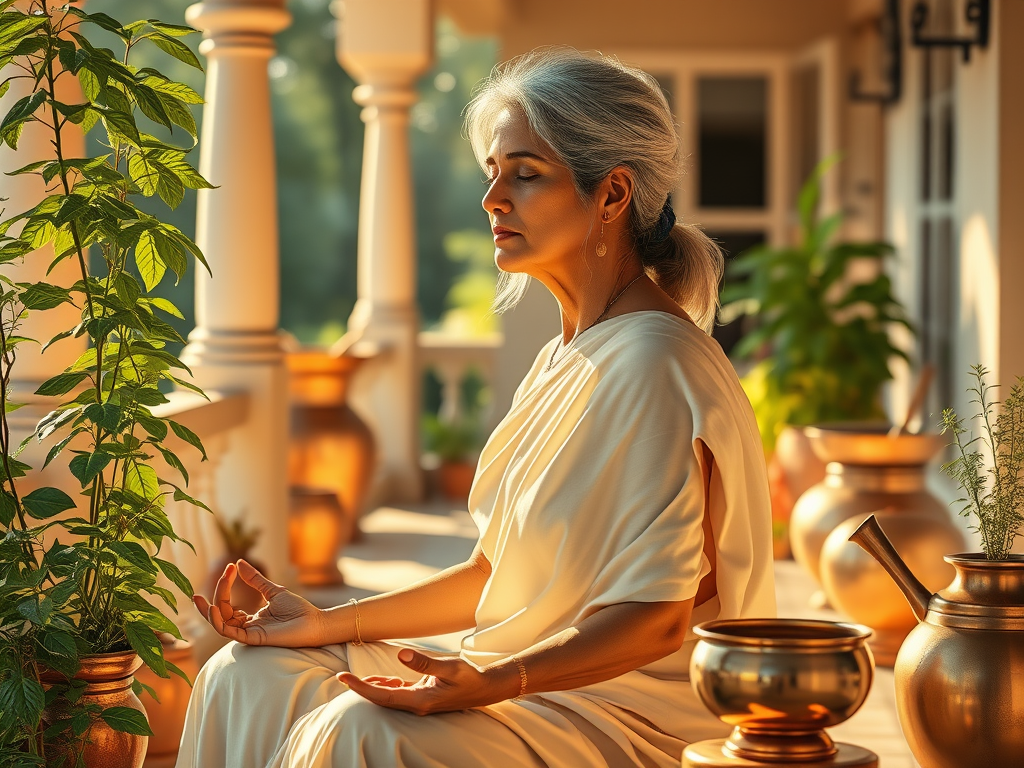

It began, like so many conversations in my home, over a cup of tulsi tea.
“My periods have stopped,” Maya said with a half-smile, half-sigh. “But the hot flashes haven’t. Neither has the world telling me I’m past my prime.”
I looked at her over the rim of my mug. “Maya,” I said gently, “according to Ayurveda, you’re not fading. You’re transforming.”
That’s the thing, isn’t it? Where Western medicine often treats menopause like a problem to be solved, Ayurveda sees it as a sacred passage—a rite of rebalancing, not a medical failure. Today, let’s explore how these two worldviews differ—not just in treatment, but in philosophy, language, and intention.
🔹 A Shift, Not a Shutdown
In Western biomedicine, menopause is largely viewed through the lens of hormone loss. Estrogen levels drop, and the resulting symptoms—hot flashes, insomnia, mood swings, vaginal dryness—are seen as clinical issues. Solutions often include hormone replacement therapy (HRT), SSRIs for mood, and targeted supplements.
Ayurveda, however, approaches menopause as a natural doshic transition.
According to Ayurvedic texts, a woman’s life can be divided into three phases:
- Kapha stage (childhood): Governed by growth and stability.
- Pitta stage (adulthood): Dominated by ambition, intensity, and heat—corresponding to the reproductive years.
- Vata stage (post-menopause): Ruled by air and space—mobility, creativity, and wisdom.
Menopause, in this framework, marks a shift from Pitta to Vata. The body is not deteriorating—it’s preparing to take flight in a new phase of life. But Vata is a tricky dosha—too much, and it creates anxiety, dryness, and instability. Hence the Ayurvedic approach is about grounding and nourishing, not replacing what’s “lost.”
🔹 Language Tells a Story
Western medicine calls it “ovarian failure.” Think about that.
In Ayurveda, it’s called “Rajonivritti”—the cessation of menstruation. A neutral word. A factual change. No judgment.
Even that shift in vocabulary changes how a woman might experience this time. Is she “failing,” or is she simply evolving?
🔹 Healing from the Kitchen First
Let’s start with what’s on the plate. In Western diets, there’s an emphasis on calcium supplements, vitamin D, and lean proteins during menopause. All valid. But Ayurveda starts with food that supports agni, or digestive fire—which can become erratic in Vata-dominant times.
So I told Maya what I tell all my clients: Go back to your grandmother’s pantry.
- Warm, cooked foods: Think khichdi, moong dal soups, stewed apples.
- Ghee: Not a villain, but a vehicle—grounding and lubricating.
- Spices like cumin, ginger, fennel, and asafetida help with bloating and indigestion.
- Ashwagandha and Shatavari: Herbs that balance stress and hormonal changes.
- Milk with nutmeg at night—an age-old sleep remedy I still swear by.
I once made Maya a bowl of warm ragi porridge with cardamom and jaggery. She wept. Partly from nostalgia, partly from relief. Because it reminded her that food can be medicine, not just math.
🔹 Beyond Pills—Into Ritual
One key difference between Ayurveda and Western medicine is that the former never isolates a symptom. Everything is connected.
So while the West might prescribe a pill for hot flashes and another for anxiety, Ayurveda asks:
- Are you getting abhyanga—the self-massage with warm sesame oil that calms Vata?
- Are you practicing pranayama, especially alternate nostril breathing, to ground your mind?
- Is your sleep hygiene intact—screens off, lights dim, mind stilled?
There’s beauty in these rituals. Asha’s Law of Healing #17: “If it feels like a chore, it won’t heal you. If it feels like self-respect, it will.”
🔹 The Emotions We Don’t Name
Here’s something the clinical charts miss: the grief.
Maya once said, “It’s like I’m mourning my old self, but I don’t even know what I’m mourning.” Ayurveda not only recognizes this, it creates space for it.
In traditional practice, grief is Vata’s cousin—light, dry, mobile. The way to manage it is not to suppress it but to ground it. Through oil, through touch, through rhythm. Through routines that tell the body: you are safe, you are stable.
And if that means crying during your third cup of tea? That’s part of the detox.
🔹 The Menopause Industry and the Feminist Reframe
Let’s address the modern wellness circus: hormone therapy innovations, vaginal rejuvenation treatments, and adaptogen products now branded for the “divine feminine.”
Ayurveda isn’t against innovation—but it does ask: what’s the intention? Are we honoring the body, or are we repackaging age-old insecurity?
As a cultural connector, I often point out how Japanese women have some of the lowest rates of menopausal symptoms—not because of soy alone, but because aging isn’t stigmatized in the same way. In many tribal cultures, post-menopausal women are seen as shamans, elders, and keepers of community memory.
Imagine what that does to your cortisol levels.
🔹 When Ghee Becomes a Gimmick
Let me tell you about Mr. Raghavan, my neighborhood spice vendor. One day he chuckled and said, “You know, Doctorji, Americans are now eating ghee like it’s ice cream. In my day, we ate it because we needed it.”
He’s right. Wellness trends love to export without context.
Just like matcha and kimchi went through their own global repackaging—suddenly dubbed “superfoods” after centuries of traditional use—ghee, ashwagandha, and shatavari are now part of a billion-dollar market. But Ayurveda asks us to personalize, not globalize. What suits one person might unbalance another.
🔹 A Closing Reflection: The Banyan Years
I call the post-menopausal phase the “Banyan Years.”
Like the banyan tree, a woman at this stage has deep roots and vast shade. She nourishes those around her not with hormones or fertility, but with presence, perspective, and power.
“Is it too late to reinvent myself?” Maya once asked me.
“No,” I replied. “It’s finally time.”
🌿 What’s Your Next Chapter?
So here’s my question to you:
Are you bracing for menopause… or are you preparing for a renaissance?
If you’re in the thick of it—or see it on the horizon—maybe it’s time to close the clinical browser tabs and open your grandmother’s spice box. To see yourself not as broken, but becoming.
As always, I’d love to hear your stories—especially the ones you were told not to tell.
Let’s rewrite this chapter, together.
We’d love to hear your thoughts. Let’s chat below!