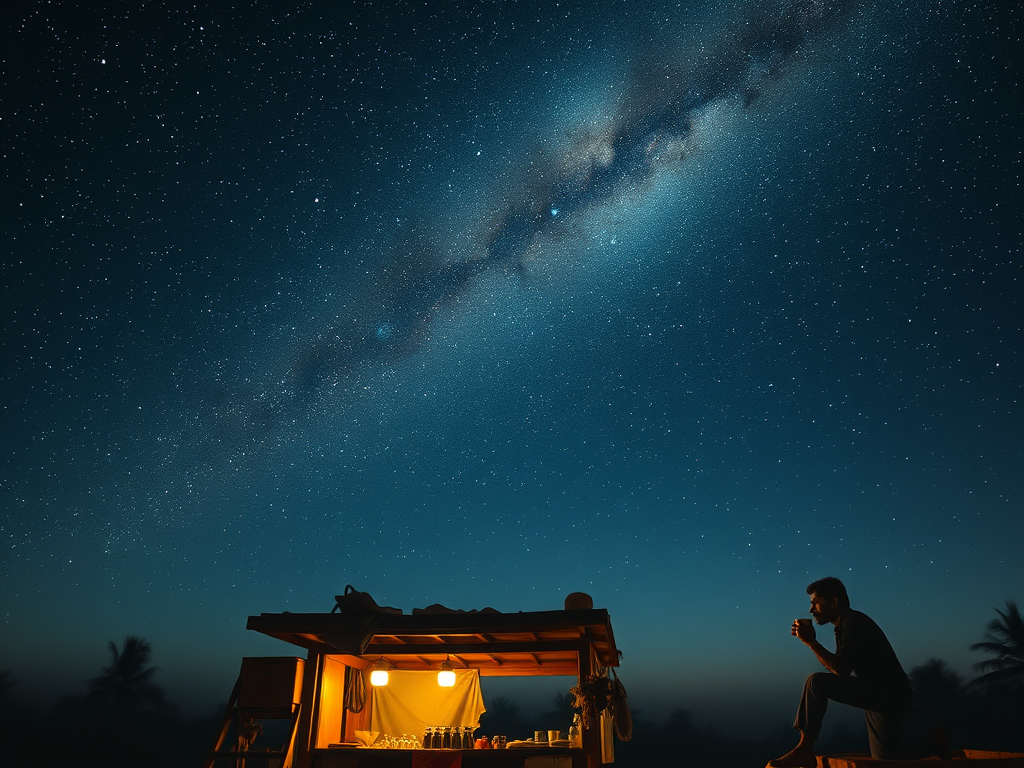

It’s just past 9 PM, and the air in Kochi is thick with the scent of rain-soaked earth and fried banana chips. I’m perched on the rusting railing outside Ambili Chechi’s tea stall, sipping her strongest chai—two spoons of sugar, a hint of cardamom, and the kind of heat that kickstarts philosophical rants. Across from me, Sukumar the fisherman is arguing that aliens exist because, “Machane, the sea sometimes hums. I’ve heard it.”
That’s all the cue I need.
Because tonight, I’ve been thinking about one of the strangest, most haunting puzzles in all of science: The Fermi Paradox.
So Many Stars, So Little Signal
Back in 1950, physicist Enrico Fermi looked up at the night sky—probably not from Kochi, but let’s pretend—and asked: “Where is everybody?” There are billions of stars in the Milky Way, many with Earth-like planets. Statistically, intelligent life should have emerged somewhere else by now. Not just emerged—built radio towers, sent probes, maybe even cruised by Earth for interstellar sightseeing.
And yet—nothing.
No signals. No artifacts. No alien postcards saying “Wish you were here!”
That’s the paradox.
But Wait, Let’s Do the Math
Let’s get briefly mathy. The Drake Equation, a kind of cosmic guesswork calculator, tries to estimate how many alien civilizations might be out there. You multiply factors like:
- the number of stars born each year,
- the fraction that have planets,
- the number of those with habitable zones,
- how many of those develop life,
- and how many eventually become smart enough to invent TikTok.
Even with cautious estimates, the number you get is huge. We’re talking thousands, maybe millions of civilizations.
But our telescopes? Silent.
Are We Early—or Too Late?
One theory is what I call the “cosmic timing fluke.” Maybe we’re just early. Imagine walking into a theatre before the movie starts—of course it’s quiet. The show hasn’t begun. Maybe intelligent life takes time to evolve, and we’re one of the first.
Or… maybe the real tragedy is the opposite: We’re late. The civilizations were here. They flourished. They vanished. Some self-destructed—nukes, plagues, nanobots gone rogue. Others maybe transcended to a state beyond detection—pure data floating in quantum foam.
Either way, we’re catching the tail end of a cosmic party, long after the music stopped.
Maybe They’re Hiding—And Maybe We Should Too
Another popular idea: the zoo hypothesis. What if we are being watched—like animals in a preserve? Civilizations far older than ours could be deliberately hiding themselves, avoiding interference. Because when your species has survived for millions of years, maybe you learn that poking every new lifeform is a bad idea.
Which begs the uncomfortable question: should we be broadcasting?
We’ve been sending out TV signals, radio waves, and “Hello!” messages into space for decades. What if the reason everyone else is quiet is because they know better?
As Stephen Hawking once said, meeting advanced aliens could be like Native Americans meeting Columbus. It didn’t go well.
Filters, Great and Terrible
This brings us to one of the scariest ideas in science: the Great Filter. Imagine evolution as a cosmic obstacle course. Life has to jump over certain hurdles: from single-cell to multicellular, to intelligence, to technology, to interstellar travel.
What if there’s a filter so hard to cross that almost no species makes it past? Something that wipes out nearly everyone before they go galactic?
And what if… we haven’t hit that filter yet?
Yeah. Sip your chai.
Maybe We’re Not Asking the Right Questions
Here’s the thing that keeps me up at night—sometimes literally, with mosquitoes buzzing philosophy into my ears.
What if we’re framing the question all wrong?
What if “intelligence” doesn’t look like us?
Imagine a civilization that lives in gas clouds, communicating with chemical pulses. Or one that never invents metal but builds entire cultures from sound. Would our instruments even recognize their existence?
Heck, octopuses on Earth have nine brains and still haven’t built a space program. Intelligence might be out there—just not in any way we understand.
And that reminds me of Rakesh—yes, the tea-stall coder—who once said, “Enta da, if ants don’t understand the internet, maybe we’re the ants.”
Or… Maybe We’re in a Simulation
Cue the simulation theory—because of course I have to go there.
What if the universe seems empty because it’s meant to be?
Think about it. If we’re living in a simulation, the creators wouldn’t need to render trillions of alien civilizations. It’s expensive, right? GPU time and all that. They’d only simulate what we need to see.
Just Earth. Just us. A kind of single-player campaign with really good graphics.
Simulation or not—my chai tastes real enough.
But Then, There’s This One Possibility
Maybe the universe isn’t empty.
Maybe it’s just quiet.
Imagine a galaxy humming with life—but not the kind that blares radio waves or builds Dyson spheres. Maybe life out there is contemplative, spiritual, inward. Maybe they communicate through quantum entanglement or gravitational waves. Maybe they sing to the stars in frequencies we haven’t even discovered.
Or maybe they just don’t care to talk to us.
Like a cosmic version of ghosting.
So Where Does That Leave Us?
Tonight, as the rain picks up and the sky turns velvet black, I’m still staring up, wondering.
Maybe we’re the first. Maybe we’re the last. Maybe we’re in a cosmic village full of shy neighbors.
But what I do know is this:
The absence of evidence is not evidence of absence.
The silence might be the prelude to a song we’ve yet to hear.
Or maybe, as Sukumar puts it, “Sometimes the fish swim deep. Doesn’t mean they’re not there.”
And honestly, on a planet where cardamom chai, fried plantains, and theoretical paradoxes can all exist on the same rainy night—I’m not sure we’re ever truly alone.
🔖 Related Reading
If the silence unsettled you, here are a few more questions worth sitting with:

We’d love to hear your thoughts. Let’s chat below!