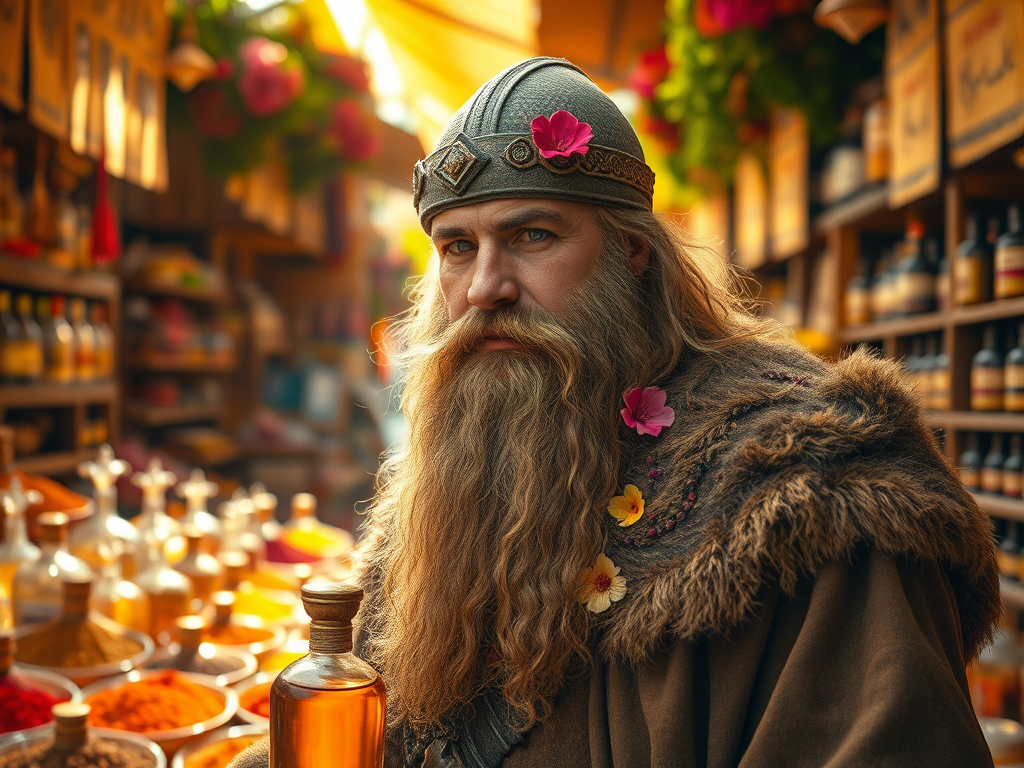

“Ah, the good old days,” I muttered, swirling a drop of rose oil on my wrist, only to be interrupted by a disgusted Bhola gagging from across the room. “Smells like a Mughal harem during mango season,” he complained, dramatically waving his broom like a sword. But dear reader, what if I told you that this very fragrance—this Persian attar of roses—once wafted from the beards of burly, battle-hardened Vikings?
Yes, Vikings. Those axe-wielding Norsemen you imagine with unwashed hair and bear pelts reeking of dried fish. Turns out, some of them smelled… divine.
The Scented Raiders
Let me take you to the 9th century—a time when Viking longships sliced through river veins like daggers, not just across the coasts of England or the monasteries of Lindisfarne, but down the mighty Volga and Dnieper Rivers, deep into the bustling markets of Baghdad. Yes, Baghdad. The heart of the Abbasid Caliphate, where perfumes were not just fashion but philosophy.
The Vikings called themselves Varangians on these journeys, and their reach extended from the frosty fjords of Scandinavia all the way to the sun-scorched bazaars of Persia. They didn’t just raid. They traded. And when they did, oh, did they acquire things—silver, silk, spices, and most curiously, scent.
One Arab writer, Ibn Fadlan, left us an unforgettable encounter with these Norsemen. While he found their bathing habits suspect (they used the same water to wash their faces in turn—Bhola nearly fainted at that part), he couldn’t help but note their obsession with grooming. They carried combs, wore clean clothes, and even adorned themselves with—wait for it—perfume.
Now pause for a moment. Take in the irony. The men who inspired Hollywood’s dirtiest battle scenes were, in fact, clean-shaven (well, clean-braided), scrubbed, and fragrantly spiced.
Persian Perfume: Bottled Prestige
Perfume in Persia was not just a scent—it was status, science, and soul rolled into a tiny vial. The Abbasids, inheritors of Greek medical knowledge and Indian botanical wisdom, had turned perfumery into a serious business. Scholars like Al-Kindi wrote treatises on distillation that would make your local chemist weep.
Their perfumes weren’t some crude splash of jasmine oil. They were layered—oud, rose, civet, musk, and even saffron. (Yes, saffron. The same ingredient I once used in a historical biryani recreation that left Bhola cursing for three days.)
For a Viking merchant or mercenary reaching Baghdad, buying perfume was like buying Bitcoin in 2012—exotic, mysterious, and, as we now know, ridiculously valuable in retrospect.
So… Why Did They Wear It?
This is the question that tickled me into writing this piece: why would a Viking, a warrior of the northern seas, care to smell like Persian royalty?
A few theories—some sensible, some wildly speculative (which are my favorites):
1. Status Symbol
Perfume was rare in the north. A tiny vial of Persian oil could cost as much as a warhorse. So wearing it? That was the Norse way of saying, “I’ve been to places you’ve only heard in sagas, and I brought back bottled dreams.”
In fact, several Viking burial sites—including at Birka in Sweden—contained small glass vessels of Middle Eastern origin. We don’t know if they contained perfume, but I like to think one still faintly smells of sandalwood if you lean in close enough (Bhola refused to test this theory).
2. Cultural Chameleon
The Vikings were practical people. When in Baghdad, do as the Baghdadis do. Wearing perfume could help gain favor in trade negotiations. Imagine a bearded Norseman, axe on hip, gently dabbing rose oil behind his ears before meeting a Persian merchant. The mind reels.
And we have evidence they adapted. Coins from Baghdad turned up in Viking hoards; Eastern fabrics were worn back in Scandinavia. The line between “raider” and “diplomat” was blurrier than we think.
3. Because It Smelled Good, Bhola
Sometimes, the answer is beautifully simple. Who wouldn’t want to smell like paradise when the alternative is… wet wool and pickled herring?
In fact, Bhola—between gags—admitted that if he’d spent a month on a Viking longship, he’d bathe in saffron water too.
The Trade Route Nobody Talks About
Now here’s where I ask you to lean in, conspirator-style.
We’re taught to imagine the world before airplanes as slow, provincial, disjointed. But history says otherwise. The Volga Trade Route connected the Baltic Sea to the Caspian. Vikings took their ships overland, using logs to roll them across portages. That’s how determined they were to reach the opulence of the Islamic world.
In turn, goods flowed back—glass, silk, dyes, and yes, perfume. These weren’t just tokens. They were cultural pollen, cross-pollinating civilizations. And like pollen, sometimes the most potent bits were invisible: a scent, a flavor, a story whispered into a beard over mint tea.
But Rajesh, How Do We Know?
Good question, imaginary skeptic (or Bhola, who is not imaginary, and just walked in to say, “Are you telling them about the scented Vikings again?”).
We know from:
- Ibn Fadlan’s writings, which describe Viking hygiene and grooming rituals.
- Archaeological finds of Middle Eastern glass and containers in Norse graves, such as at Birka.
- Linguistic traces—some Arabic and Persian words in Norse trade terminology.
- And my favorite: the absence of contradiction. If the Vikings weren’t wearing perfume, no one in the Islamic world thought it odd to sell it to them.
Sometimes, silence in history is just as telling as speech.
Of Stew and Saffron
Last month, in a burst of inspiration (and possibly poor judgment), I tried to recreate a Viking-Persian fusion dish: goat stew with sumac and rosewater. “For the full sensory experience,” I explained. Bhola took one whiff and threatened to alert the archaeological department.
But here’s the thing—he still talks about it. Because that’s what scent does. It lingers, even in memory. Just like history.
Final Whiff
So, why did Vikings wear Persian perfume?
Because the world was more connected than we give it credit for. Because trade is not just about silver and spices—it’s about curiosity, mimicry, envy, and admiration. Because even warriors seek beauty. Because scent, like story, travels.
And maybe—just maybe—because the line between raider and romantic was never as thick as we thought.
So next time someone says history is dry, hand them a rose-scented beard comb and tell them about the time a Viking walked into Baghdad, bought a bottle of perfume, and changed how we think about both.
Bhola may still roll his eyes. But I saw him the other day—just before his afternoon nap—dab a faint drop of attar behind his ears. He claimed it was mosquito repellent. But I’m not buying it.
We’d love to hear your thoughts. Let’s chat below!