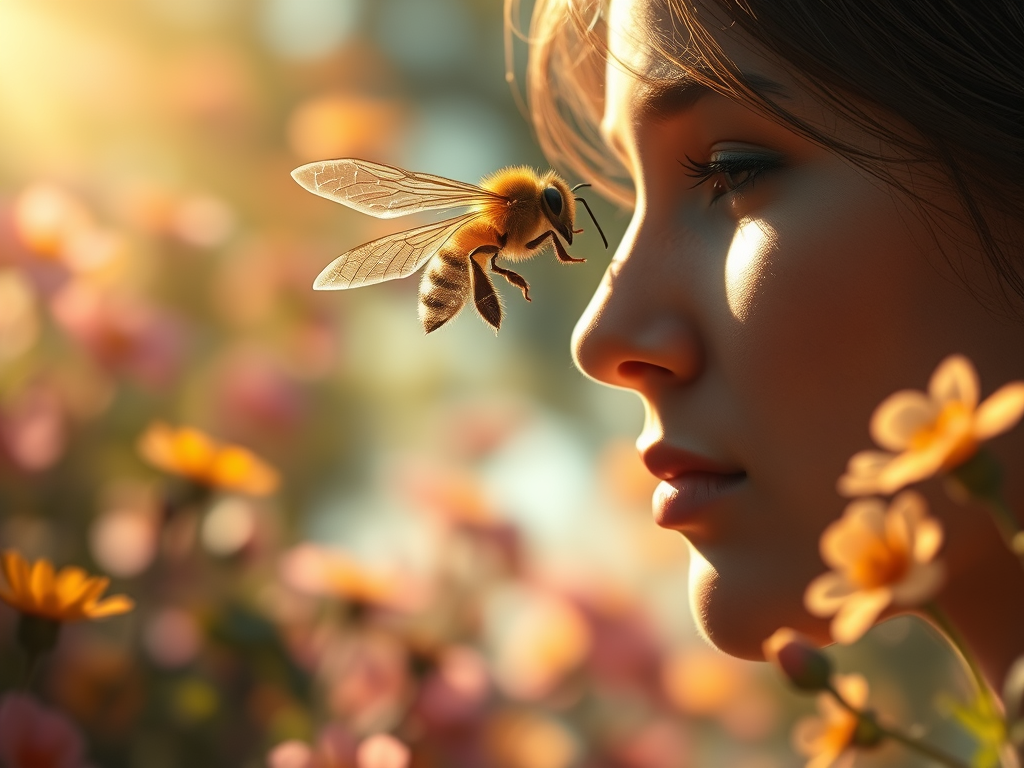

Last week, I was sitting under the frangipani tree in Cubbon Park, sipping on a near-perfect cup of filter coffee (courtesy of Mr. Murthy, of course), when a little honeybee landed on the rim of my cup. It didn’t seem in a hurry. It just hovered there, antennae twitching, wings catching the sunlight like stained glass. I watched it, amused, wondering if it recognized me from the last time I spilled sugar on the bench. And that’s when it hit me—can bees actually recognize human faces?
It sounds like something out of a sci-fi children’s book, right? Tiny creatures with pin-sized brains, flying from flower to flower, memorizing faces like little aerial detectives? But, as it turns out, nature has a way of humbling us. What we consider “simple” or “small” is often far more sophisticated than we assume.
So let’s dig in—what’s the buzz (sorry, couldn’t resist) about bees and their surprising ability to recognize faces?
Small Brain, Big Abilities
First, let’s talk brains. A honeybee’s brain is roughly the size of a sesame seed and contains about 960,000 neurons. That might sound like a lot, but compare it to the human brain, which boasts over 86 billion. And yet, bees can do some pretty astonishing things—navigate complex environments, communicate through a waggle dance (yes, that’s a thing), and now, apparently, recognize individual human faces.
Wait—how?
It all comes down to something called configural processing. This is the same technique humans use when we recognize faces—not by identifying every individual feature in isolation, but by interpreting the overall arrangement: eyes above a nose above a mouth, spaced in a familiar way.
In a 2005 Journal of Experimental Biology paper, Dyer and colleagues trained bees to associate specific black-and-white images of human faces with a sugary reward. They used a Y-shaped maze, placing a face image at the end of each arm—only one rewarded with sweet syrup. Over multiple trials, the bees learned to fly consistently toward the correct face, even when other distractions were introduced.
How Bees See the World
Let’s step back a bit and try to see through a bee’s eyes—literally. Bees perceive a different spectrum of light from us. While we see red, green, and blue, bees see ultraviolet, blue, and green. Flowers often have UV patterns invisible to humans—like runway lights guiding bees to their nectar. So how on earth do they recognize faces that don’t emit UV signals?
It seems bees don’t need color to perform facial recognition. They’re surprisingly adept at analyzing spatial relationships—how one shape is positioned relative to another. In fact, when researchers scrambled the facial features in the images (like putting the mouth where the eye should be), bees were totally thrown off. This suggests they were truly processing the face as a whole, not just memorizing a bunch of black-and-white blobs.
It kind of reminds me of that time during the pandemic when I waved excitedly at who I thought was my friend Pooja outside the bakery—only to realize it was a total stranger behind the mask. Eyes and hair matched, but once the mask came off… oops. Goes to show, even we humans rely a lot on the full layout of a face. No wonder the bees got confused when features were scrambled!
Arre, it’s like you and I recognizing a friend across a crowded VV Puram chaat stall—not because we analyze each eyebrow, but because something about the whole face just “clicks.”
Why Would a Bee Even Need This Skill?
Okay, but let’s ask the Bangalore-style question my neighbor Ravi Uncle would definitely pose: “Why on earth would a bee need to recognize a human face? They’re not socializing at Cubbon Park, no?”
Good point, Ravi Uncle. The truth is, bees didn’t evolve to recognize humans. But their ability to recognize faces is a byproduct of their broader visual intelligence.
In the wild, bees must distinguish between thousands of flower types—each with different shapes, arrangements, and patterns. They must remember which flowers offered nectar recently, how to return to the hive, and how to avoid predators. All of this requires sharp pattern recognition.
So when a researcher introduces a human face into the equation, bees just treat it like another pattern to decipher. It’s not that they evolved for facial recognition—it’s that they evolved to be excellent visual learners. And that talent generalizes.
Kinda like how Shalini from my science club learned the Fibonacci sequence to win a math quiz but now keeps seeing spirals in everything from snail shells to flower petals. Once your brain is trained to spot patterns, it starts applying that logic everywhere.
Face-Like Recognition in Nature
Now here’s a twist I didn’t see coming. Did you know that even some plants have evolved to mimic faces? Not human ones, obviously, but to look like the facial structure of predators or larger insects. The goal? To deter herbivores or attract the right pollinators.
Nature loves a good face. Even inanimate things like sockets or clouds sometimes look like they’re smiling, right? That phenomenon is called pareidolia—our tendency to see faces where none exist. So maybe bees aren’t the only ones tuned in to facial patterns. Maybe face recognition, in some form, is baked into the biology of observation itself.
Lessons from the Hive
What’s the bigger picture here?
For one, it reminds us not to underestimate small minds. The bee’s brain may be tiny, but it’s efficient, adaptable, and astonishingly clever. We often link intelligence with size, with volume. But bees—and many insects—show us that evolution doesn’t always reward brawn. Sometimes, it’s the elegant economy of thought that wins.
It also nudges us to rethink how we define memory, learning, and awareness. If bees can perform tasks we associate with primates and dolphins, what else are we missing about the minds of animals around us? Is that crow watching you from your balcony really just… watching?
Honestly, the more I think about it, the more I feel humbled. We humans tend to imagine ourselves as the peak of perception. But the world is full of silent observers—bees, ants, birds—that are mapping, remembering, and recognizing more than we realize.
A Challenge for You
The next time you see a bee buzzing near your breakfast table or flitting through your garden, pause for a second. Don’t swat it away. Instead, wonder: has it seen you before? Does it recognize the curve of your cheek, the line of your brow?
Sounds fanciful, I know. But so did “bees recognize human faces” once upon a time.
And if you really want to test this—try what I did yesterday. I wore a bright orange dupatta and sat still on the terrace for a good 10 minutes. The same little bee came back twice. Maybe for the sugar on my saucer. Or maybe—just maybe—because she remembered me.
Maybe that little bee on my coffee cup wasn’t just curious. Maybe she remembered.
We’d love to hear your thoughts. Let’s chat below!