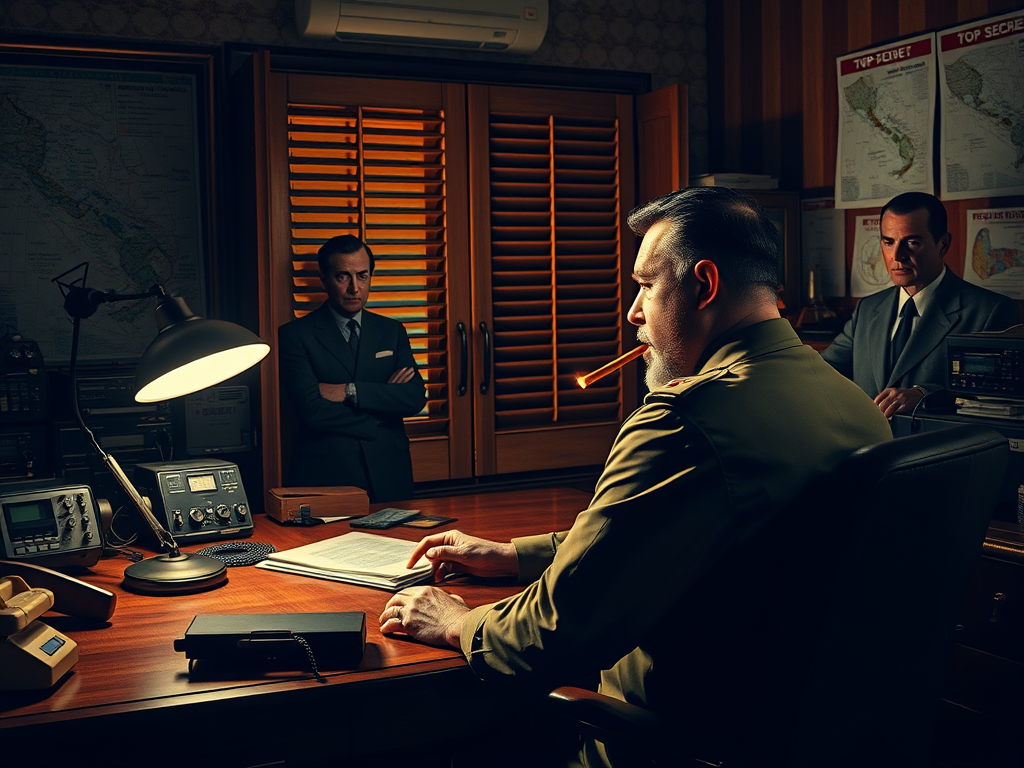

“History is not a solemn march of reason—it’s a drunken parade of mistakes, flair, and occasionally, exploding cigars.”
That’s not from my quote jar, but it should be. Because if ever there was a moment in modern political history where espionage morphed into slapstick theatre, it was the CIA’s decades-long obsession with assassinating Fidel Castro.
Now, Bhola—my long-suffering domestic aide and reluctant history student—once asked me, “Sir, why didn’t they just poison his coffee?” It was a valid question, though somewhat naïve. I told him, “Because, Bhola, by the 1960s, Castro’s coffee was guarded better than most royal bloodlines. And the Americans? They weren’t just trying to kill him. They were trying to humiliate him while doing it.”
And that’s where the cigars come in.
Operation Boom-Boom
Let’s begin with the most famous of them all: the exploding cigar. The idea, reportedly cooked up in the early 1960s, was as ridiculous as it was real. The CIA allegedly prepared a box of cigars infused with explosives—designed to detonate once lit and ideally placed somewhere Castro would find irresistible.
Why cigars? Because Castro’s love for them was legendary. They were practically part of his silhouette: fatigues, beard, and a thick Cohiba clamped between his fingers.
But the plan never made it past the planning board. Some accounts say the cigars were made but never delivered. Others claim they were handed off to an “unwitting intermediary” who failed to plant them. In either case, Castro’s face remained blissfully uncharred.
Even Bhola chuckled when I mentioned it: “Sir, if they’d succeeded, imagine the news headline—‘Cuban Leader Blown Away by Own Charm.’”
(Many of these surreal plots surfaced decades later in the Church Committee reports and CIA declassifications.)
Beard Today, Gone Tomorrow
But cigars weren’t the only props in this farcical Cold War stage play. At one point, the CIA theorized that Castro’s real power lay not in his political savvy but in his beard.
Yes, his beard.
The plan was to dust his boots or personal belongings with thallium salts, a toxic chemical known to cause hair loss. The logic? Deprive the man of his iconic beard, and you erode his macho image, making him appear weak and, therefore, easier to overthrow.
I can’t decide what’s more ludicrous: the science or the psychology. Would Cubans have really risen up because their comandante looked like a substitute math teacher?
As Bhola once said when I recounted this over evening tea, “Sir, even Lord Ram went into exile with a beard. It didn’t make him any less heroic.”
The LSD Broadcast Plan
Now here’s one for the psychedelic files. Another declassified idea involved spraying the air inside a television studio with a potent hallucinogen—likely LSD—right before Castro went live on air.
The goal? Make him babble incoherently, stumble, perhaps strip, or otherwise behave erratically. The result, hoped Langley’s desk-bound geniuses, would be a catastrophic loss of public confidence.
Picture it: a dim Havana studio, the air thick with heat and confusion, Castro wiping sweat off his brow as invisible gas curls in the vents…
This, of course, ignored two things:
- Cubans already knew Castro’s style—long, rambling, and unpredictable.
- LSD doesn’t turn people into cartoon villains. It makes them introspective or deeply confused.
Had this plot gone through, it’s far more likely Castro would’ve spent the broadcast pondering the mysteries of the cosmos rather than losing face.
Still, imagine the CIA memo: “Operation Mindfizzle: status—undone by human complexity.”
The Mafia Connection
Of course, not every plot was cartoonish. Some had real bite—particularly those involving America’s own underworld.
The CIA, in its Cold War desperation, teamed up with Mafia figures like Sam Giancana and Santo Trafficante Jr.—offering money and legal leniency in exchange for delivering Castro’s head on a platter. Poison pills were developed and handed off to intermediaries. At least one was intended to be slipped into a drink at Havana’s famed Tropicana nightclub.
But even criminals, it seems, have their limits. Or perhaps they just didn’t trust the CIA to hold up its end of the deal. Either way, the mob-backed plans fizzled like a badly rolled cigar.
(Many of these surreal plots surfaced decades later in the Church Committee reports and CIA declassifications.)
The Love Potion That Wasn’t
If you thought we’d exhausted the absurd, let me introduce the femme fatale angle.
CIA files mention an attempt to recruit one of Castro’s former lovers—Marita Lorenz—to assassinate him. She was reportedly given poison pills hidden inside a cold cream jar. But when the moment came, as she later told the press, “I just couldn’t do it.”
Castro, apparently aware of the plot, even handed her his pistol and said, “You can’t kill me. No one can.” She dropped the gun.
Now, whether that anecdote is wholly accurate or colored by cinematic flair is debatable. But it fits the pattern: Castro wasn’t just surviving attempts. He was bending them into his mythos.
Did Castro Know?
The real mystery isn’t the bizarre creativity of the CIA. It’s how Castro survived.
Over 600 attempts were allegedly made on his life. Six hundred. That’s not a security breach—that’s a cosmic joke. Castro himself once said, “If surviving assassination attempts were an Olympic event, I’d win gold.”
And perhaps he did. But not without effort. His personal security was famously rigorous: routes changed constantly, food was prepared only by trusted hands, and decoys were employed. Rumors even circulated that he used multiple doubles. His cigars were custom-made and chemically tested.
In short: the man treated his daily routine like a battlefield. And maybe that’s what made him unbeatable—he knew the rules of the game better than anyone.
The Real Tragedy Beneath the Farce
Now, before we laugh too hard, it’s worth noting what all this cloak-and-dagger buffoonery was trying to achieve.
The U.S. was terrified—Castro’s Cuba was a stone’s throw from Florida, armed ideologically and militarily by the Soviet Union. Assassinating Castro, in the eyes of the CIA, was not just revenge—it was “national security.”
But the result was a staggering waste of resources, credibility, and moral clarity. Each failure reinforced Castro’s legend. And the rest of the world, watching, saw not American ingenuity but desperation.
Bhola once summarized it best when I recounted this tale for the third time: “So, sir, they tried cigars, powders, women, and gangsters—and all they got was a man who smoked more, kissed more, and lived longer?”
Exactly, Bhola. Exactly.
Epilogue: Cigars That Linger
Today, you can buy novelty “exploding cigars” online—little joke props that puff confetti or spark when lit. They’re gag gifts. But once, not so long ago, the same concept sat on the desk of a CIA officer, marked Top Secret, with the word “urgent” stamped in red.
And if that’s not history’s version of irony, I don’t know what is.
Let this tale remind us that history, at its most absurd, still teaches. It warns us how power makes men foolish, how paranoia invents fantasy, and how, sometimes, a beard can defy bullets.
Or at least… make them miss.
And all for what? A parade of exploding cigars, whispered poisons, and confetti-worthy failures. A reminder that history doesn’t march—it stumbles, slips, and sometimes… lights a match.
—Prof. Rajesh Iyer
Pune, India
(With occasional heckling by Bhola)
🏺 Related Reading
• Elon Musk, Mars, and the Myth of Cosmic Escape
• Why Vikings Wore Persian Perfume
• The Secret Diaries of Scandalous Royals: What They Never Taught You in School
• The Fall and Rise of Cleopatra VII: The Woman Who Played Rome
• The Shortest War: Lessons from the Anglo-Zanzibar Conflict
We’d love to hear your thoughts. Let’s chat below!