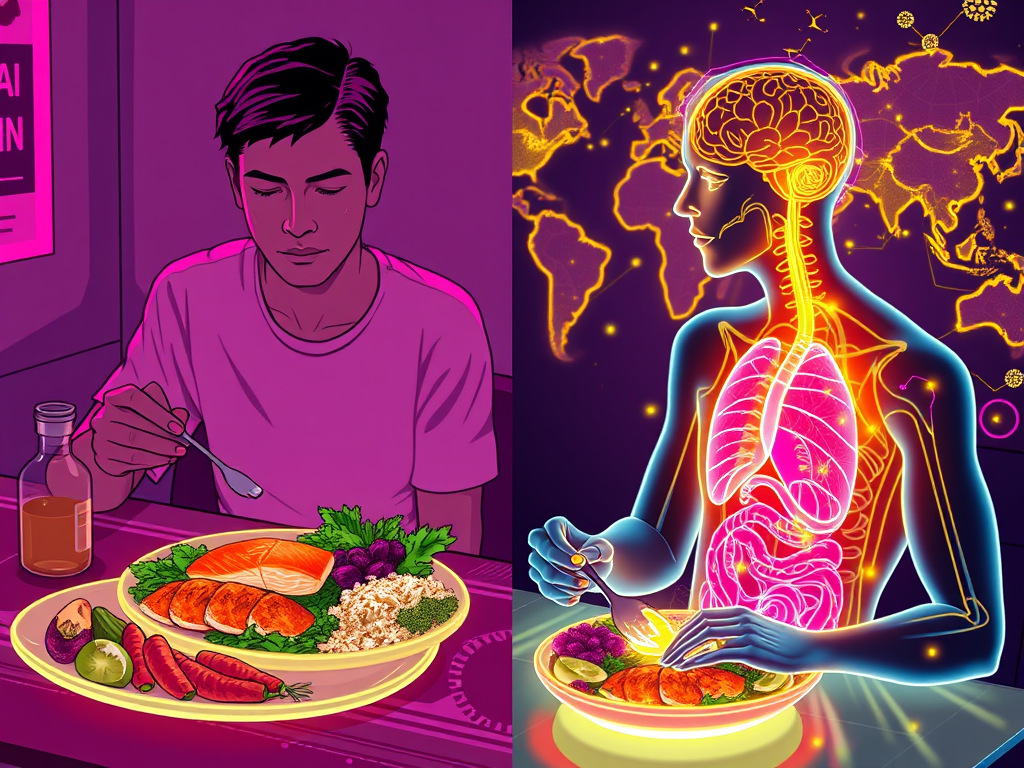

The other day, my niece Chinni looked up from her plate of rajma chawal and asked me,
“Maasi, if I eat healthy food but still feel tired, is my stomach lazy?”
I smiled and gently corrected her:
“It’s not about a lazy stomach, darling—it’s about how well your body can absorb what you eat.”
And just like that, we were down the rabbit hole of digestion—where pop nutrition advice often stops at “eat this, not that,” but ancient wisdom and modern science agree on something deeper:
Digestion isn’t just consumption. It’s transformation.
Let me take you on that journey.
🍽️ The Forgotten Half of Digestion: Absorption
Most of us think digestion ends when the food leaves our plate. But real nourishment begins after the chewing stops.
Your body is like an orchestra. The mouth starts the melody, but it’s the intestines—the quiet violinists of wellness—that determine if your nutrients get absorbed or flushed out.
You could eat a bowl of sprouted quinoa with flax oil and moringa powder. But if your gut lining is inflamed or your digestive enzymes are out of sync, that nutrient-dense meal becomes… expensive compost.
Digestion is breaking food down; absorption is getting it into your bloodstream.
You can digest perfectly but still absorb poorly—like cooking a nutritious meal and leaving it untouched.
In Ayurveda, we call this agni—your digestive fire. A strong agni means your body can extract rasa (essence) from food. A weak agni leads to ama—undigested residues that clog your system and your clarity.
Modern medicine echoes this. Researchers studying celiac disease, IBS, or even chronic fatigue now look beyond food labels. They ask:
Is this person absorbing their nutrients? Is their gut environment conducive to assimilation?
🧫 Meet the Gatekeepers: Enzymes, Microbes, and Mucosa
Let’s break this down.
1. Digestive Enzymes
These are your body’s molecular scissors—snipping proteins, fats, and carbs into absorbable bits.
If you’re low on enzymes (due to age, stress, or poor gut flora), it’s like handing a toddler a whole coconut and expecting them to drink the water inside.
2. Gut Lining
Your small intestine isn’t just a passive tube.
Think of villi as the plush carpet of your gut.
If it gets flattened, nutrients can’t sink in—they slide past like rain on a waxed windshield.
These villi are made of enterocytes, which renew every 3–5 days—a rapid turnover that requires a calm, uninflamed environment to function properly.
When inflammation sets in, tight junctions between cells can loosen, a condition often referred to as “leaky gut,” allowing toxins and partially digested food to escape into the bloodstream.
Several studies, including those published in Nutrients and Frontiers in Immunology, have shown how chronic inflammation impairs absorption by damaging this crucial barrier.
3. Microbiome
Ah, the microbial multiverse.
Your gut is home to trillions of bacteria that help digest fibers, produce vitamins (like B12 and K2), and maintain your gut barrier.
If these microbes are out of balance—what we call dysbiosis—your absorption suffers, and inflammation reigns.
A Japanese proverb says:
“Better to nourish a thousand good guests than fight one intruder.”
Your microbes are those guests.
🫙 Ancient Ferments, Modern Proof
Mr. Raghavan, my beloved spice vendor, swears by a spoonful of kanji (fermented rice water) before meals.
“Cleans the belly like a temple floor,” he insists.
Science would agree.
Fermented foods—be it Korean kimchi, Ethiopian injera, or our humble dahi—carry beneficial bacteria that not only help break down food but also train your gut to absorb better.
They lower gut pH, making minerals like iron and calcium more bioavailable.
This is why traditional cultures intuitively paired foods:
- Idli with chutney (acid + enzymes)
- Khichdi with ghee (fat for vitamin transport)
- Pickles with heavy meals (lactic acid + digestion boosters)
Absorption isn’t just molecular—it’s cultural.
🧠 Stress: The Silent Nutrient Thief
Let me tell you about Maya, my best friend and resident skeptic.
She once switched to a “superfood” diet: chia, kale, quinoa, goji berries. Yet her energy dipped, and her B12 levels plummeted.
When we looked closer, the problem wasn’t food—it was her pace.
She ate in 5 minutes, standing. Scrolled through Slack between bites. Snacked during Zooms.
Stress diverts blood flow away from the gut.
It slows enzyme production. It alters gut flora.
In Ayurveda, we call this vata derangement—when wind energy disrupts digestion.
Modern studies show that chronic stress reduces nutrient absorption and even damages the intestinal lining.
One 2010 study from Ohio State University found that stressed individuals had significantly lower absorption of zinc and vitamin C, even when diet was held constant.
Elevated cortisol levels, the hallmark hormone of stress, are also known to reduce stomach acid and slow gastric motility—meaning food lingers longer, digestion stagnates, and absorption suffers.
So yes, how you eat matters as much as what you eat.
💡 Five Absorption Boosters Worth Bookmarking
🌶️ Spice It Right
Cumin, ginger, black pepper, ajwain.
Black pepper alone increases curcumin absorption by 2000%, as shown in a 1998 study published in Planta Medica.
A dash of spice can ignite digestive fire.
🌿 Bitter Starters
Raw mango, ajwain water, or bitter greens spark digestive enzymes and bile.
In both Ayurveda and Chinese medicine, bitters are said to “wake up” the gut.
🦷 Mindful Chewing
Chew 20–30 times.
Saliva contains enzymes—amylase and lipase—that kickstart digestion before the food even reaches your stomach.
🔥 Warm Meals
Cold suppresses enzymes.
Choose lightly cooked, warming meals to stoke digestive fire—especially helpful in colder months or for those with bloating.
🧫 Fermented Companions
Add a spoon of kanji, dahi, or kefir.
Start slow—too much too fast can overwhelm the gut and trigger bloating in sensitive individuals.
🌍 The Global Tapestry of Absorption Wisdom
This isn’t just Indian wisdom. Around the world, cultures revered the how of eating.
- The French linger over meals—not just for pleasure, but because slow eating enhances digestion.
- In Chinese medicine, the spleen is considered the digestive powerhouse, weakened by cold and raw foods.
- In South America, sipping warm herbal infusions (like yerba mate) with meals is believed to “open” the gut.
- Greek grandmothers advise olive oil before a meal—modern studies now show it primes fat absorption and reduces post-meal inflammation.
Traditional Indian thalis also evolved with absorption in mind: fermented raitas, pickled elements, ghee-drizzled dal, bitter karela sabzi—all served in specific sequences to prime, aid, and complete digestion.
Every culture had a dance between food and flow, meal and mood, bite and breath.
🌀 Absorption Isn’t Static—It Evolves
Your body doesn’t digest the same way at 45 as it did at 25.
Age, hormonal shifts, gut damage, antibiotics, and stress can all dim your digestive fire.
But the good news? It’s not irreversible.
You can rebuild absorption capacity. Slowly. Gently. With patience.
Think of it like gardening.
The soil needs to be nurtured, not just seeded.
Your gut is that soil.
Water it with slowness.
Fertilize it with kindness.
Weed out what clogs you—mentally, emotionally, and nutritionally.
✨ The Wisdom on Your Plate
So the next time you eat something “healthy” but still feel off, don’t just blame the food.
Ask: is my body able to receive it?
Because digestion isn’t just chemical. It’s energetic. Emotional. Ancestral.
Your grandmother’s chutneys, the pause before meals in Japanese culture, the bitter tonics of African villages—these were all tools to prime absorption, not just fill stomachs.
My Nani always said,
“Don’t eat if you’re angry.”
Now I know—she was protecting my enzymes.
Wellness isn’t a pill—it’s a pattern.
A dance between fire and stillness, food and feeling, ritual and rhythm.
Absorption is the music.
And your gut? It’s been listening all along.
What’s one food memory that felt like medicine to you?
If this stirred a thought, sparked a memory, or reminded you of your own kitchen wisdom, I’d love to hear it.
Leave a comment, pass it to someone curious, or just take a breath before your next bite.
Because wellness, like digestion, deepens when it’s shared.
📚 Related Reading
🔗 The Night Plate: Foods for Sleep, Skin, and Digestion
🔗 The Spiritual and Health Benefits of Eating with Your Hands
🔗 Seasonal Eating Isn’t a Trend—It’s a Memory Our Bodies Still Carry
🔗 Unveiling Golden Milk: The Journey of Haldi Doodh
🔗 The Plant That Eats Metal: Nature’s Toxic Appetite
We’d love to hear your thoughts. Let’s chat below!