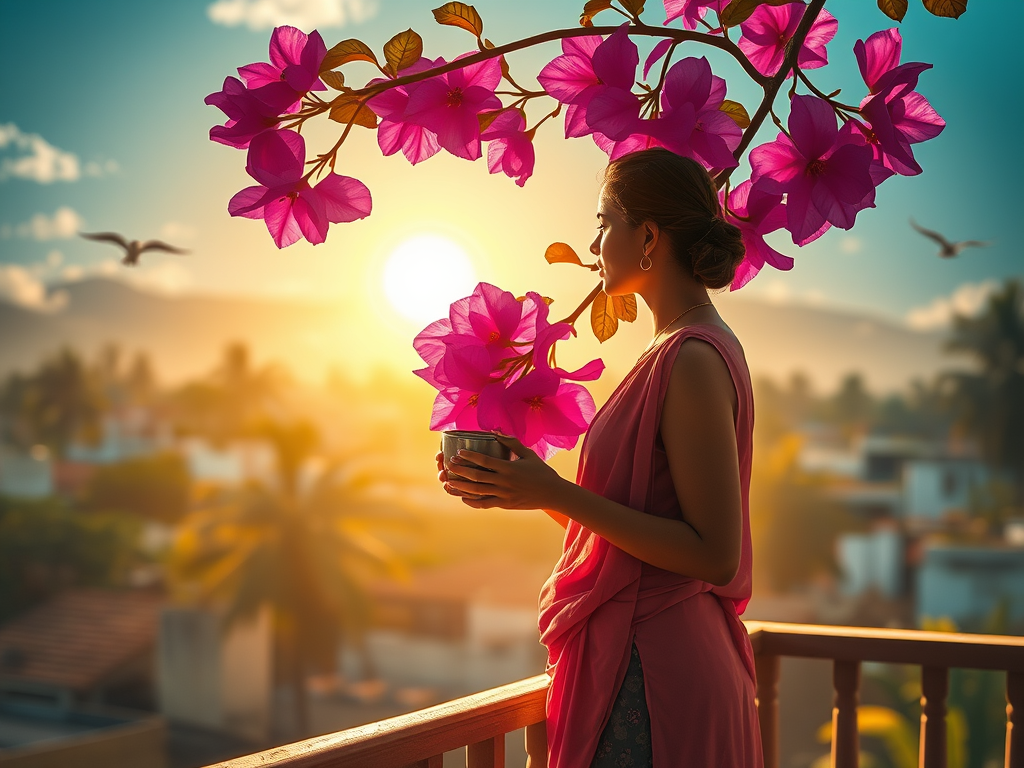

The other morning, I found myself utterly hypnotized by a bougainvillea branch swaying outside my balcony.
The sun hit just right, turning the magenta petals into tiny stained-glass windows. I stood there—half-toast in hand, filter kaapi slowly going cold—wondering, “Why did that catch my eye so deeply? Why does beauty stop us in our tracks?”
Not just me. All of us. We stare at sunsets, gasp at baby smiles, get goosebumps from music, tear up at an old painting. We go out of our way to find beauty—in a face, a flower, even in the perfect drizzle during evening traffic.
But why?
Why are we so tuned to beauty?
And what does it do to us?
💫 A Shortcut to Survival—or Something More?
Let’s rewind a bit. Evolutionary biologists would say beauty—at least the kind in nature—was originally a shortcut. Bright, symmetrical fruits meant ripe and edible. Clear skin and shiny hair hinted at good health. A well-patterned bird? Probably a healthy mate. In short: we learned to see beauty because it helped us survive.
But that’s not the full picture.
If beauty were only about survival, then why does a perfectly symmetrical rangoli pattern feel satisfying even when it’s made of chalk and won’t feed us? Why do we feel awe watching Saturn’s rings through a telescope, or staring at the Milky Way during a power cut? Why do we cry listening to a violin, or feel something stir when raindrops trace paths down a windowpane?
I once asked Ravi Uncle about this—he was poking at his ancient transistor while I sketched a leaf in my journal.
“Beauty,” he said, without looking up, “is our mind recognizing patterns. But it’s also our soul whispering, ‘Pay attention—this moment matters.’”
I liked that.
🌼 What Makes Something Beautiful?
Now this is where things get more science-rich—and strangely poetic. Studies show that humans across cultures tend to prefer:
- Symmetry – Our brains love balance.
- Proportionality – Especially the Golden Ratio, found in galaxies and seashells.
- Curves over jagged edges – Smooth lines signal safety.
- Vivid color and contrast – It grabs our attention, fast.
- Familiarity with surprise – We like things that feel new but not alien.
In fact, researchers at the University of Toronto found that people consistently rated faces and landscapes with balanced proportions as more beautiful—even if they couldn’t explain why. It’s as if our brains are wired with a secret geometry detector.
But here’s the twist: beauty isn’t just in the object. It’s in the beholder. Brain scans show that when we see something beautiful, the medial orbitofrontal cortex lights up—the same area activated by chocolate, music, and even romantic love. That’s your brain saying, “Oof, this feels good. Let’s stay a while.”
In a way, beauty is a form of nourishment. Not for our stomachs, but for our attention, our memory, even our well-being.
🧠 Beauty Isn’t Optional—It’s Essential
Let’s go one level deeper.
Studies now show that beauty isn’t just a fleeting pleasure—it’s vital for our mental and physical health.
Exposure to natural beauty has been linked to lower cortisol levels, our body’s primary stress hormone. People who regularly experience awe—whether through sunsets, music, or art—tend to report higher life satisfaction and even show lower levels of inflammation in the body.
Some neuroscientists even argue that the ability to perceive beauty is a core component of human consciousness—that our sense of wonder might be as essential as our ability to speak or solve puzzles.
In other words, noticing beauty isn’t a distraction. It’s a form of alignment. A reset. A quiet, built-in therapy.
🍃 The Biophilia Buzz
There’s a theory I adore called biophilia—the idea that humans have an innate desire to connect with nature and living systems. It’s why hospitals with garden views see faster patient recovery. Why walking in Cubbon Park calms our racing minds more than strolling through a mall. Why even a photo of trees can reduce stress hormones.
It’s why we scroll past five reels but stop at a leaf trembling in the wind.
Once, during a tree-planting drive with my friend Pooja, I saw a young boy kneel down and gently smooth the soil around a neem sapling. “It looks happier now,” he said. And I thought—yes, maybe we all look happier near growing things.
There’s beauty in growth. In life unfurling.
📚 Beauty as Brain Hack
Here’s something wild: noticing beauty isn’t just pleasurable—it’s a form of cognitive tuning.
Dr. Anjan Chatterjee, a neurologist who studies aesthetics, suggests that beauty evolved as a “visual shorthand” to focus our attention. In a world full of chaos (like MG Road at 6 PM), our brain has to decide: what’s worth noticing? Beauty acts like a highlighter pen. It says, “Look here. This matters.”
And once we look, we tend to remember.
That’s why teachers use colorful visuals. Why religious ceremonies are often filled with rich music, incense, patterns. Beauty encodes memory.
In my science club, when little Shalini painted the phases of the moon using rangoli colors, she said, “Akka, I’ll never forget which side is waxing now!” Her brain had latched onto beauty to store knowledge.
Isn’t that amazing?
🌏 Culture Colors Our Sense of Beauty
Of course, what we call beautiful also depends on where we’re from, what we’re taught, what stories we carry.
In Japan, they have a concept called wabi-sabi—a love for the imperfect, the transient, the worn. Like a chipped teacup. Or a crumpled leaf.
In India, beauty dances between symmetry and chaos. The kolam outside a house might be mathematically precise, but it’s also smudged by rain and footsteps. And that imperfection adds life.
In the West, the concept of the sublime—that mix of fear and reverence when facing something vast—has shaped art and literature for centuries. Think Turner’s stormy seas or Beethoven’s crescendos. Beauty here often feels like standing at the edge of something greater than ourselves.
Even here in Bangalore, my idea of beauty has changed over time. As a teenager, I thought beauty meant polished shoes and shiny hair. Now, it’s moss on a rusted gate. It’s the sleepy grin of Mr. Murthy handing me a steaming steel tumbler of coffee at 6:30 AM. It’s the gentle sag of marigold garlands at the temple gate, drooping like tired dancers after a long night.
Beauty is memory. It’s meaning.
🌌 Why Beauty Makes Us Feel Small—and That’s a Good Thing
Ever stood on a beach at night and felt… tiny? Or watched clouds gather before a storm and felt a mix of thrill and fear? That’s something psychologists call the awe response.
Awe stretches our sense of time. It dissolves ego. It makes us feel part of something vast—and that’s oddly comforting. Like we’re threads in a much larger tapestry.
One study even found that people who experienced awe (from music, nature, or art) became more generous and cooperative afterward. As if beauty reminded them: you’re not alone in this universe. Share the wonder.
During last year’s eclipse, I remember watching from a rooftop with my neighbors. For a few minutes, the world turned eerie and golden. Even the crows went silent. Nobody said anything. But we were all smiling like kids. That kind of beauty doesn’t just entertain—it humbles and connects.
👀 Finding Beauty in the Ordinary
Here’s the thing I keep coming back to: beauty isn’t always fireworks and waterfalls. Sometimes, it’s the smallest moment.
- The shadow of a crow flapping across your tea.
- A cracked footpath where wildflowers bloom.
- The rhythm of dosa batter falling in perfect circles on a hot tava.
I once caught Ameen Bhai, my auto driver friend, staring at raindrops on his rearview mirror. “They look like tiny worlds,” he said. And just like that, I started noticing them too.
The science of beauty says we’re wired to notice. But maybe the art of beauty lies in choosing to see.
🌺 So What Does It All Mean?
Why are we drawn to beauty? Because it:
- Captures attention
- Cements memory
- Enhances mood
- Encourages empathy
- Signals meaning
- Promotes healing
- Anchors us to something greater
In other words—it makes life feel more alive.
And in a world that’s often noisy, hurried, or heavy, beauty gives us small portals of pause. Like filter coffee bubbles swirling before the first sip. Or a toddler laughing at pigeons.
Maybe beauty is the universe’s way of nudging us:
“Hey, look here. Even this magenta petal, even this exact moment—matters.”
🌸 Your Turn
So here’s a little challenge, friend:
The next time something beautiful stops you—a tree blooming in defiance of concrete, a song lyric that gives you goosebumps, even a perfect slice of mango—pause. Let your brain light up. Let your soul whisper.
And if you feel like it, tell me about it.
Leave a comment, send a note. I’d love to know:
What beauty did you notice today?
📚 Related Reading
🔗 Global Skincare Rituals for Natural Glow
🔗 A Day in the Life of a Mayfly
🔗 Ancient Night Rituals for Better Sleep: A Modern Guide
🔗 Synesthesia: When You Can Taste Colors
🔗 Ancient Cave Paintings and the First Scientists of Wonder
We’d love to hear your thoughts. Let’s chat below!