
A Curious Fruit and a Lingering Question
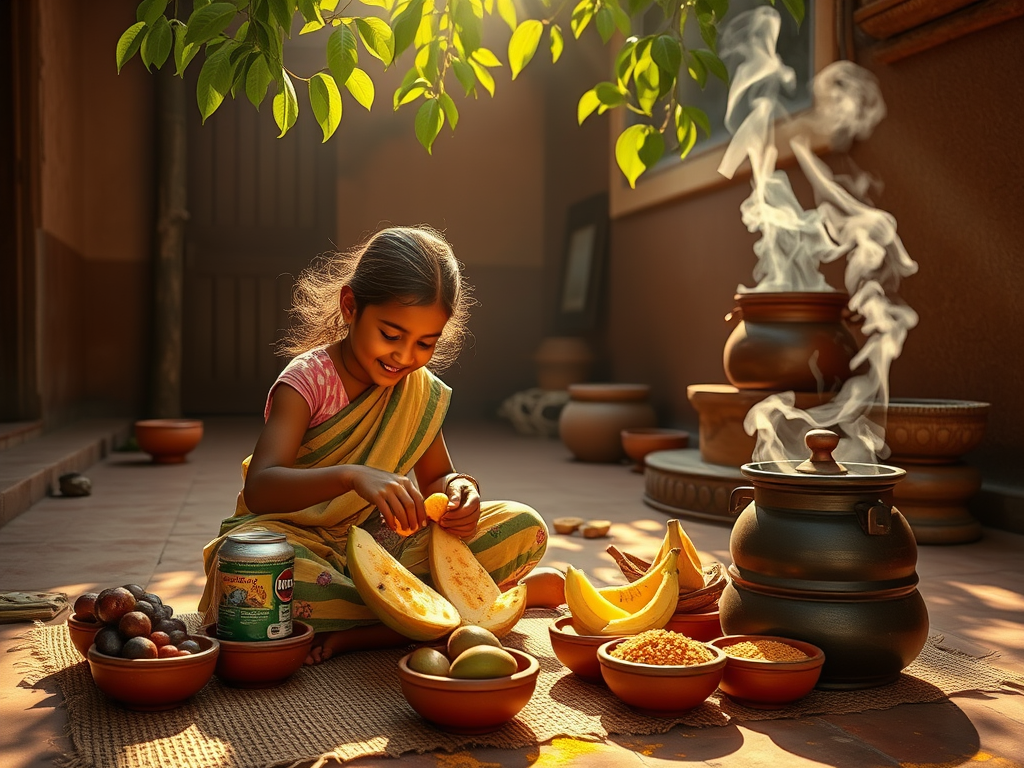
Last Sunday, as the sun filtered through the neem branches over my veranda, my niece Chinni sat crisscrossed on the floor, inspecting a large jackfruit. She handled it with the reverence of a museum curator.
“Maasi,” she whispered, poking at the prickly skin, “who decided this dinosaur fruit was food?”
I laughed. But her question lingered.
Who indeed? And why did we stop listening to them?
We live in a world where quinoa has become a pantry staple in Pune, but millets—our very own hardy, heritage grains—are still struggling to reclaim their rightful space on the thali. Where imported blueberries sit proudly atop smoothies, while the antioxidant-rich jamun stains the streets of our cities, untouched.
In our quest for the next “superfood,” have we forgotten the wisdom under our own feet?
Today, let’s journey back—through fields, folklore, and forgotten recipes—to understand why local foods matter not just for health, but for memory, meaning, and even survival.
🌾 The Science Beneath Our Soil
Let’s begin with the obvious: local foods are fresher, more seasonal, and often more nutrient-dense than their long-distance counterparts.
A 2014 study in the Journal of Food Composition and Analysis found that spinach loses nearly 90% of its vitamin C within 24 hours of harvesting. Think about that the next time you reach for those triple-washed “organic” greens flown in from thousands of miles away. Meanwhile, your local sabjiwala’s saag—harvested that very morning—sings with chlorophyll and bite.
And it’s not just about nutrients. There’s a growing body of research suggesting that the microbiomes in our gut thrive when we eat foods grown in the same soil we inhabit. These foods carry bacteria, enzymes, and minerals that harmonize with our environment.
Dr. Rob Knight, co-founder of the American Gut Project, has shown how microbial diversity in our gut is directly influenced by the diversity of foods we eat—particularly those grown close to home. The connection is so intimate that researchers now talk about a “soil-to-gut microbiome” link, where exposure to local microbes helps train and support our immune system.
In fact, studies have shown that individuals consuming hyper-local produce tend to host more resilient gut flora—better equipped for local pathogens and allergens.
Ayurveda intuited this long ago with the idea of desh (location) and prakriti (constitution)—that the body’s balance is linked to where it lives. Our soil doesn’t just grow our food. It seeds our immunity.
🧬 Ancestral Immunity: More Than DNA
When Mr. Raghavan—the spice vendor near Mandai market—handed me a fistful of ajwain the other day, he didn’t offer a chemical breakdown. He just said, “This will fix your stomach faster than any capsule.”
He wasn’t wrong.
Generations of our ancestors evolved eating certain spices, grains, and fruits. Their bodies built micro-adaptations to local allergens, microbes, and stressors—passing those strengths down epigenetically.
You and I may carry not just our grandmother’s cheekbones, but her cumin tolerance and curry leaf wisdom too.
Emerging research in nutritional epigenetics suggests that our dietary history may influence gene expression and immune responses across generations. Even our microbiota—those invisible allies in our gut—can be inherited through maternal lineage and early exposure to local diets.
So when we trade methi seeds for flaxseeds, or kokum for cranberry, we’re not just swapping flavors—we might be short-changing our evolutionary insurance.
🌍 A Global Glimpse: It’s Not Just Us
This isn’t just an Indian dilemma.
In Japan, the traditional washoku diet—rooted in seasonal vegetables, fermented soy, and local fish—was declared an Intangible Cultural Heritage by UNESCO. Why? Because it nourishes not just the body but community bonds, seasonal awareness, and respect for nature.
In Italy, the Slow Food movement was born as a resistance to McDonald’s opening near the Spanish Steps. It blossomed into a global call to protect regional food traditions—from cheese-making in Sardinia to lentil stews in Umbria.
And in Ghana, elders are reviving abunuabunu, a nutrient-rich green soup made with local leaves and snails, urging younger generations not to trade it for instant noodles.
The message across continents is the same: modern convenience is erasing ancestral nourishment.
🧄 The Lost Recipes in Our Kitchens
My best friend Maya—skeptic, spreadsheet queen, and sworn oat-milk evangelist—once challenged me: “But local food is boring, Asha. What can you even do with a baingan besides burn it?”
Challenge accepted.
We went on a week-long experiment: one forgotten local ingredient per day. There was motha rice from Wayanad turned into a nutty kheer. Sorghum flatbreads with til chutney. And a glorious parval stir-fry that made her say, “Okay, I take it back. That was… weirdly delicious.”
But the highlight? We even baked laddoos with sprouted horsegram, jaggery, and coconut—her protein powder sat ignored for days. She even made a millet risotto that fooled her Italian roommate.
Rediscovering local foods isn’t about restriction—it’s about re-enchantment. It’s looking at ridged gourds and red amaranth not as poor cousins of kale and zucchini, but as culinary possibilities waiting to be unwrapped.
🍋 Global Superfoods vs. Local Gems
Still unsure what to swap? Start here:
- 🫐 Instead of goji berries, try amla—it has 20× more vitamin C.
- 🥬 Forget kale—colocasia leaves (arbi patta) are rich in calcium, iron, and gut-friendly fiber.
- 🥗 Trade quinoa for kodo millet—diabetic-friendly, protein-rich, and drought-resistant.
- 🍷 Skip apple cider vinegar; sip kokum sherbet—a digestive cooler with anti-inflammatory properties.
- 🍫 Craving chocolate? Try jamun seeds powder—used in Ayurveda for balancing blood sugar.
The point isn’t to demonize global foods. It’s to celebrate the superfoods in our own backyard.
🛒 So How Do You Actually Rediscover Local Foods?
Here’s your gentle, aromatic roadmap:
1. 🌽 Befriend Your Local Vendor
Skip the air-conditioned aisles once a week. Walk to your nearest mandi or farmer’s market. Ask the sabjiwala what’s fresh, what’s arriving tomorrow, what his grandmother used to cook. I’ve gotten better recipes from onion-sellers than from cookbooks.
2. 📔 Start a Local Ingredient Journal
Each week, pick one unfamiliar local food. Note its taste, how you cooked it, how your body felt. Bonus points if you uncover a folk story or grandma trick tied to it.
3. 🧪 Cross-Cultural Swaps
Use your favorite global recipe but substitute a local ingredient. Thai green curry with moringa leaves. Pasta with sautéed banana stem and garlic. Turn every experiment into a lesson.
4. 🍵 Revive the Forgotten Brews
Tulsi, lemongrass, betel leaf, ajwain water—start your mornings or end your nights with these. Your gut will thank you. So will your grandmother’s portrait.
5. 🧓 Cook With Elders
Invite an aunt, a grandparent, or a retired neighbor for a cooking afternoon. Ask for their “sick day soup” or “rainy day rice.” These oral recipes are disappearing faster than we think.
🌿 More Than a Meal—It’s a Memory
Every time we choose local, we are voting for biodiversity, for farmer livelihoods, for climate resilience. But we’re also choosing intimacy. With land. With history. With our own bodies.
You’re not just biting into a bhindi. You’re tasting centuries of seed-saving, of monsoon prayers, of spice route exchanges and market gossip.
Consider this: India has lost over 90% of its traditional rice varieties in the last century—a quiet extinction buried under hybrid convenience. That’s not just a culinary loss—it’s a cultural amnesia.
That jackfruit Chinni was poking? It became a smoky curry that night. She called it “dragon fruit’s older, wiser cousin.” Not wrong.
We ended dinner with bel sherbet and a game of “Guess the seed.” And in that moment—sunset light, sticky fingers, belly laughter—I realized local food wasn’t just about nutrients.
It was about coming home.
🪔 Asha’s Reflection
Rediscovering local foods is an act of cultural resilience. It’s a way of telling the world, “We remember. We honor. We choose again.”
Start small. One ingredient. One story. One bite.
And if something stirs—a childhood flavor, a forgotten name, a question like Chinni’s—don’t let it pass. Chase it. Cook it. Share it.
Because in the end, the real superfood is memory—served warm, with a side of belonging.
And Maya? She now asks for sprouted horsegram laddoos with her spreadsheets.
💬 Your Turn
Have you recently rediscovered a forgotten local food? A dish that surprised you with its flavor—or its story?
I’d love to hear it. Drop a comment, share a picture, or pass this along to someone whose masala box still smells like childhood.
Let’s keep the kitchen doors open and the stories simmering.
📚 Related Reading
🔗 The Plant That Eats Metal: Nature’s Toxic Appetite
🔗 The Hidden Memory of Leaves: Nature’s Silent Storytellers
🔗 The Truth About Ghee: Ancient Superfood or Modern Health Hazard?
🔗 Discover Fermented Foods for Gut Health
🔗 The Spiritual and Health Benefits of Eating with Your Hands
We’d love to hear your thoughts. Let’s chat below!