
🛍️ A Surprise on M.G. Road
I was walking down M.G. Road last weekend when I saw it.
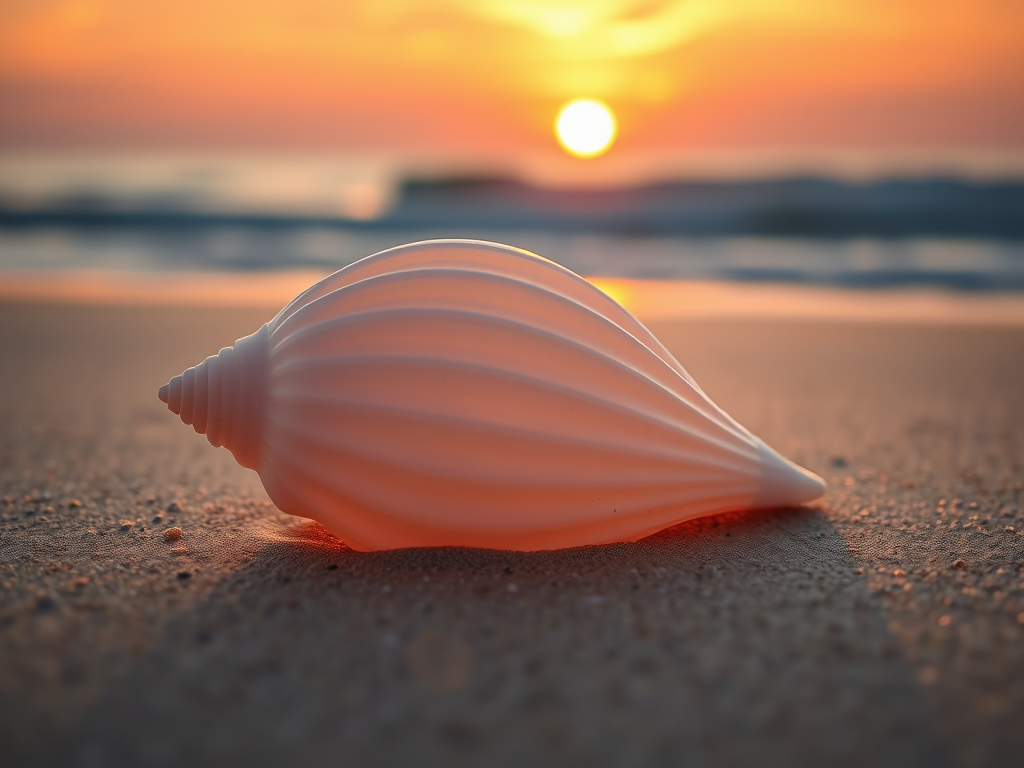
Nestled between dusty piles of plastic toys and keychains at a pavement stall—right near the “3 for ₹100” sign—was a seashell. Pale pink with ridged spirals and a little chipped on the edge, like it had stories it was too shy to tell. There was a tiny grain of sand still clinging inside—stubborn, like memory.
Of course, I bought it. ₹30. Bargain, boss.
And just like that, I was holding an entire ocean in my hand.
🐚 The Shell That Speaks
Have you ever held a seashell to your ear and heard the ocean?
Shalini—my young scientist-in-training—once asked, “Akka, is there a tiny wave stuck inside it?”
Not quite, I told her. What we hear isn’t the sea itself, but the ambient sound around us—the whoosh of traffic, our own blood pumping—echoing inside the curves of the shell. It’s like the shell becomes a little amphitheatre, tuning and bouncing sounds until they hum like waves.
It’s a trick of acoustics. A conch is basically a natural resonator. Just like how a guitar body amplifies string vibrations, the inner spiral of a shell amplifies ambient noise in a way that mimics the low rush of surf. That’s why you can still “hear the ocean” even if you’re smack in the middle of Bangalore’s noisy Shivajinagar.
Science, yaar. Always sneaking in through poetry.
🌀 Spirals That Remember
Now look closely at that shell. That curl? That swirl? It’s not just pretty—it’s math. Specifically, a logarithmic spiral.
Unlike a simple circle, a logarithmic spiral gets wider but keeps its shape. Zoom in or out—it still looks the same. Nature loves this design. You’ll find it in sunflower seeds, hurricanes, galaxies, even the cochlea inside your ear.
Ever think a snail could out-math a city planner?
I once tried drawing this spiral. Gave up by the third loop. My hand cramped, my compass slipped, and I spilled coffee on the page. The mollusk does it better—no pencils, no drafts, just quiet precision.
🗣️ “This? It’s ocean jewelry.”
The shopkeeper on M.G. Road saw me staring at the shells. He grinned and held one up dramatically.
“This?” he said, “Ocean jewelry. Bangalore aunties love it. No one asks where it came from.”
I asked.
He shrugged. “Some beach in the South. Someone brings a sack once a month. I just clean ‘em.”
I smiled. Even secondhand, the sea had found a way into the city.
🧬 The Animal You Never Met
Inside that shell once lived a mollusk. Maybe a sea snail, maybe a conch, maybe a shy little gastropod with eyes on stalks and a foot like a soft slipper. We don’t know her name. We never saw her crawl across coral or feel the current stir her antennae. But we hold her home. Her leftover architecture.
Isn’t that intimate? Like finding someone’s diary and realizing every line was written not in ink, but in calcium carbonate and time.
Shells are secret storytellers.
The outer bumps and ridges? Those mark where the creature paused or struggled—during food shortages, storms, even lunar cycles. Some shells have tiny repair scars where predators tried and failed to crack them open.
If you know how to read them, shells carry a full biography: age, diet, growth rate, even ocean temperatures across years. Pooja once showed me research where scientists used isotopes in old shells to study ancient climate patterns. Talk about eco time machines!
🌱 From Birth to Bangalore: A Shell’s Journey
Let’s trace her story.
She began as a larval mollusk, barely visible, drifting in warm coastal waters—perhaps near Udupi or Rameswaram. A speck of life carried by tide and time.
As she grew, she began secreting calcium carbonate, shaping the first whisper of her spiral. Each day, each wave, left its mark. She grew thicker where the currents were strong, sharper where predators lurked, broader as food was plenty.
Then—one day—she stopped. Maybe she lived her full span. Maybe a fishing trawler stirred the seabed too violently. Maybe pollution crept too close. Whatever it was, she died.
Her empty shell tumbled in the surf for weeks. Sand polished it. Crabs might have peeked inside. Eventually, someone—barefoot, scanning the shore—picked it up, slipped it into a basket, and sold it inland. It changed hands. It crossed highways. And finally, it sat quietly in a dusty plastic tray on M.G. Road.
Until I came along.
🏙️ Urban Shells, Bangalore Whorls
Sometimes I wonder—what if cities left shells behind when they moved? What would Bangalore’s look like?
Maybe a spiraling form, each curve a new phase—British cantonment, post-independence sprawl, IT boom, metro lines. The rough ridges where traffic swelled. The smooth arcs of parks and lakes (those that survived). The cracks where trees once stood.
Majestic Bus Stand? That’s the cracked spiral center, boss—where everything converges and radiates.
Just like mollusks, we build outward and carry our history in layers. Some we polish and show off. Some we bury and forget.
Every time I hold a shell, I think: what’s my shell? What am I building around me, one invisible ring at a time?
🛡️ Armor, Not Ornament
Ravi Uncle once said, “People think shells are jewelry. But to the animal, it’s a roof and a shield.”
He’s right. Shells aren’t decorations—they’re survival gear.
Made mostly of aragonite or calcite (forms of calcium carbonate), shells are secret champions of materials science. They’re hard, yes, but also flexible enough to absorb shock. Some mollusks even modify their shell thickness based on predator pressure. Like DIY home improvement—“Shark nearby? Better beef up the east wing!”
Take the Chambered Nautilus—a deep-sea marvel that adds perfectly partitioned chambers to its shell as it grows, like adding rooms to a spiral mansion. It even adjusts buoyancy by controlling gases in those chambers. Evolution didn’t just give it beauty—it gave it a submarine.
There’s even a species—Chiton—that lines its shell with eyes made of aragonite. Eyes! In the shell! Nature really said, “Why not?”
🧪 Chemistry of Beauty
Ever wondered why shells are so smooth?
It’s not just erosion or polish. The mollusk secretes layers of proteins and minerals in a staggered, brick-like pattern—called a nacreous structure. If you’ve seen mother-of-pearl, you’ve seen nacre. Iridescent, layered, strong.
That shimmer? It’s due to thin-film interference. Like oil on water. Light waves bounce, overlap, and cancel or enhance each other depending on the layer thickness.
So yes—your seashell is using quantum physics to glow. Take that, Diwali LEDs.
🗣️ “Boring? Look at this!”
I once showed a shell under my pocket microscope to a friend who thought they were “just beach junk.”
He gasped. “Boss. It’s like a cathedral in there. Look at those patterns!”
We ended up geeking out for an hour. He still keeps that shell on his bookshelf. Sometimes wonder hides best in the quietest spirals.
🌍 From the Sea to Shivajinagar
And somehow—this ancient oceanic artifact ends up in a cardboard box next to neon hair clips and plastic lizards in Bangalore.
Who brought it here? A coastal trader? A kid who went to Gokarna for holiday and sold it for pocket money? Someone who didn’t know what to do with their grandmother’s old collection?
The journey of a shell doesn’t end at the beach. It moves through hands, across cities, into pockets and altars.
Mr. Murthy keeps one in his coffee stall for good luck—right next to the laminated photo of Rajkumar and a faded ₹10 note. Ameen Bhai has one dangling from his rearview mirror. “Keeps bad vibes away,” he says, tapping it gently before turning onto K.R. Road.
Funny, isn’t it? Something born of plankton and tide becomes talisman and trinket. Proof that wonder doesn’t need pedigree—only presence.
🗣️ “Akka, it’s like sea-earphones!”
Back to Shalini. When I gave her one of the shells, she put it to her ear and said, “Akka, this is like sea-earphones! Only no wires.”
I laughed. But maybe she was right.
A shell isn’t just a fossil. It’s a recording.
✨ The Echo in Your Hand
I’ve kept seashells since I was a child—some found, some gifted, some stolen from time before I knew what time was.
Some were from school trips. One from Mangalore. One from Shalini. One from the day the sea felt close even in Shivajinagar.
Why do we keep them?
Maybe because they’re portable awe. Tiny echoes of a world we can’t live in but long to touch. Maybe because shells remind us that beauty doesn’t always shout—it sometimes spirals inward, slowly, patiently, waiting to be noticed.
Or maybe because in a world of glass and metal, holding something made by a creature with no voice feels grounding.
🪄 ₹30. Bargain, Boss.
That shell I bought on M.G. Road?
Last week, I gave it to Shalini.
She placed it next to her notebook labeled “Things That Glow and Breathe.”
And for a moment, I swear I heard the ocean again.
💬 Share Your Shell Story
Have a seashell story? One from your childhood, your last beach trip, or even your desk drawer?
Tell me in the comments—I’d love to hear what the sea whispered to you.
And if this made you smile or wonder—share it with a curious friend.
There’s magic hiding in the most ordinary things, yaar. Let’s go find it together.
📚 Related Reading
🔗 Can Animals Laugh? Exploring Joy in the Wild
🔗 The Defense Architectures of Plants: Thorns, Toxins, and Mimicry
🔗 Ayurveda’s View on Menopause—And How It Differs from the West
🔗 When Light Hurts: Ancient Migraine Remedies for a Modern World
🔗 The Hormone Shift After 35: What Every Woman Should Know

We’d love to hear your thoughts. Let’s chat below!