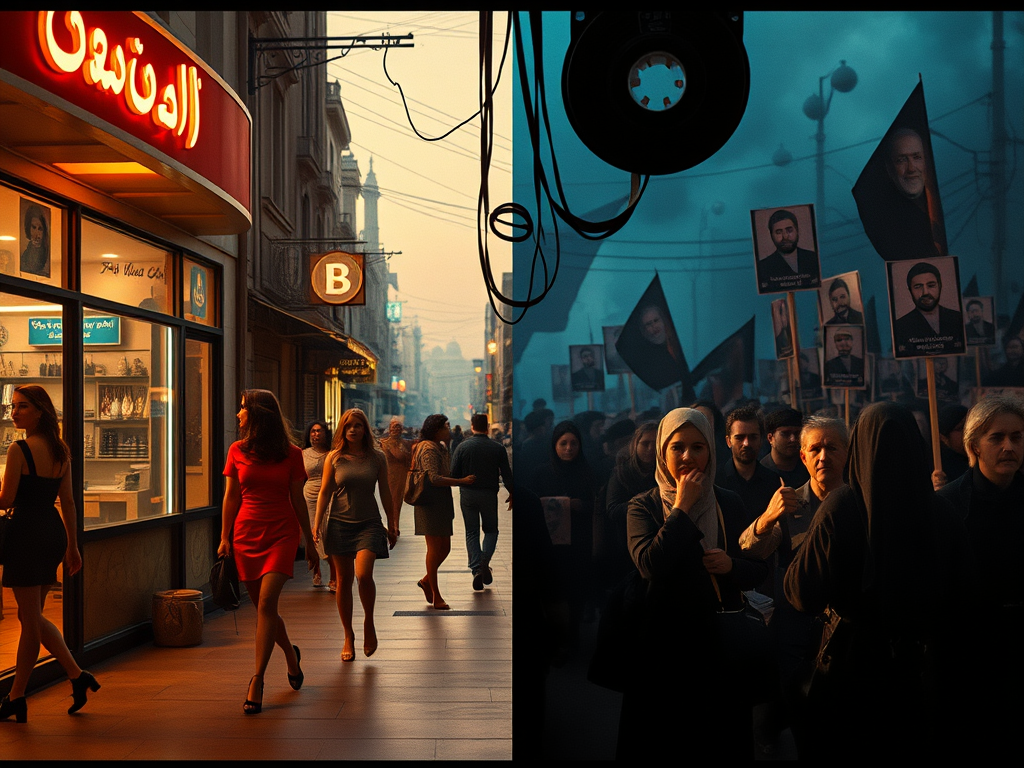

🕯️ “History is like a mirror pool. You see what you want—and sometimes, you see your ghosts.”
🪔 A King’s Toast, A Nation’s Boil
Once, over dinner in Shiraz, I heard a proverb from an elderly bookseller with turmeric-stained fingers: “A crown that grows too heavy cracks the neck that wears it.”
An old proverb—more folk wisdom than citation—but fitting.
He was talking about Shah Mohammad Reza Pahlavi. Or perhaps, about every ruler who mistook glitter for greatness.
The Iranian Revolution of 1979 is often narrated with the briskness of a textbook: Ayatollah Khomeini returns, the Shah flees, the Islamic Republic is born. But that simplification is like describing the monsoon by saying “it rained.” In truth, what happened in Iran was a cultural supernova—centuries of faith, pride, humiliation, and modernity all colliding in a single, convulsive moment.
Let’s rewind—not to 1979, but to the quieter tremors before the quake.
📸 The Peacock Throne and Its Mirror
The Pahlavi dynasty was born not from divine right or ancient lineage, but from military boots. Reza Shah, father of Mohammad Reza, seized power in 1925—an iron-fisted nationalist who admired Atatürk’s secularism and loathed clerical interference. He banned the veil, ordered men to wear Western hats, and tried to scrub Iran of what he saw as backwardness.
His son, Mohammad Reza, inherited the throne in 1941. But unlike his father’s gravel-toned authority, he glittered with imported polish. Educated in Switzerland, soft-spoken, fond of perfumes and palace balls—he tried to rule a turbulent Iran like it was Versailles.
That was the first crack.
Because Iran was not Versailles.
It was a land where Zoroastrian ruins whispered from hills, where Shia imams were not just preachers but power brokers, and where oil bled beneath soil that had been bartered too often with foreigners.
And it’s oil—yes, always oil—that lit the next fuse.
⛽ The Mossadegh Moment: When Democracy Briefly Dared
In 1951, Mohammad Mossadegh, a charismatic, slightly eccentric Prime Minister with a taste for pajamas and patriotism, dared to nationalize Iran’s oil. That meant wrenching it away from British control—specifically the Anglo-Iranian Oil Company (now BP).
Bhola, were he listening now, would mutter, “Never mess with empire’s income.” And he’d be right.
The British raged. The Americans schemed. Together, through the CIA’s Operation Ajax, they orchestrated a coup in 1953 that toppled Mossadegh and reinstalled the Shah as an absolute monarch. A CIA agent famously said it was “easier than a Broadway play.”
But the Iranian people remembered. Not in headlines, but in hushed bitterness. In whispered prayers. In the way a father would tell his son, “We once had a chance.”
👑 Modernization with a Muzzle
Flush with foreign support, the Shah launched his “White Revolution” in the 1960s—a program of land reforms, women’s rights, and literacy drives. It looked good on paper. Progressives abroad applauded.
But here’s the catch: it was without consent. Farmers were displaced. Clerics were sidelined. Political dissenters were jailed or exiled. SAVAK, the Shah’s secret police, became infamous for torture—its very name whispered like a curse in tea houses.
And looming above it all was the perception—correct or not—that Iran’s soul was being sold. That beneath the gloss of modernization, the nation’s traditions, identity, and faith were being bartered away for cocktail parties and American jets.
✨ A Modernity Too Fast for Its Roots
In the cities—especially Tehran—Iran shimmered with a version of modernity that, to outsiders, looked like Paris had been dropped into the Middle East. Women walked the streets in miniskirts. Western music played from cafés. Nightclubs hummed. Imported magazines sat beside the Quran in corner stalls.
It was dazzling. It was fast. And for many, it was alien.
To the rural heartlands, to devout communities, to dislocated farmers—it felt less like progress and more like erasure. A storm of sequins and slogans that arrived without invitation.
And that, perhaps, was the fatal miscalculation: you cannot Photoshop modernity onto a nation’s soul. Not without it blinking. Not without it bleeding.
🕋 The Ayatollah in Exile: A Fire Sermon from Paris
Enter Ayatollah Ruhollah Khomeini.
A quiet-spoken cleric with sharp eyes and a steel spine, Khomeini had been exiled for denouncing the Shah’s regime and its ties to the West. From Turkey, then Iraq, and eventually Paris, he recorded sermons that smuggled themselves into Iran as cassettes—yes, those humble, whirring rectangles of magnetic tape.
And the people listened.
Not just the religious, but the poor, the marginalized, the students tired of hypocrisy. His message was less about theology and more about injustice.
His words promised justice, not theology—but what arrived was both.
He framed the Shah not as a monarch, but a puppet. Not as a leader, but a betrayer.
A line—reportedly from a protester’s diary found in a charred bookstore—maybe real, maybe myth, but repeated like scripture—read:
“He gave us words when our mouths were broken.”
🔥 1978: The Year Iran Caught Fire
It started, as revolutions often do, with a bad article.
In January 1978, a state-run newspaper published a smear piece against Khomeini. Seminary students in Qom protested. The police opened fire. The dead were buried. Mourning ceremonies were held.
But here’s where it gets potent: in Shia Islam, martyrs are mourned every 40 days. So, every 40 days, fresh protests. More deaths. More mourning. It became a rhythm of resistance.
By autumn, millions were marching. Oil workers struck. Intellectuals joined hands with clerics. Bazaaris funded rebels. Leftists and Islamists stood shoulder to shoulder, united not by a vision—but by a shared “No.”
The revolution had many mouths—but only one returned from exile to speak for them all.
By January 1979, the Shah left “for a vacation.” Few believed he’d return.
On February 1st, Khomeini flew back.
And just like that, centuries turned on their axis.
⚖️ Empire Dismantled, Republic Declared
Within weeks, the monarchy was abolished. A referendum—its fairness debated—installed the Islamic Republic. Khomeini, now Supreme Leader, merged political power with religious authority in a way unseen in modern history.
Many secular revolutionaries were sidelined—or worse.
For many women, it felt like a second betrayal—once by the Shah’s autocracy, then again by the clerical state they’d helped usher in.
Women who had marched in jeans found themselves asked to wear veils again.
Artists, poets, and even former allies were purged.
The Revolution, like Saturn, began devouring its children.
Dancing, dating, singing in public—every beat of personal freedom was recast as rebellion.
And yet—for millions—it still felt like justice. A reckoning. A reclamation. Iran, after decades of puppetry and humiliation, had finally chosen its own path—even if that path was winding, sharp, and unforgiving.
🧩 Echoes and Ironies
Here’s a paradox for you, Bhola would say: “A revolution built on freedom gave birth to a regime built on control.”
And yet, history rarely offers neat endings.
The Shah died in exile in Egypt. Mossadegh died in house arrest, never vindicated. Khomeini died revered, yet left behind a deeply polarized nation. And Iran today—embattled, proud, censored, creative—still lives in the long shadow of 1979.
Even now, young Iranians dance underground, blog anonymously, rebel quietly. The Revolution, it seems, continues—not in streets, but in spirit.
📜 Final Thought: History in the Mirror Pool
I once asked an old cleric in Isfahan what he thought of 1979. He chuckled and said, “History is like a mirror pool. You see what you want—and sometimes, you see your ghosts.”
So here we are, decades later, still peering in. Some see tyranny. Others see liberation. Most, I suspect, see both.
Because Iran’s Revolution wasn’t a single tale—it was a thousand stories told at once. Of kings and clerics. Of oil and oracles. Of modern dreams and ancient memories.
And like all good stories, it refuses to end.
If this piece made you pause, remember, or rethink—pass it on. That’s how history lives.
📚 Related Reading
🔗 Operation Ajax: The Coup That Shaped Modern Iran
🔗 The Trial of Nelson Mandela: Terrorist, Prisoner, President
🔗 Understanding Inflammation: The Fire Within Us
🔗 The Mythical Peacock Throne: Power and Legacy
🔗 The Shortest War: Lessons from the Anglo-Zanzibar Conflict


We’d love to hear your thoughts. Let’s chat below!