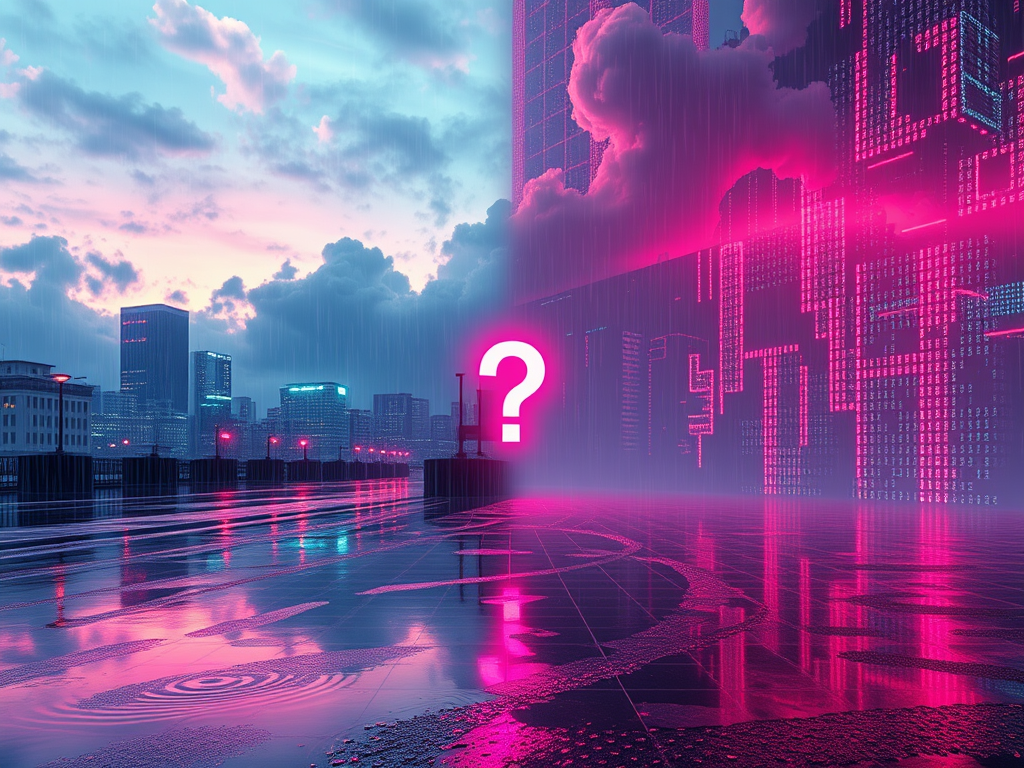

A Rainy Afternoon in Kochi
Sometimes, on rainy afternoons in Kochi—when the scent of fish curry floats lazily through the air and the clouds hang so low you can almost touch them—I find myself staring out at the ripples on the water and wondering: What if all of this is just code? A glitch in the Matrix, a digital dream. I mean, is that raindrop on my window pane any different from the pixels on my screen? Chetta once told me over a steaming glass of chai at the corner stall on MG Road that life’s too real to be a simulation. But I’m not so sure.
The Simulation Hypothesis
Let’s start with the basics, because not everyone spends their nights reading about quantum entanglement and AI singularities (like some of us science nerds do). The simulation hypothesis is the idea—first popularized by philosopher Nick Bostrom—that our entire universe might be an artificial construct, like a cosmic video game. In simple terms, it suggests that what we call reality could be a simulation, created by an advanced civilization with computing power far beyond our own. Think about it like this: just as we can simulate weather patterns, traffic flows, or even human behavior using powerful computers, maybe someone (or something) is simulating us.
Moore’s Law and Exponential Tech
Now, this might sound like science fiction—and maybe it is—but let’s park that skepticism for a moment. If we accept that technological progress doesn’t just plateau, but rather accelerates exponentially (thanks, Moore’s Law), then eventually a civilization could reach a point where its computing power is so vast it could simulate entire worlds. Not just physics, but consciousness too. Here’s the kicker: if that’s possible, then statistically speaking, there might be more simulated realities than “real” ones. I know, that’s enough to make your head spin faster than a dervish at a Kochi street festival.
Starry Nights and Paradoxical Realities
But here’s the thing: how would we even know? I remember one monsoon night, I was stuck on the backwaters during a power cut—no Wi-Fi, no chai, just me and the stars. And I started thinking: What if every star I see is just a rendering, a calculated point of light in a cosmic code? Like a ray-traced skybox in a video game. When I finally made it back to my small apartment, still dripping from the rain, I scribbled this thought in my dog-eared notebook: “Simulation or not—my chai tastes real enough.” I guess that’s the paradox: even if it’s fake, it feels real. And maybe that’s the only test that matters.
Quantum Mechanics: A Lazy Universe?
Let’s get a bit more technical for a moment—don’t worry, I’ll keep it spicy. Take quantum mechanics, for example. One of the weirdest things about our universe is that particles can exist in multiple states at once, like Schrödinger’s famous cat being both alive and dead until someone opens the box. This is called superposition. Now, when we observe these particles—bam!—they collapse into a single state. It’s as if the universe waits for us to look before deciding what’s real. Like a video game rendering a new scene only when you walk into it. Could it be that our universe is similarly “lazy”—saving computational resources by only rendering what’s needed?
The Double-Slit Experiment
And that reminds me of the double-slit experiment (cue: Aarav’s favorite thought experiment). When we shoot electrons at a screen through two slits, they create an interference pattern—like ripples in water—if we don’t observe them. But if we do observe them, they act like tiny bullets, choosing one slit or the other. It’s as if the universe is coded to produce different outcomes depending on whether someone’s watching. Now, if that doesn’t sound like a rendering trick, I don’t know what does.
Error-Correcting Codes in Physics
But let’s not get ahead of ourselves. Some scientists argue that these quantum weirdnesses are just natural phenomena, not evidence of a simulation. Fair point, but let’s entertain another idea: error-correcting codes. A few years ago, theoretical physicist James Gates and his team found that certain equations describing fundamental particles resemble digital error-correcting codes—the same kind we use to fix glitches in DVDs and satellite signals. Could that be the universe’s source code? I mean, come on—that’s like finding a cheat code for Mario Kart embedded in the laws of physics.
Cosmic Glitches and Abandoned Servers
Sometimes I wonder if this simulation—if it exists—was built by beings that are long gone. Maybe we’re running on some abandoned server in the cosmic equivalent of an internet café in Thrissur that no one’s paid rent on in centuries. And maybe that’s why we see all these weird cosmic phenomena—like black holes and dark matter—that don’t quite fit neatly into our equations. Glitches in the system, bugs that the cosmic devs never got around to patching.
Consciousness: The Ultimate Puzzle
And that brings me to consciousness—because what’s a simulation without a player? Are we just NPCs in some alien’s RPG, or is there something genuinely special about our minds? The “hard problem” of consciousness—why subjective experiences feel like something rather than nothing—still baffles even the sharpest minds. If we are in a simulation, is consciousness just an emergent property of complex code? Or is it something the simulation can’t replicate, like the aroma of freshly brewed filter coffee wafting through my Thiruvananthapuram kitchen?
The Mystery and the Wonder
I guess that’s why this question is so tantalizing. It’s not just about whether we’re living in a simulation, but what it means for who we are. If everything is code, then free will, love, art, even the smell of rain on tin roofs—could all be just lines of code. But then again, even lines of code can create beauty. After all, my friend’s code once simulated the monsoon rain on his phone’s screen so realistically that it made me homesick. And I can’t help but smile at the irony.
The Big Question
So what do I believe? I like to think of the simulation hypothesis not as an answer, but as a question—a lens through which we can see ourselves, our universe, and our place within it. It challenges us to rethink what’s real, what’s possible, and what we take for granted. Maybe it’s a cosmic joke, or maybe it’s the key to unlocking deeper truths. Either way, it keeps me curious, and that’s enough for me.
A Chai Stall Reflection
Some nights, I still find myself at that same chai stall, listening to the sound of rain on tin roofs, watching the lights flicker in the distance. I stir my tea and wonder: If this is a simulation, then who—or what—is the player? And maybe, just maybe, I’m okay with not knowing. After all, the mystery is half the fun. And anyway, simulation or not—my chai tastes real enough.
🔖 Related Reading
If this stirred something in you, you might also enjoy:
We’d love to hear your thoughts. Let’s chat below!