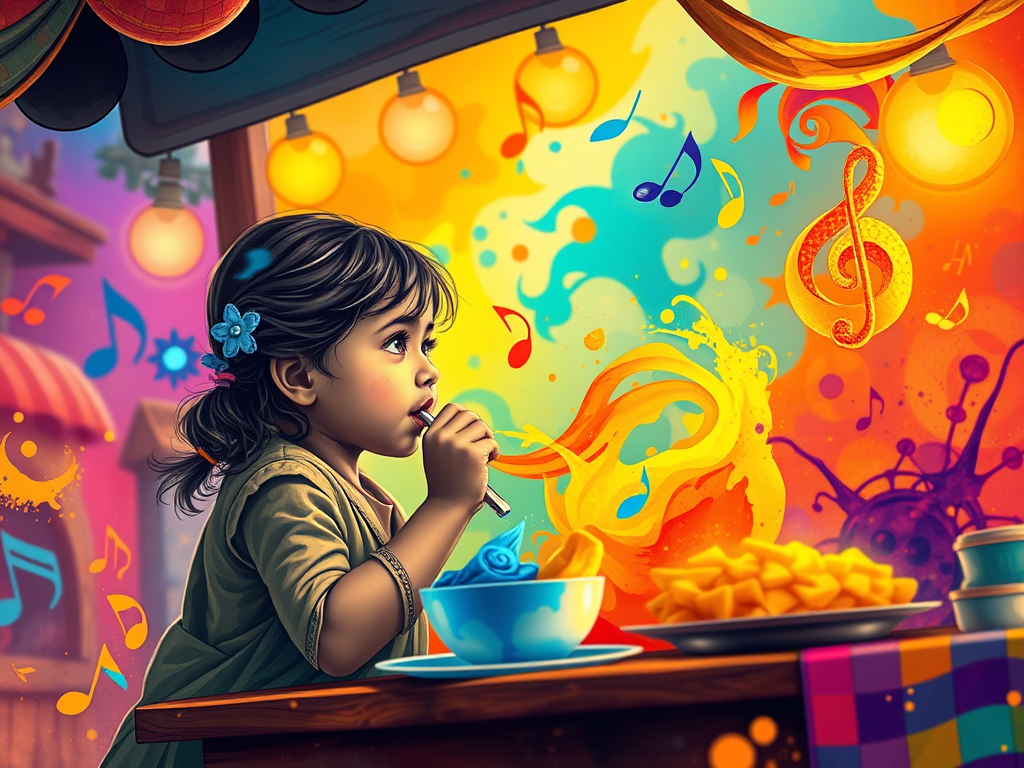

It happened at the dosa stall, of all places. I was sipping my filter coffee and watching a little girl argue with her mother about which color tasted better—blue or orange. “Blue is sweet like laddoo,” she insisted, licking her lips, “but orange is too loud.” Her mother just laughed, but I leaned in, curious. What if she wasn’t just being imaginative?
Welcome to the strange, wonderful world of synesthesia, where your senses like to throw a party together—and forget to follow the usual rules.
Wait, You Can Taste Colors?
Yes. And some people genuinely do. In synesthesia, sensory wires that are usually separate in the brain get cross-connected. That means a person might see colors when they hear music, or taste mangoes when they read the number 4, or even feel textures when they hear words.
It’s not a hallucination. It’s not imagination. It’s very real—for the people who experience it.
Scientists estimate that about 3–4% of people may have some form of synesthesia. That’s not a huge number, but it’s not rare either. You might even know someone who has it—and they just think everyone experiences the world like they do.
The Brain’s Secret Color Mixer
Let’s do a quick detour through your brain. Normally, your senses are handled by separate regions—like vision in the occipital lobe, sound in the temporal lobe, and taste in the insular cortex. But in synesthetes, these regions seem to communicate more actively, creating a sort of cross-sensory orchestra.
One theory is that in early childhood, everyone’s brain starts out with these rich connections between senses. As we grow, the brain prunes these pathways to make perception more streamlined. But in synesthetes, some of those early connections remain—like secret passageways linking color, sound, number, or taste.
Meet a Synesthete
My friend Pooja, an environmental researcher, recently introduced me to her colleague Arun, who casually mentioned, “The letter ‘R’ has always been a deep green to me. Like the leaves after rain.”
At first, I thought he was joking. But Arun explained he had grapheme-color synesthesia—where letters and numbers appear colored, even when printed in black. It’s automatic and consistent. The letter “R” will always be green for him, no matter the font or paper.
I asked him if he ever gets confused. He grinned, “No more than someone might be confused by a perfume in a crowded market. It’s just… part of the background.”
A World Painted with Sound and Flavor
There are over 60 documented types of synesthesia. Here are a few:
- Chromesthesia: Hearing sounds triggers a visual color response. A piano note might shimmer gold, while a violin could streak blue across your mind.
- Lexical-Gustatory Synesthesia: Words trigger tastes. The word “city” might taste like peppermint.
- Mirror-Touch Synesthesia: You feel sensations on your own body that you see happening to others—like a kind of empathic echo.
- Time-Space Synesthesia: Days of the week or months appear spatially arranged—like Monday is always to your left and December is a curve upward.
Isn’t that a kind of magic?
From Mozart to the Markets of Bangalore
Some of the most famous artists and thinkers are believed to have had synesthesia—Mozart, who saw colors in musical notes; Kandinsky, whose paintings were inspired by sound; and even Pharrell Williams, who describes seeing colors when composing songs.
I once walked through Bangalore’s Russell Market during Ramzan, when the scents of haleem and rosewater mingled in the air, and a qawwali singer’s voice floated over the crowd. I remember thinking—this moment feels golden and spicy. Maybe I was having a tiny taste of synesthesia too.
Is It a Superpower?
That depends on how you look at it.
Some synesthetes say it’s beautiful—a kind of private art gallery in their minds. Others say it can be overwhelming, especially when too many sensory inputs collide. Imagine trying to read a spreadsheet while your brain insists each number is a different flavor and color!
But researchers are fascinated because synesthesia might offer clues to how creativity, memory, and perception work. Synesthetes often score higher on creativity tests. They’re more likely to notice patterns and make unexpected associations.
Some scientists are even exploring whether synesthesia can be trained—or mimicked—to enhance learning or design more immersive experiences.
How Does It Feel?
To better understand, I asked Shalini, the curious 12-year-old from my science club, to imagine what it would be like.
“If you say ‘Wednesday’,” I prompted her, “what color pops into your mind?”
She thought for a second. “Kind of teal? Like the inside of my lunchbox.”
Then she paused and asked, “But… doesn’t everyone see colors for days?”
Ah. Maybe Shalini’s a synesthete too—and we never realized it.
Cultural Flavors of Synesthesia
Interestingly, synesthesia isn’t interpreted the same way across the world. In some cultures, it’s linked to spiritual visions or artistic inspiration. In others, it might go unrecognized entirely.
In India, we’ve long associated senses in unusual ways. Think of ragas that evoke particular seasons, or Ayurvedic descriptions of foods that “cool the mind.” Is that not a form of cross-sensory mapping too?
It makes you wonder: Where does culture end and synesthesia begin?
Okay, But Can You Train Yourself?
There’s no known way to “become” a synesthete in the true neurological sense. But some artists, poets, and even chefs train themselves to think in cross-sensory metaphors.
Like describing a poem as “bitter and red” or a painting as “soft as silence.”
I sometimes play a game with my students where we assign flavors to numbers or pick the “color” of a book’s mood. It’s not real synesthesia—but it opens up the imagination.
Side Note: The Curious Case of the Mantis Shrimp
You think humans are good at perceiving color? Let me introduce you to the mantis shrimp.
This flamboyant sea creature has up to 16 types of photoreceptors in its eyes (we humans have just three: red, green, and blue). It can detect ultraviolet, polarized light, and possibly colors we can’t even imagine.
If synesthetes are blending existing senses, the mantis shrimp might be inventing new ones altogether.
What would the world look like through those eyes?
Living in a More Sensory World
Synesthesia reminds us that the world we experience isn’t the world as it is, but the world as our brain interprets it. And sometimes, our brain chooses to remix things in beautiful, unexpected ways.
Maybe the little girl at the dosa stall wasn’t just being silly. Maybe she was part of the rare few who live in a world where taste and color waltz together like old friends.
And maybe we could all use a bit of that wonder, don’t you think?
So, Next Time…
When you see sunlight catch on a puddle, or hear your favorite raga at dusk, pause and ask yourself:
What color is this moment?
What flavor does it leave behind?
Because science isn’t just about facts—it’s about wonder. And sometimes, the most astonishing truths are the ones hiding right in front of our senses.
🔖 Related Reading
If the senses ever felt like a secret language to you, here’s more to explore:
We’d love to hear your thoughts. Let’s chat below!