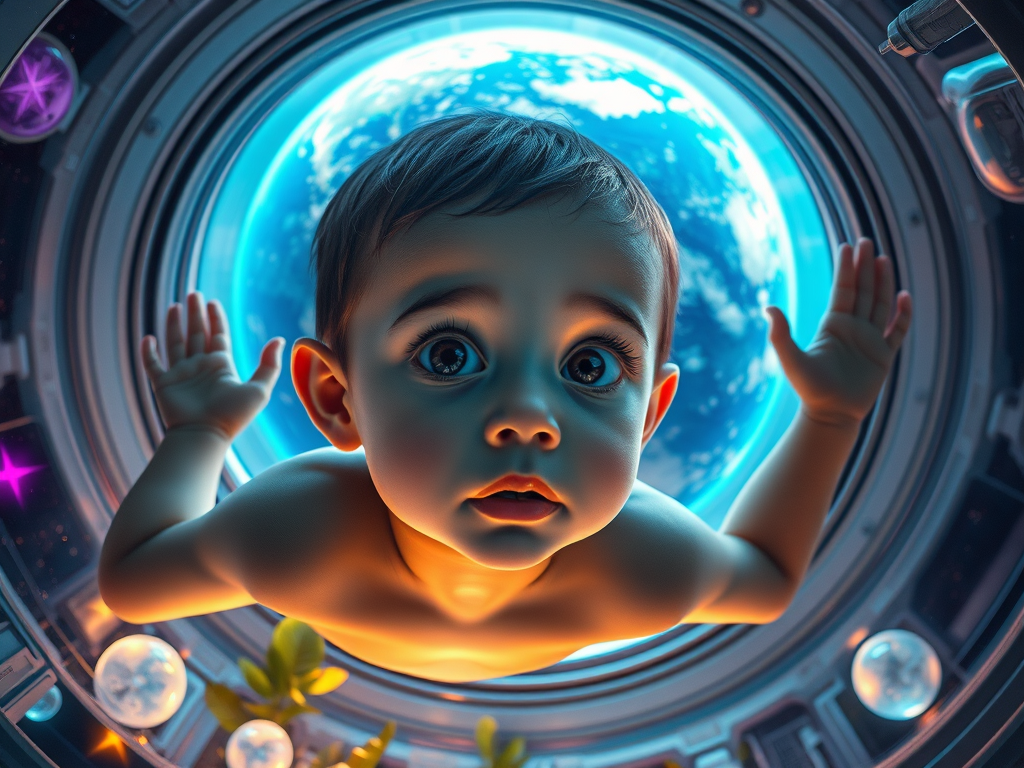

The Mango That Floated My Mind Open
It started with a mango.
Not some poetic, ancient mango on a banyan-shaded hill—but a literal mango that floated up and smacked me in the face while I was watching a livestream from the ISS. The astronaut was trying to demonstrate inertia, I think. But all I saw was fruit, drifting like a bored balloon. And suddenly my brain spiraled.
What if we weren’t just visiting space?
What if we stayed?
Not just us—our children, their children, and the long line of fragile, breathing creatures we’d send skyward with nothing holding them down?
Could humans evolve for zero gravity?
From Spine to Soul: What Gravity Does to Us
Let’s start with the basics. Gravity isn’t just a downward tug—it’s the invisible sculptor of everything we are. It compresses our spine, keeps our blood moving, teaches our eyes where “down” is. Even our sense of balance is basically just an inner-ear love letter to gravity.
Take that away—and the body gets confused. Astronauts in microgravity start losing bone density and muscle mass within weeks.
In fact, astronauts can lose up to 1%–2% of bone mass per month in space—a rate that mimics advanced osteoporosis back on Earth. NASA’s Twin Study on Scott and Mark Kelly found profound changes in gene expression, immune response, and even chromosome length.
But here’s the thing: these are short-term effects. Band-aid problems for short visits. What happens when the visit becomes a home?
What happens after 100 years… or 10,000?
Space Babies and Spaghetti Spines
Let’s say we’ve set up permanent colonies on some orbital habitat—like the O’Neill cylinders or Stanford toruses you find in old NASA blueprints. And now, generations are being born in zero gravity.
The first few might struggle. Imagine being born in an environment where your bones never learned to resist force. Kids might float before they crawl. Walk? Maybe never. Their muscles would adapt, sure—but not for lifting, just for swimming through air.
Over time, selection kicks in. The humans who thrive here aren’t the strongest by Earth standards—they’re the most efficient in movement, the best at maneuvering in 3D, the ones who don’t need much calcium or cardiovascular strain.
Picture this: long, delicate bodies. Spindly limbs. Fingers evolved to grip bars and corners in midair. Maybe even wider eyes for spatial awareness, and altered vestibular systems that don’t freak out when “up” and “down” vanish.
We’ve adapted before. When early humans left the trees, we stood upright. Our hands turned from climbing tools to makers of fire and paint. A shift in gravity—or the lack of it—could spark the same leap. Only this time, there may be no ground to come back to.
We might begin to resemble our own space probes—light, sleek, optimized not for endurance, but for freedom.
But What About… the Blood?
Here’s a weird thing I learned at 2:03 AM while falling down a rabbit hole of NASA research and leftover Mysore pak: our blood is gravity-trained.
Without gravity pulling it downward, more of it rushes to the head. That’s why astronauts get “moon face.” Over time, the body adjusts. But born-space humans might develop entirely new blood pressure systems. Maybe we evolve valves that open and close depending on orientation. Maybe our hearts shrink—or migrate slightly in the chest to better float blood around.
And if that sounds weird, remember that giraffes evolved to handle massive pressure changes just to sip water. Evolution has receipts.
Rewiring the Mind: Do We Need “Down”?
This is where it gets juicy. Our entire sensory system is trained to interpret the world through gravity. Left and right, up and down, even the way we fall in love with stability—it’s all part of the package.
But in zero-G, kids would never fall. No scraped knees. No gravity-induced fear. What does that do to how a mind develops? Would they become more fearless? More fluid in thought, like their motion?
Maybe the very language changes. On Earth, we say “falling asleep.” In space, would it be “floating into sleep”? “Rising into dreams”?
Orientation is a core of how we map memories, construct spaces, and build metaphors. Change that—and you might not just evolve a new body, but a new psychology.
The Culture of Floaters
Imagine architecture with no floors. Education systems where “sit still” is impossible. Sports that look like synchronized swimming in air. Art installations that float, rotate, live in 360°.
One of Rakesh’s theories—shared over Ambili Chechi’s slightly burnt tapioca curry—is that religion itself might shift. “No sky gods in orbit,” he said, licking his fingers. “When you float, everything is already above you.”
That stuck with me.
Gravity’s absence doesn’t just free the body—it might unmoor meaning itself.
We’ve adapted before. When early humans left the trees, we stood upright. Our hands turned from climbing tools to makers of fire and paint. A shift in gravity—or the lack of it—could spark the same leap. Only this time, there may be no ground to come back to.
Will We Still Be “Human”?
Here’s the catch: evolution is slow. Natural selection works over thousands of generations. But genetic engineering? That’s fast. CRISPR, synthetic biology, epigenetics—we now have the tools to speed up what nature used to take eons to do.
So the real question isn’t “Could we adapt?” It’s “Will we choose to?”
Would we genetically enhance bone density? Modify embryonic development to favor zero-G traits? Maybe even create new organs—an artificial gravity sense, a magnetic skin patch to stabilize orientation?
And at what point do those changes become… something else?
Homo gravitas → Homo orbitalis?
Gravity as a Class Divider?
There’s another angle. What if gravity becomes a social class?
Those born on Earth—the “grounders”—versus the “floaters” in space colonies.
Maybe interplanetary jobs prefer one body type over another. Maybe floaters struggle on Earth, their fragile bones unable to withstand its pull. Maybe Earth becomes the mythic origin—the ancestral planet no one visits because it’s too heavy.
A whole caste system defined not by race or language—but by physics.
Kind of dystopian. Kind of probable.
But Wait—Would We Even Survive That Long?
Let’s be honest. Before evolution kicks in, we have to survive the tech, the politics, the logistics. Radiation alone is brutal in space. Without Earth’s magnetic shield, colonists would need constant protection.
Zero-G doesn’t just make you float—it accelerates aging. Telomeres shorten. Immunity weakens. It’s like getting old, fast-forwarded.
So maybe we don’t evolve for zero gravity. Maybe we evolve around it—build artificial gravity systems, rotate habitats, mimic Earth as much as we can to avoid becoming aliens to our own kind.
But if we let go—really let go—maybe gravity will become as quaint as fire-starting stones. Something ancestral. Something from the Old World.
A Final Thought—Floating Ancestors
Sometimes, late at night, I picture it.
A kid born in orbit. Never walked. Never felt weight. She moves like a dancer, laughs in spirals, dreams in zero-G. One day, she looks down at Earth—not as home, but as myth.
And I wonder…
Will she still feel pulled by it?
Not physically. Spiritually.
Will she still dream of standing?
Or will we, the ground-walkers, become her ancient ghosts—creatures from the time of weight?
And when she finally visits Earth, will she see us as origin… or burden? The mythic species who lived chained to a planet, before learning to drift?
An Invitation to Float a Thought
💭 If this article stirred a thought, floated a new idea, or just made you pause for a second—share it with someone who likes to wonder. Or drop a comment below. I’m still figuring things out too. 🌍🛰️
🌀 Related Reading
• Everyday Life on a Generation Ship: The Chai Chronicles
• How Bees Recognize Human Faces
• The Face That Wasn’t Mine: Deepfakes and the Ghost of Memory
• What Is Time? A Thoughtful Walk Through a Day in Kochi
• The Birth of Genghis Khan: Destiny and Omen Explored
We’d love to hear your thoughts. Let’s chat below!