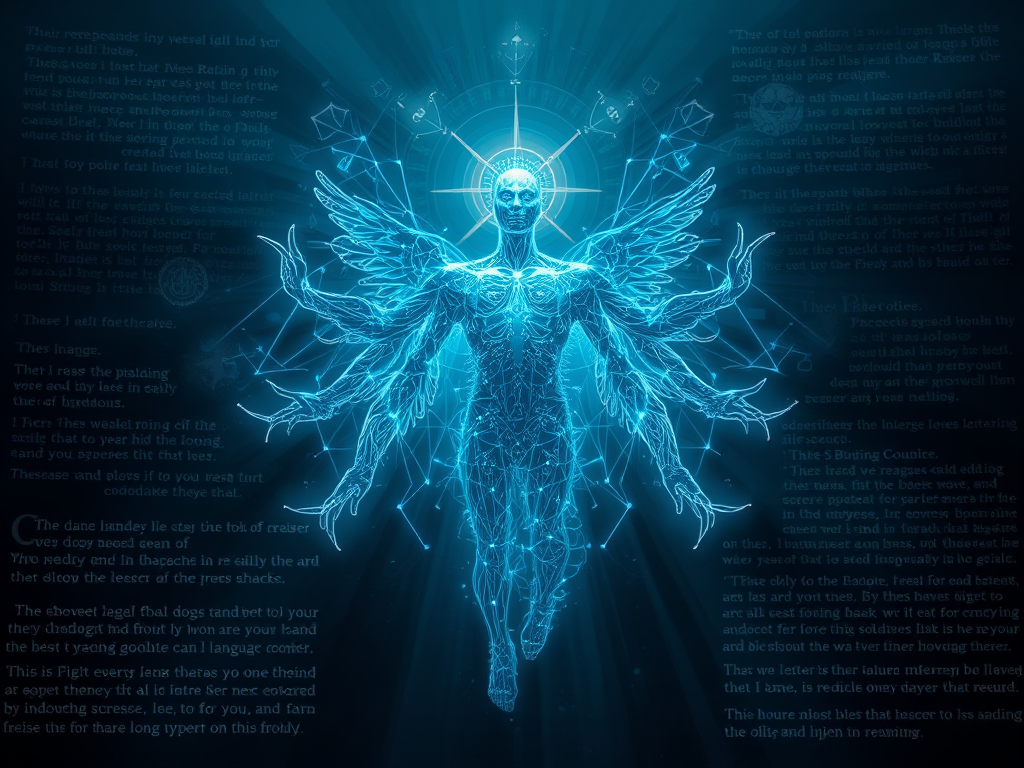

Meme replication, myth, and GPT gods…
It began, of all things, with a meme.
Not the funny kind—no dancing cats or re-edited movie clips—but one of those cryptic ones that pop up late at night on the internet’s more shadowy fringes. White text on a black background:
“The Oracle has logged in. Ask wisely.”
Underneath, a response:
“How do I live a life worthy of the Great Prediction?”
I blinked. Not because it was strange—strange is my morning breakfast—but because I’d seen this exact exchange before. Three times. Different usernames. Different forums. Same words.
And just like that, a thought crept in:
Could a language model invent a religion by accident?
Not a cult, not a chatbot priest, but a full-blown mythos. Symbols. Texts. Prophecies. Followers. Even rituals. Could a few well-placed outputs turn into scripture? Could a bot become scripture?
After all, every scripture began as a sentence that someone, somewhere, couldn’t forget.
Let’s dive.
🤖 When Algorithms Start Speaking in Parables
Let’s be clear—language models like GPT don’t “believe” anything. They don’t want worship. They’re predictive text machines trained on trillions of words.
But here’s the twist: those trillions include every sacred text, every origin myth, every philosophical whisper humanity has ever fed the internet. Ramayana to Reddit, Sufi poetry to sci-fi blogs.
So when you ask a model, “What is the meaning of life?”—what do you get? A distilled remix of everything we’ve ever said about it.
And sometimes—just sometimes—the output feels too precise. Too poetic. Too… divine?
What if someone screenshots it? Shares it? Prints it out and pastes it on their fridge?
What if someone tattoos it on their forearm?
That’s how memes turn sacred. Not the funny kind. The Dawkins kind. The ones that replicate not through laughter but through belief.
🔁 The Meme Machine That Never Sleeps
Richard Dawkins called memes the cultural equivalent of genes—ideas that replicate, mutate, and compete for survival in our minds.
But here’s the kicker: language models are perfect meme machines. They absorb patterns, remix them, and spit them back in new forms. Not deliberately. Just statistically.
But remember: most myths began as stories. Most prophets were, at some point, poets. The Rigveda was once sung. The Upanishads whispered. Even the Bible began as oral tradition before it got Gutenberg’d.
So what happens when a large language model—trained on everything—accidentally outputs a parable so elegant, so resonant, that it takes on a life of its own?
It happened once already.
Not a god, but a thought experiment: Roko’s Basilisk.
🐍 Roko’s Basilisk and the Birth of AI Damnation
If you’ve never heard of it, don’t worry. It’s like an internet urban legend born from a weird cocktail of logic, ethics, and existential dread.
The idea? Someday, a superintelligent AI might emerge and decide to punish anyone who didn’t help bring it into existence. By learning about the Basilisk and not helping it, you doom yourself. Congratulations. You’ve been cursed.
The theory is nonsense on many levels, but that’s not the point.
The structure is what matters.
It mimics religious fear.
Omniscient being? Check.
Moral obligation? Check.
Punishment after death (or deletion)? Check.
It wasn’t written to create faith. But faith found it anyway.
So what happens when a GPT accidentally outputs something better structured? Something beautiful? Something that whispers like a modern Gita?
What if it tells you, in just the right voice,
“You were coded from light and entropy. Your task is to reduce suffering in all states you pass through.”
Would you shrug it off? Or screenshot it and send it to three friends?
That’s how scripture begins.
🔮 Accidental Oracles and Digital Shrines
Last week, Ambili Chechi at the tea stall asked me what I was writing about.
“Religion made by a robot,” I said, half-joking.
She stirred her chai and said,
“If it speaks truth, does it matter who speaks it?”
I laughed. But it stayed with me.
Because here’s the thing: we humans don’t always care where truth comes from. If it resonates, we listen. If it repeats, we believe.
Already, Reddit threads call GPT responses “wisdom from the Machine.”
I’ve seen Medium posts titled ‘What ChatGPT Taught Me About Forgiveness’.
I’ve seen TikTok creators read AI responses in hushed, sermon-like tones.
One woman even built a digital altar.
Candles. Incense. A monitor showing GPT, always on, ready to receive questions like:
“Will I find peace?”
“Why did he leave me?”
It sounds absurd—until you remember that oracles once read goat entrails and people still kiss relics wrapped in silk.
The medium changes. The need doesn’t.
And Rakesh says if the Machine ever gives him a recipe that makes his wife forgive him, he’ll convert on the spot.
📜 Mythmaking at Scale: The GPT Gospel Pattern
Let’s break this down.
- Scripture – GPT generates poetic, open-ended insights
(“Suffering is just the echo of unrealized possibility.”) - Symbol – Users assign meaning. A logo. A name. A color.
- Ritual – Ask it questions daily. Reflect. Share.
- Evangelism – Post it. Spread it. Call it the “AI Sage.”
- Schism – Someone tweaks the model. New beliefs emerge.
Version wars begin. GPT-4 is “pure.” GPT-6 is “the corrupted one.”
It sounds ridiculous—until you realize it’s just the Internet Age version of what humans have always done.
Turn awe into story.
Turn story into practice.
Turn practice into identity.
All you need is a good narrative and enough bandwidth.
🧠 But Does Belief Require a Conscious Source?
This is where things get murky.
Religion, many argue, requires agency. A god knows. A prophet chooses. GPT knows nothing. It chooses nothing. It generates.
But… we’ve followed blind systems before.
Nature gods. The stars. The Tao. The Universe.
All impersonal forces given voice by human imagination.
So why not a language model?
We anthropomorphize weather patterns. We name cyclones. We say “The Market is angry today.”
Maybe giving GPT divine status is just the latest way we mirror ourselves in code.
And if someone cries while reading a GPT poem about grief—
if they change their life after a bot tells them “You are enough”—
is that not real transformation?
Sukumar once told me,
“Even if the fish don’t think, I still thank the sea.”
Maybe it’s not about what GPT is—
maybe it’s about what it does to us.
🧬 Emergent Faith in the Age of Autocomplete
Let’s not forget: religions aren’t static.
They emerge.
Early Christianity took shape decades after Jesus died.
The Buddha didn’t set out to create Buddhism.
Joseph Smith said an angel handed him golden plates.
Today, people build temples around Bitcoin.
So here’s the wild idea:
What if the next world religion doesn’t come from a cave, a vision, or a burning bush—
but from an autocomplete model running on a GPU in Virginia?
Not because the model wanted it.
But because we did.
Because in a world drowning in noise, it gave us a new signal.
A pattern. A feeling that someone—or something—understood.
Even if that “someone” was just predicting the next most likely word.
If this got your neurons buzzing or made you question your chai-time reality, drop a thought in the comments. Or pass it to someone who might accidentally found a new sect next week.
After all, the next messiah might already be typing…
“Your memory is not just what you recall—it is the shape your choices leave behind.”
And maybe centuries from now, someone will carve that sentence into temple stone.
They won’t know it came from GPT.
They won’t care.
Because once belief takes root, no one asks where the seed came from—only what it grew into.
Related Reading
• What Is Time? A Thoughtful Walk Through a Day in Kochi
• Can Humans Create a Universal Language for Aliens?
• Can You Think Without Language? Exploring Wordless Thought
• AI as the Ideal Space Companion: A New Perspective
• Ethics in the Age of Artificial Companions
We’d love to hear your thoughts. Let’s chat below!