
🎲 The Tuxedo of Randomness
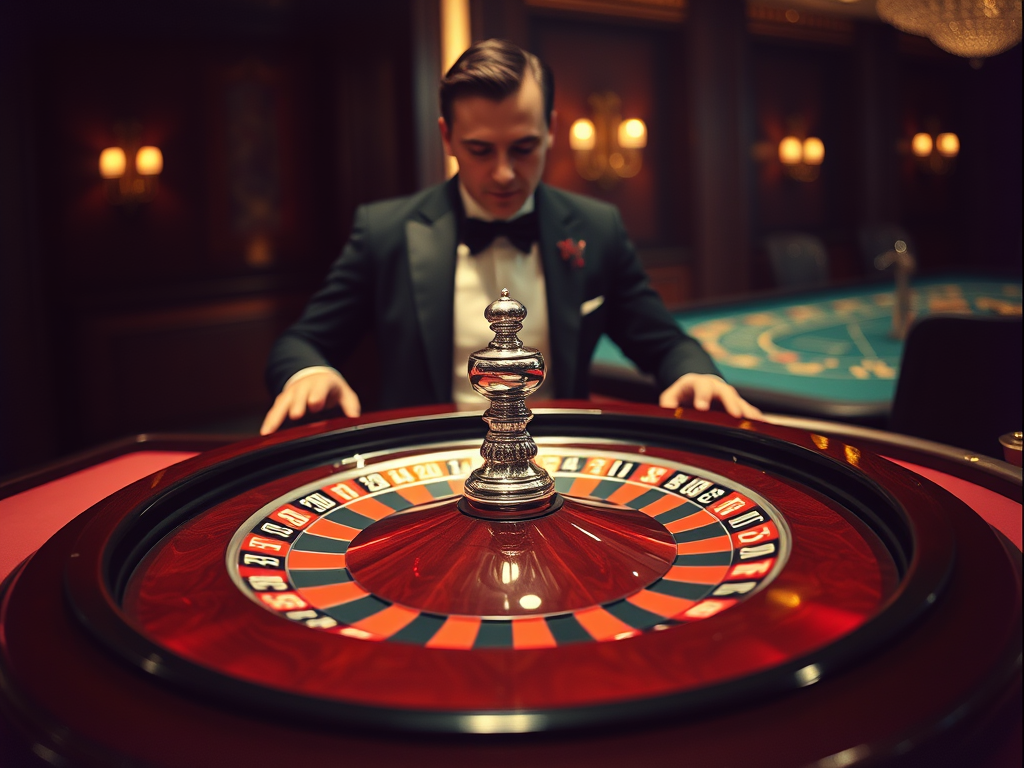
It started with a tuxedo. Not mine—I don’t own one—but the croupier’s, sharp as entropy’s edge and smooth as a freshly debugged neural net.
I was in Goa again, dragged into a casino by Rakesh under the pretense of “observing emergent pattern dynamics in controlled environments.” Which is just his fancy way of saying he wanted to gamble ₹2000 on shiny things.
So there I was, watching a roulette wheel spin.
Not for the money. Not really. I was watching the wheel like it was a physics experiment disguised as theatre. The ball spun, danced, clicked over the pockets like a drunk electron hopping energy states, then fell into 17 black.
And in that moment, a strange thought emerged—half whim, half whisper:
What if the roulette wheel isn’t about winning or losing?
What if it’s a ritual we invented to make peace with chaos?
🔁 Entropy, Loops, and Luck
There’s something oddly seductive about roulette.
I mean, look at it. The wheel, the velvet, the numbers—red and black alternating like a heartbeat. A single green zero thrown in like a smirk.
It doesn’t just simulate randomness—it performs it.
The tuxedo, the tuxedo, the tuxedo.
You see, in a universe where particles can tunnel through walls and exist in multiple states until measured, maybe we need our chaos to look neat.
We wrap it in rituals. We let it wear a tux. We assign it rules—not to tame it, but to feel like we understand it.
And the wheel? It’s not just a game. It’s a metaphor with momentum.
📐 The Physics Beneath the Velvet
Let’s pause and rewind to second-year thermodynamics—where I once got into an argument with my professor about whether entropy was destruction or liberation.
Entropy, for those not juggling coffee and chaos equations daily, is the measure of disorder in a system.
The second law of thermodynamics tells us: left to itself, everything drifts toward chaos.
Roulette captures this perfectly. Spin after spin, there’s no memory. No causality. No pattern. Just a closed system sliding into beautiful disorder.
The numbers don’t know the past. The wheel doesn’t care. It’s entropy on a lazy Susan.
But here’s the twist: humans are terrible at accepting randomness.
We look at a sequence—17, 6, 17 again, 9—and start whispering: “There’s a pattern.” We believe in streaks, in lucky numbers, in ‘due’ outcomes.
Rakesh, after seeing black show up five times in a row, bet big on red.
“It’s bound to flip now,” he said.
I just smiled. “Or it’s bound to not care.”
Physicists have repeatedly tested roulette-like chaos in real systems—John Bell’s quantum experiments being the gold standard.
(See: “Bell’s Theorem and the Reality of Quantum Entanglement,” Physics Today, 1985)
Even chaos, it seems, has a structure—if not an explanation.
🧠 Pattern-Hungry Brains in a Patternless World
Now here’s a juicy contradiction.
Roulette is deterministic in theory.
If you had perfect knowledge of the wheel’s angular velocity, the ball’s spin, the friction coefficient of the rim, air resistance, imperfections in the ball’s surface, even the temperature of the room—you could, in principle, predict where the ball would land.
A few physics students in Cambridge once built a hidden shoe computer in the ’70s to do just that.
🎯 Fun fact: In the 1970s, a group of physics students at the University of California used a concealed toe-clicking device in their shoes to calculate ball speed and wheel deceleration in real time.
They allegedly walked away with thousands—until the casino caught on.
Even chaos has weak points, if you know where to look.
But the real world isn’t so generous.
The tiniest changes—a micro-groove on the wheel, a breath of air—amplify over time.
Welcome to chaos theory. Sensitivity to initial conditions. The butterfly effect, dressed in casino lighting.
In short: roulette is a deterministic system that behaves as if it were random.
Which, if you think about it, is true of a lot of life too.
💭 The Control Illusion
There’s a phenomenon in neuroscience called apophenia—our brain’s tendency to perceive meaningful patterns in random data.
It’s why we see faces in clouds, or why Sukumar (our local fisherman-philosopher) once claimed that his net caught more fish when he wore his lucky lungi.
Humans crave cause and effect. It’s wired into us.
If berry A made us sick and berry B didn’t, that wasn’t just evolution—it was survival.
But when we apply the same instinct to roulette?
We start seeing ghosts.
One woman at the table kept placing bets on her birthday numbers.
Another guy muttered a prayer before every spin.
Me? I just leaned back and watched the ball spin—marveling at how belief persists even when logic has left the building.
🪞 The Mirror Effect
Here’s where it gets deeper.
The wheel doesn’t just spin randomly—it exposes a hidden wound in us. The wound of unpredictability.
See, most of our life is lived in controlled environments.
We plan, schedule, optimize. Our apps know when we’ll wake up, our maps tell us where to turn, our health trackers monitor our heartbeats.
But when we sit at a roulette table?
There’s no control. No undo. Just spin and surrender.
And oddly—that surrender feels good. Like breathing out after holding in too long.
Maybe that’s why we gamble.
Not just for thrill.
But for a moment where we don’t have to pretend we’re in charge.
🐠 Sukumar’s Net and the Quantum Wheel
Roulette mirrors the universe in miniature.
You have the known (the rules), the unknown (the outcome), and a closed system where both interact.
Just like physics. Just like life.
You can study probabilities all day, but when it lands on green zero—it’s like the universe winking at your calculations.
It’s Schrödinger in a bowtie. Heisenberg sipping gin.
We call it chance, but it’s really complexity wearing a smile.
💡 So, What Does the Wheel Really Teach?
I once asked Sukumar if he thought the sea was fair.
He said, “Some days the fish jump in the net. Some days, they vanish. Just like the wheel, chetta.”
At first, I laughed.
But later, it hit me: that is quantum thinking.
The world doesn’t owe you outcomes. It just offers probabilities.
We collapse one into reality with every act—every bet, every step, every spin.
And sometimes, even with all your theories and models and machines, the fish don’t show up.
That doesn’t make the sea unfair. It just means you’re not the center of it.
To me, roulette is more than a game.
It’s a ritual where humans come face to face with the edge of knowledge.
A spinning sermon on chaos and meaning.
It teaches you that:
– Even in deterministic systems, unpredictability can emerge.
– Our brains will invent patterns just to soothe the unknown.
– The desire for control is often stronger than logic.
– Sometimes, the most honest answer is: We don’t know, and that’s okay.
And somewhere in all that, there’s a kind of freedom.
The kind you only get when you stop trying to win the universe—and just watch it spin.
🌀 Final Spin
So next time you find yourself in front of a roulette wheel—or life itself—don’t just look for numbers.
Look for metaphors.
Look for the tuxedoed chaos, the entropy in motion, the delicate dance between determinism and disorder.
And ask yourself:
Do we spin the wheel?
Or does the wheel spin us?
Of course, maybe it’s just a wheel.
Maybe we’re the ones dressing it in philosophy, because we can’t stand silence.
But then again, isn’t meaning what we make of the spin?
🪙 “The universe doesn’t owe you outcomes. It just offers probabilities.”
Either way, I’ll be watching—with my chai in hand, and my bet placed firmly on curiosity.
If this piece spun something new in your head—or helped you make peace with a little chaos—drop a thought in the comments or share it with someone who loves questions more than answers. 🎩🎲
🎲 Related Reading
• Why the Universe Might Look Random—But Isn’t
• What If Earth’s Magnetic Poles Flipped Overnight?
• How Spider Silk Inspires Super-Strong Materials: Lessons from Nature’s Engineers
• Understanding the Mandela Effect: Memories and Reality
• The Science Behind Firefly Synchronization
We’d love to hear your thoughts. Let’s chat below!