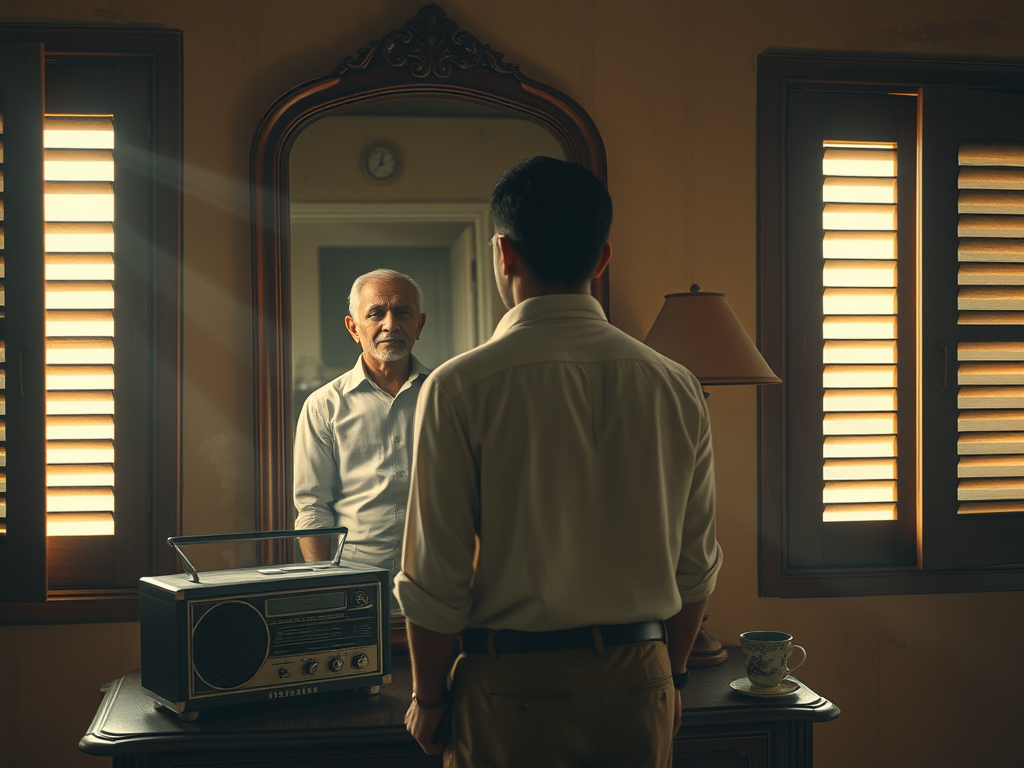

A poetic dive into physics, paradox, and why your memory might be a time machine.
I forgot where I was going. Because I was trying to figure out how to kill my grandfather. In theory.
Somewhere between two steaming glasses of cardamom chai and a confused auto ride through MG Road, that thought hit me like a pothole. Not metaphorically. I genuinely forgot my destination.
The driver, Venuettan, kept glancing back through his rearview mirror, waiting for directions. But I was busy wondering: what if I went back in time and accidentally (or maybe deliberately?) killed my grandfather?
Not because I have anything against him, mind you. The man was a legend—used to fix radios with bare hands and once built a swing from a discarded bicycle chain. But I was stuck on the famous “grandfather paradox”—one of those delightful brain-knots in theoretical physics that makes your head feel like a quantum Rubik’s cube.
If you could travel back in time and kill your grandfather before your parent was conceived, wouldn’t that erase your own existence? But if you were never born, how did you go back in time to do the killing?
Cue the universe glitching like a bad internet connection.
⏳ The Problem with Time (It Might Not Exist)
Let’s take a breath.
Time, as we experience it, flows in one direction—from past to future. That’s what the arrow of time is all about. Entropy increases, things fall apart, chai cools down.
But physics doesn’t really care about that direction. Most of our fundamental equations—whether it’s Newton’s laws or Schrödinger’s wave equation—work just as well forward or backward.
Time’s arrow, it seems, is something we impose from our human perspective.
So what if time isn’t a river but a frozen block of ice—a “block universe” where past, present, and future all exist simultaneously like rooms in a hotel, and we’re just walking through them?
Think of it like a Netflix series you’ve already downloaded—every episode exists all at once, but you’re watching one at a time.
If that’s the case, maybe traveling between rooms is possible.
🚪 Enter the Time Machine (Hypothetically Speaking)
Theoretical physicist Kip Thorne—yes, the same man who advised on Interstellar—showed that under certain exotic conditions (like negative energy and wormholes), closed timelike curves could exist.
Think of them as cosmic roundabouts. You enter one end of spacetime and loop back to an earlier point.
🌀 Bootstrap Loop
But here’s the catch.
If you loop back and interfere with your own history, the paradox kicks in. Let’s say you hand your younger self a physics textbook, and that version of you grows up to hand that same textbook back. Who wrote it?
Nobody. It’s an object with no origin—what physicists call a “bootstrap paradox.”
But paradoxes don’t just twist logic—they fracture possibility. And that’s where quantum weirdness creeps in.
🐱 Schrödinger Had a Grandfather Too
This brings us to quantum mechanics, the unruly teenager of physics that refuses to behave.
In the quantum world, particles exist in superpositions—multiple states at once—until observed. So maybe, just maybe, when you go back and attempt to kill your grandfather, the universe branches into two timelines:
One where you succeed and vanish, and one where you fail and return to your time with nothing but guilt and a knife-shaped headache.
This is the many-worlds interpretation.
🪞 Picture It:
A timeline that splits like a cracked mirror the moment you raise your hand to act—
One shard where he lives, one where he doesn’t,
And infinite others where the teacup never even falls.
Let’s simplify: Imagine two versions of you—one holding the knife, one dropping it. Both exist. They just don’t talk.
You didn’t undo your own existence—you just jumped tracks.
Like a train leaving the main line to explore a weird little town where reality smells slightly of cardamom and paradox.
In fact, physicist David Deutsch argued that quantum computation requires parallel timelines—because a quantum computer, in essence, explores multiple realities at once before settling on the answer.
🧠 Destiny, Free Will, and the Pothole That Ate the Past
Now, here’s where it gets interesting.
If time travel is allowed but paradoxes are forbidden (as per Novikov’s self-consistency principle), then the universe won’t let you change the past in a way that prevents the future from happening.
🔫 The Gun That Won’t Fire
You might go back, gun in hand, trembling with existential drama, but something will intervene. The gun jams. You trip. A pothole swallows you whole.
(Very plausible in Kochi, by the way.)
In other words: you can visit, you can witness, but you can’t rewrite the script in a way that unravels your own plotline.
Kind of like how Ambili Chechi’s tea stall always runs out of vada just before I arrive.
No matter how early I leave. Some outcomes are just… written.
But what if time travel isn’t something we build—it’s something we already do?
📌 Memory as a Time Machine?
Let me offer you a slightly stranger thought.
Maybe we don’t need a DeLorean or a wormhole. Maybe memory is time travel—just in one direction.
Think about it.
Every time you vividly recall a moment—your first day of school,
the smell of your grandfather’s aftershave—sharp and minty, like time trying to stay awake—
the exact look of the clock when you got your exam results—
You’re collapsing the quantum fuzz of your brain into a state that resembles the past.
Memory isn’t nostalgia—it’s an anchor. So what happens when it drifts?
Neuroscientists say our brains reconstruct memories like virtual simulations.
In a way, remembering is like reloading a saved game—but the save file rewrites a little each time.
Would I still be me if the moment that shaped me was undone?
And if I wouldn’t—then who’s remembering this?
If the universe splits with every decision, then what happens to our regrets? Do they fade—or multiply?
Don’t get me wrong—I’m not saying we can “will” our way into a different timeline.
But if reality is fundamentally quantum (and that’s still an open debate), then observer effects could go far deeper than we think.
Imagine a civilization advanced enough to stabilize retrocausal effects—not just travel through time, but receive information from the future and act on it in the present.
There’s already some spooky talk in quantum physics about weak measurements and delayed choice experiments that hint at this.
Unthinkable, until we think it.
Also: look up the Polchinski paradox sometime. I’m not touching that mess.
🎥 A Film with Missing Reels
The grandfather paradox is ultimately about narrative.
We like our stories neat: beginning, middle, end. But time might not work like that.
It might be more like one of those Malayalam movies where the second half changes your understanding of the first.
Or a Christopher Nolan film, if you’re into that flavor of confusion.
So instead of asking “Can I go back and kill my grandfather?”, maybe the better question is:
Can the story of time tolerate loops?
If the universe is a self-consistent story, maybe it writes around paradoxes the way authors write plot holes into poetry.
It doesn’t delete scenes—it reframes them.
Maybe your attempt to kill your grandfather was part of the timeline all along.
Maybe he survived because of it.
Maybe that’s the reason he became who he was—the man who would later fix radios with bare hands and pass on his strange curiosity to you.
🪞 So… Could You Kill Time, or Just Rewrite It?
Here’s where I land.
You can’t kill the past.
You can’t cut the thread.
But maybe, just maybe… you can change the song.
The grandfather paradox doesn’t mean time travel is impossible—it means reality is more layered than linear.
It tells us that cause and effect might not be as rigid as we think.
That loops, echoes, and strange feedback could be baked into the fabric of existence.
I don’t believe you can kill the past.
Not because you lack the power—but because the past isn’t a single fixed thing.
It’s a set of intertwined quantum records, smeared across possibility, echoing forward in the choices we make now.
In that sense, time isn’t a thread to cut—
it’s a song to remix.
The real time machines aren’t made of spinning wormholes or pulsing crystals.
They’re the stories we tell, over and over, until something shifts inside us.
That old radio still hums, like it remembers that same minty trace of him too.
Maybe that swing still creaks at night—looping back not to a paradox, but a memory becoming real again.
Some stories—like time itself—don’t end. They loop.
So if your mind just did a loop-de-loop… pass it on.
And if I meet your grandfather in a dream, I promise: I won’t mess it up.
And if time really does loop, maybe he’s still building that swing somewhere—waiting for me to find it again.
Related Reading
• Evolving in Zero Gravity: Future Humans in Space
• Are We Living in a Simulation?
• The Hidden Memory of Leaves: Nature’s Silent Storytellers
• Will AI Ever Tell Us a Joke We Didn’t Teach It?
• From Saunas to Ice Baths: Exploring Global Healing Traditions
We’d love to hear your thoughts. Let’s chat below!