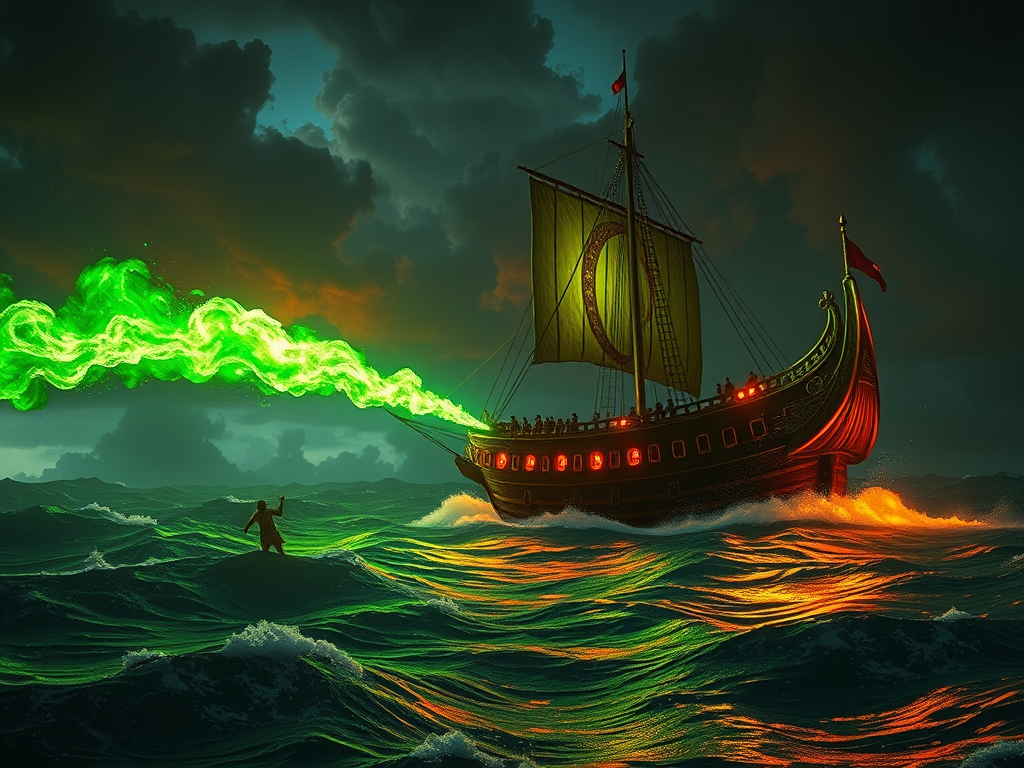

🪔 “And it was as if the sea itself caught fire.”
— Anonymous Arab chronicler, c. 8th century CE
What happens when something too powerful to explain becomes too dangerous to remember?
There are weapons that conquer lands, and then there are weapons that conquer imagination. Greek Fire was the latter—and, for nearly four centuries, the terror of the seas.
Let me tell you a story.
Like all great fire, this one doesn’t just burn. It leaves shadows long after it’s gone.
🔥 The Birth of a Legend
It begins not in Rome or Athens, but in Constantinople—a city with one foot in Asia, the other in Europe, and its head squarely in the clouds.
By the 7th century, the Eastern Roman Empire—what we now call the Byzantine Empire—was holding on to its glory like a nobleman clutching his last heirloom. Rome had long fallen. Barbarians were gnawing at Europe. And the Arabs, fired by their new faith, were storming up from the south, eager to claim the empire’s coastal jewels.
The Byzantines, to put it mildly, were surrounded—and desperate. But desperation, as any good cook or commander will tell you, is the mother of invention.
Somewhere in the Byzantine court—likely under the reign of Emperor Constantine IV—an alchemist-turned-engineer named Kallinikos of Heliopolis arrived with a gift that would change naval warfare forever. Or perhaps he was just the one who improved it. Like all good Byzantine stories, the truth is wrapped in mystery and dunked in olive oil.
What he brought was Greek Fire.
❓ So… what was Greek Fire, really?
Ah, here’s the catch. We don’t fully know.
What we do know is this: it was a thick, flammable liquid, possibly based on naphtha or quicklime, that could be hurled in jars or, more terrifyingly, sprayed through pressurized siphons mounted on Byzantine ships. Once ignited, it clung to ships, sails, and flesh—and kept burning. Even on water.
Yes. On water.
Imagine being an Arab sailor in the 8th century, rowing toward Constantinople, when suddenly the enemy ship belches out a stream of what looks like dragon’s breath. Your boat is now a bonfire, your escape routes soaked in flames, and the sea—your last refuge—offers no mercy.
It wasn’t just fire. It was divine fire—a weapon that defied the laws of nature, and, to many, confirmed that the Byzantines had God on their side.
📜 The Recipe That Died With an Empire
Now here’s where things get truly Byzantine.
Despite centuries of spying, copying, and even capturing entire ships, no other civilization—not the Arabs, not the Crusaders, not even the Ottomans—could replicate Greek Fire.
The formula was a tightly guarded state secret, reportedly passed only to a few trusted military engineers. Some sources say it was so secret that each component was produced by separate teams, none of whom knew the full recipe. Imagine baking a cake where the flour guy doesn’t know there’s even going to be eggs.
But Bhola, my ever-inquisitive helper who once tried to make his own mosquito repellent using clove oil and camphor (and nearly burned off his eyebrows), asked me a simple question while dusting maps one morning:
“Sir, if it worked so well, why did it disappear?”
I gave him a biscuit and said:
“Because sometimes, Bhola, a secret kept too well becomes a secret lost.”
That’s the tragic irony. When the empire began to crumble in the 13th century and later fell for good in 1453, the knowledge of Greek Fire vanished with it.
No recipe. No manuals. Just fearful chronicles and the scorched wrecks it left behind.
🔬 The Science Behind the Magic
Modern historians and chemists have guessed.
Theories include petroleum-based mixtures, sulfur compounds, resin, and even saltpeter. Some believe the ignition was triggered by water itself—reactive chemicals like quicklime producing enough heat on contact to start the blaze.
Others suggest that the delivery system—a kind of ancient flamethrower—used pressurized bronze tubes, possibly operated with bellows or siphons.
There’s even talk of grenades: ceramic pots filled with Greek Fire, lobbed by hand or catapult. An early Molotov, if you will.
But no reconstruction has truly matched the horror described in enemy accounts.
And here’s where I must pause and offer a gentle reminder:
History is not a laboratory. We don’t always get clean answers. Sometimes we get echoes, burnt scrolls, and contradictory monks scribbling from memory.
🧠 A Weapon of Morality and Myth
For the Byzantines, Greek Fire wasn’t just chemistry—it was psychology. A weapon wrapped in mystery tends to burn longer in the minds of enemies than on the battlefield.
It reinforced the myth of the invincible Christian empire, protected by divine fire. The Orthodox clergy often claimed that the formula had been a divine gift—possibly from an angel or a saint. To use Greek Fire was not just to win a battle, but to enact divine will.
Of course, not everyone was impressed. Some Western Europeans, especially during the Crusades, muttered about “ungodly tactics.” But let’s be honest—many of those knights later tried to reverse-engineer it themselves.
Hypocrisy, after all, is also historical.
⚔️ The Battles That Turned on Fire
Let me share a moment—a hinge in time.
In 717 CE, during the Second Arab Siege of Constantinople, the Umayyad navy brought over 1,800 ships to blockade the city.
It should’ve been a slaughter. But the Byzantines, waiting with siphons, let loose arcs of fire across the waves. Ships went up like torches.
The sea hissed like a beast in pain. The fire did not stop.
Sailors leapt into the sea to escape, only to find the water itself alive with fire—sticking to skin, roaring in the waves like a god betrayed.
The siege failed. The empire survived.
One could argue that Greek Fire didn’t just protect a city—it preserved a civilization.
Without it, the Byzantine Empire might have fallen centuries earlier. And with it, gone too would be the Orthodox tradition, Byzantine art, and maybe even the buffer that kept early Islam from sweeping further into Europe.
Small fire. Big ripples.
🎭 Fact, Legend, and the Dance Between
Now, let’s clear the smoke a bit.
Some tales about Greek Fire grew taller with time. Chronicles speak of barrels that chased enemies like hounds, or of liquid flame that could be turned off and on like a lamp.
One Russian legend says Greek Fire could distinguish friend from foe—burning only the wicked.
Convenient, no?
But even the most outlandish versions reveal something true:
That fear is part of warfare, and mystery can be as potent as metal.
Bhola once quipped—after watching a documentary with me—that Greek Fire sounds like a schoolteacher’s glare.
Burns through your soul, and you don’t know what started it.
He may have a point.
🕯️ Why We Still Care
Here’s the thing.
In an age where we can launch missiles by voice command and simulate battles with AI, the story of Greek Fire feels almost… poetic.
A lost art. A reminder that science, secrecy, and superstition once sailed in the same boat—literally.
We’re drawn to it not just because it worked, but because it disappeared.
Because it hints at what might be possible when knowledge, desperation, and legend collide.
And because, perhaps deep down, we all want to believe that somewhere—beneath Istanbul, beneath our own histories—there’s a secret not yet lost.
A fire that remembers.
A flame that still waits.
Not on the sea, but in the story.
It was more than a weapon—it was a whisper of control in a world spinning out of it. The kind of fire we all want: something that makes us feel safe, feared, and chosen.
It was a fire not just of oil and lime—but of secrecy, survival, and the fear of being forgotten. The kind of fire civilizations carry in their lungs when the light around them dims.
Sometimes I imagine stumbling on it. Not in a library, but in a forgotten cellar—half-buried in dust, still warm.
Maybe the real danger was never Greek Fire.
It was forgetting that we once held something we couldn’t quite understand—and dared to use it anyway.
🔥 Related Reading
• Understanding Inflammation: The Fire Within Us
• How Elephants Remember Watering Holes
• The Shortest War: Lessons from the Anglo-Zanzibar Conflict
• Everyday Life on a Generation Ship: The Chai Chronicles
• The Face That Wasn’t Mine: Deepfakes and the Ghost of Memory

We’d love to hear your thoughts. Let’s chat below!