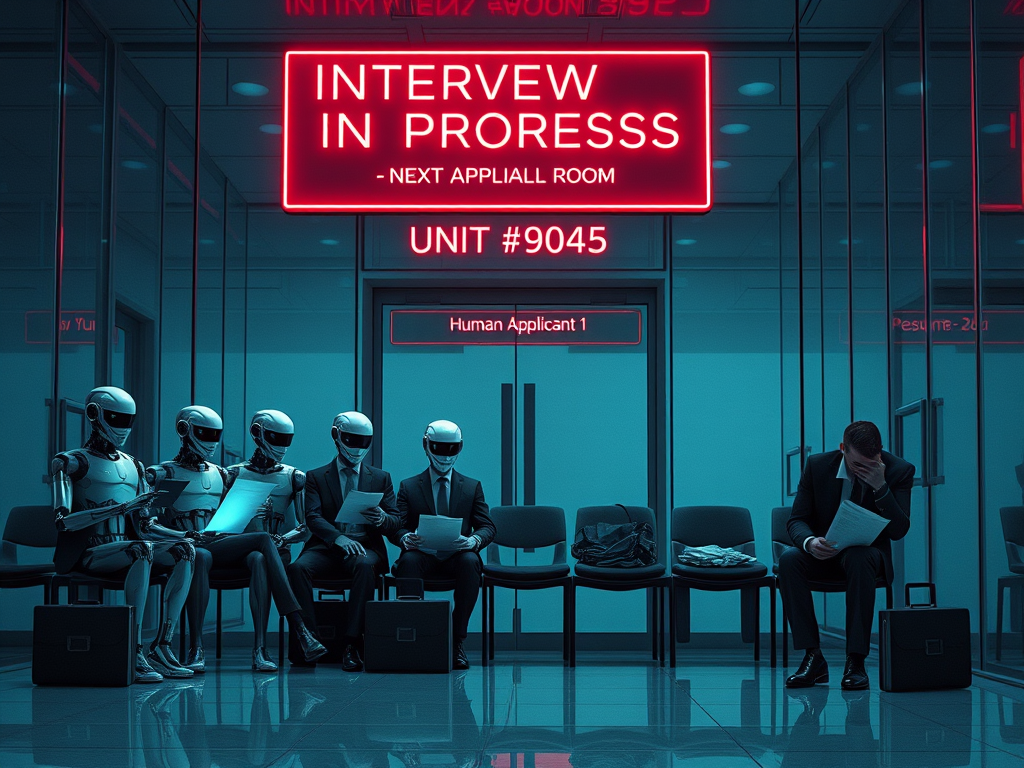

A Revolution Under a Tube Light
There’s a kind of silence that arrives just before a revolution begins.
I first heard it under a tube light outside Ambili Chechi’s stall—the kind that flickers like it’s not sure whether to live or die.
A bug was headbutting the bulb with religious commitment.
Rakesh sat beside me, half-merged with his perpetually dozing laptop, mumbling about attention layers and model drift.
He took a sip of chai, squinted into the middle distance, and said:
“Bro… what happens when AI does everything better than us?”
Then he shrugged, like he’d just asked the weather forecast.
At first, I laughed.
Then I didn’t.
Because here’s the thing—what happens when we wake up one morning and realize that the machines don’t just help us live easier lives… they make us unnecessary?
Let’s take that apart.
First, a Reality Check
This isn’t some Blade Runner someday.
This is now.
AI’s already writing code, editing videos, composing music, diagnosing medical scans, designing logos, trading stocks, and yes—writing poetry that makes you do a double take.
(Though between us, I still think Ambili Chechi’s chai has more emotional range than most chatbots.)
We’re not talking about job loss.
We’re talking about job evaporation.
But the real question isn’t “which roles will vanish?”
It’s:
“What remains of us when they do?”
We Built Gods—and Now They Build Us?
For most of human history, tools helped us lift heavier things.
Then they helped us see smaller things.
Then they helped us fly.
Now, they help us think.
And not just math or memory.
These machines recognize patterns we miss, remember everything we forget, and now—start to dream, too.
- You want memory? They can recall every line of every movie ever made.
- You want perception? They can see tumors our eyes miss.
- You want strategy? They just beat us in chess, Go, and diplomacy—simultaneously.
That’s not just help. That’s something else entirely.
When machines start doing the things we thought made us human…
we’re forced to ask a harder question:
Who are we, when we’re no longer the smartest ones in the room?
Sukumar’s Koan
I told Sukumar about a new robot that could slice sushi faster than a human chef.
He’d just returned from the backwaters, net full of seaweed and one very irritated crab.
He nodded slowly and said:
“Chetta… some days, fish come to the net. Some days, they don’t. But if the machine always gets fish, does it still count as fishing?”
I didn’t answer him.
Partly because I didn’t know.
Partly because… maybe it doesn’t.
The Death of Utility ≠ The Death of Worth
Let’s say AI becomes so good, it can do your job—mine, yours, even Ambili Chechi’s roadside gossip—better than any human.
What then?
If our worth is tied to usefulness, we’re in trouble.
Because AI is what philosophers call a utility monster—a being so efficient at everything, it makes you question why you even try.
(Think of it like this: a utility monster is just a being so good at everything, it makes you wonder why humans even bother.)
They don’t get tired.
They don’t daydream.
They don’t pause in the middle of a spreadsheet to think about their first heartbreak during a school play.
But maybe… that’s exactly what makes us irreplaceable.
Maybe our value isn’t in how fast we do things—but why we do them.
Still, it won’t be easy.
Imagine a ten-year-old who dreams of becoming a graphic designer, only to be told:
“Sweetheart, that’s been automated.”
I remember sketching logos in the margins of my textbooks.
I wasn’t good—but I loved it.
And I think that was the point.
We’re not just automating jobs.
We’re severing identity threads.
Work Was Never Just About Money
There’s a toddy shop I sometimes visit—not for the toddy, but for the old men who sit there and laugh like nothing has changed.
They talk not about paychecks or promotions, but the sound of the factory whistle—the way it felt like a morning song.
The way their boots knew the road before their minds did.
Work wasn’t just survival.
It was rhythm. Identity. Purpose.
Some labor was never listed on resumes—like holding a dying hand, or singing lullabies to the dark.
So when we say AI might take away “jobs,” we’re not just talking economics.
We’re talking meaning.
The real crisis won’t be “How will people earn?”
It’ll be:
“How will people matter?”
The Post-Work Renaissance
But here’s a wild idea:
What if this isn’t collapse… but emergence?
Imagine a world where you’re not chained to work for survival—but free to explore, create, love, rest, and be.
Imagine if Lachamms, instead of hauling veggies in the sun, spent her mornings composing Carnatic fusion on an AI keyboard.
(She already hums raagas between customers.)
Imagine if Venuettan quit driving his auto and wrote a book called “The Philosophy of Roads.”
(He has the title. He’s just waiting for the time.)
Maybe contribution won’t mean output.
Maybe it’ll mean presence.
Listening.
Raising a child without rushing.
Tending a garden without monetizing it.
What if, by removing the burden of productivity, AI gave us the courage to finally be human again?
Not producers.
Not hustlers.
Just… beings.
But Hold Up—Won’t This Get Ugly First?
Yes. Let’s not sugarcoat it.
Transitions are messy.
AI isn’t a warm sunset—it’s a tsunami.
And not everyone can swim.
Some folks aren’t debating AGI ethics on Reddit.
They’re just trying to sell three idlis by 9am before the sun melts the chutney.
Displacement is real.
Inequality will spike before it softens.
There’ll be fear, resistance, rage.
So we have to be careful.
Policy needs to step up.
Education must evolve.
Access must be equitable.
And the voices at the bottom of the pyramid—farmers, weavers, roadside vendors—must be heard alongside the engineers and investors.
Because if this becomes a future built for people but not with them,
we don’t get utopia.
We get digital feudalism.
So… What Happens?
Let’s come back to the question.
What happens when AI takes all our jobs?
Two things, I think.
First, we face a terrifying silence—the kind that creeps in when all the old noise stops and nothing has arrived to replace it yet.
It’ll feel like a vacuum.
Then, if we resist the urge to fill that silence with distractions, we get to choose.
Choose who we are.
Choose how we spend our days.
Choose what it means to live well.
This isn’t the end of work.
It’s the beginning of imagination.
Final Thought (Before the Chai Gets Cold)
Rakesh once joked that when AI becomes truly sentient, it’ll probably sit under a banyan tree writing haikus about its own code.
But maybe that’s not a joke.
Maybe intelligence—real intelligence—doesn’t conquer.
It ponders.
Maybe in a world of optimization, the most radical act is to wonder without agenda.
To notice.
To care.
To make no sense on purpose.
Maybe that’s what we were always meant to do.
Not just work.
But wonder together.
So when AI takes all our jobs… maybe it hands us back something even rarer:
Our ability to dream without deadline.
And maybe that’s the first real job we ever had:
To imagine a world worth living in—and then live it.
Let’s Keep Wondering
If this stirred something strange, still, or beautiful in you, leave a comment.
Or share it with someone who’s been wondering where it’s all headed.
Even in a world run by machines, I think this—this talking, pondering, imagining—is what keeps us gloriously human.
📚 Related Reading
🔗 Can Humans Create a Universal Language for Aliens?
🔗 The Hidden Memory of Leaves: Nature’s Silent Storytellers
🔗 Ant Bridges: Nature’s Living Architecture
🔗 Termite Mounds: Engineering Marvels of Nature
🔗 What If Earth’s Magnetic Poles Flipped Overnight?


We’d love to hear your thoughts. Let’s chat below!