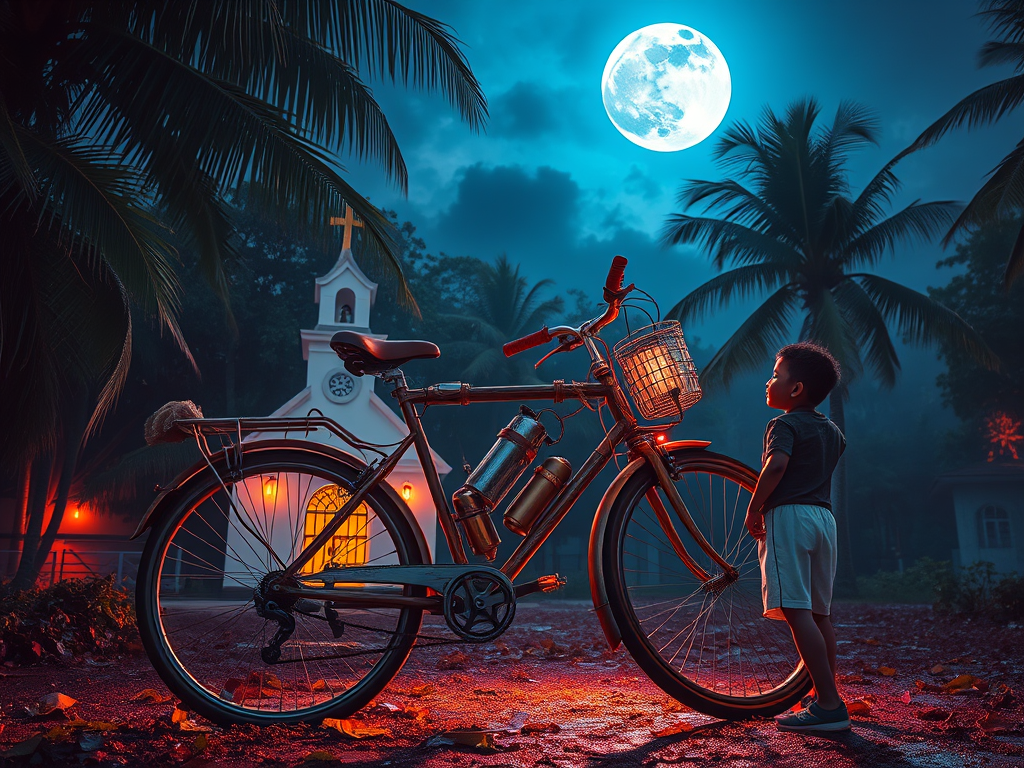

From a borrowed church to the surface of the Moon—how India’s quietest scientists launched the loudest dreams.
🛠️ How Do You Launch a Dream?
One summer afternoon, while I was sketching flight paths in the condensation of a chai glass at Ambili Chechi’s stall, a kid from the neighborhood—cheeks full of jackfruit chips—asked me:
“Chetta, did we really send rockets on bicycles?”
I looked up.
Rain had just started drumming on the tin roof, and the moon—pale, polite—was peeking through a tear in the clouds.
And I said, “Not just rockets, monu. We carried the impossible.”
🍚 Of Hunger, Hope, and the Sky
It sounds absurd when you say it out loud: Post-independence India—famines, floods, border wars, no money, no food—and somehow we thought: Let’s build rockets.
I mean, imagine standing in a ration line with a steel token and telling someone, “One day we’ll find water on the moon.”
They’d probably hand you a banana and ask you to lie down for a bit.
But that’s the thing about dreams.
They don’t wait for you to be ready.
They wait for you to ache—
not just in the stomach,
but in the soul.
And India, in the 60s, was starving for dignity. For self-belief. For one thing we hadn’t yet tried: wonder.
⛪ Thumba, and a Church That Launched the Stars
You know that story, right?
A rocket was assembled in a fishing village called Thumba, carried piece by piece—nose cone on a bicycle, fuel tank in a bullock cart—to a launch site that used to be a church.
I’ve been there. The air still smells like palm trees and soldering flux. You can almost hear Father Kurien and Vikram Sarabhai arguing over where to mount the telemetry unit—between the altar and the choir loft.
That’s where India’s space program was born. Not in a lab. But in a prayer hall.
We didn’t begin with power. We began with permission.
A bishop gave us his chapel. Fishermen gave us their coast. The sky gave us silence.
And in that silence, we lit fire.
👕 Rockets in Cotton Shirts
ISRO’s never been flashy. You won’t find gold epaulettes or celebrity astronauts or billionaires making touchdown speeches. No livestreams with dubstep countdowns.
Just scientists in half-sleeve shirts. Women in jasmine flowers. Notes scribbled on the back of filter coffee bills. A whole engineering department running on vada pav and stubbornness.
Rakesh once said ISRO feels like that uncle who fixes your ceiling fan, wires a battery to your scooter, and still finds time to launch a satellite from the kitchen.
And still—they built the PSLV. The rocket that can send 104 satellites into space with the same nonchalance you see in a dosa master flipping twenty at once on a tawa in a train station canteen.
They mastered gravity assists—using the motion of planets to slingshot their dreams further. They designed modular launchers. They reused engines like wedding decorations that keep showing up with new garlands but the same steel frame underneath.
And the one that still gives me chills?
Escape velocity.
11.2 kilometers per second.
That’s how fast something needs to move to break free from Earth’s pull.
Pause.
But when I think about ISRO, it feels deeper than physics.
Because what they achieved wasn’t just motion.
They reached the speed of belief.
🚀 Mangalyaan and the Mars That Blushed
We sent a probe to Mars. On the first attempt. For less than the cost of Gravity.
I remember that day. Sukumar had dragged his old CRT TV onto the verandah because the reception was better near the guava tree. We were surrounded by mosquitoes, but none of us moved. When the words MOM in orbit flashed on the screen, the street lights flickered like even the grid had goosebumps.
Sukumar leaned back with his coconut shell full of coffee and said:
“Entammo. We reached Mars…
and this TV still needs a knock to change the channel.”
We laughed. But it wasn’t just at the joke.
There was something about that moment—
a quiet knowing—
that somehow, in all this mess,
we were getting somewhere.
🌕 Chandrayaan and the Silence That Spoke
Chandrayaan-1 was our first whisper to the Moon.
We found water—the universe’s oldest memory—
tucked into a place where light never touched,
but hope did.
Nobody expected it.
We simply nodded, noted it down, and kept going.
Then came Chandrayaan-2.
That one still makes my throat tighten.
I was on the rooftop, under a sky too clear for comfort, watching telemetry updates in real-time. The lander—Vikram—was descending, decelerating, almost dancing. And then… silence.
The screen froze. The data flatlined. And for a moment, so did we.
A technician later said in an interview:
“We had two hours of sleep in three days. But if you’d asked us to launch again, we’d have stayed up three more.”
I remember sitting cross-legged on the terrace tiles long after the stream ended, drawing imaginary parachutes in the air, as if they could soften the fall.
ISRO didn’t rage. It didn’t spiral into PR drama. It simply bowed to the Moon and said, “We’ll return.”
Chandrayaan-3 was that promise kept.
And when Vikram landed—soft, sure, serene—I was back on that rooftop. Sukumar handed me binoculars (they were cracked, but emotionally effective), and we stared at the Moon like it was suddenly ours to mourn and celebrate at the same time.
We didn’t just land a machine.
We landed unfinished prayers.
👩🌾 Why Space, When We Had Hunger?
You’ve heard it.
“Why send rockets when there’s hunger?”
It always lands like a punch that thinks it’s a question.
And I get it—I do.
But here’s the thing no one says:
It wasn’t about reaching the stars.
It wasn’t about competing with other countries.
It was about our existence.
Our identity.
Who we would be—if we didn’t build it ourselves.
In 1966, when the questions came, Sarabhai answered—not with pride, but with purpose:
“There are some who question the relevance of space activities in a developing nation… But we are convinced that if we are to play a meaningful role, we must be second to none in the application of advanced technology to the real problems of man and society.”
That’s it.
Let it echo.
🛶 Sukumar and the CRT Screen
We watched the Chandrayaan-3 landing under the guava tree again.
Same CRT TV.
Same antenna held together with copper wire and two clothespins.
Sukumar insists the reception is better there because the tree “has seen things.”
The picture jittered.
The sound lagged behind like it was catching its breath.
But when the words “Vikram has landed” blinked across the screen, the entire lane went still.
Sukumar leaned forward, peeled half a banana, and said:
“Entammo. We reached the Moon…
and I still haven’t reached Thrissur.”
No one laughed.
Not this time.
He smiled.
Not like a man who’d made a joke.
But like someone who’d just seen something land
—that had been floating in him for a very long time.
☕ Final Sip
Above us, the sky hadn’t changed.
But something in us had.
Now we’re planning manned missions.
Gaganyaan.
A space station.
Maybe even Venus.
Big dreams.
But I still think about how we began.
Not with ambition.
Not with ego.
But with a borrowed church, a bicycle, and a blackboard.
Someone once pointed at that same moon and said:
we go not because we’re ready,
but because it’s time.
And when we arrived—
we didn’t carve names, plant flags, or call it ours.
We just touched it.
Quietly.
Like a question answered.
We carried the impossible once. Quietly.
And we still do.
So tonight, if the sky is clear—
just look up.
You’ll still see the Moon.
But if you’ve been paying attention,
you’ll see something else, too.
A line.
Drawn gently through history.
From a coconut grove in Thumba.
To a patch of grey dust,
where a machine called Vikram
learned how to land.
🚲🌕
📚 Related Reading
🔗 Cartography’s Oddities: The Case of Two Moons Above India
🔗 The Lunar Pull: How Moon Phases Affect Us
🔗 The Dead Hand: USSR’s Doomsday Device That Still Might Exist
🔗 Keto. Paleo. Vedic? How to Spot a Diet Disguised as Spirituality
🔗 The Plant That Eats Metal: Nature’s Toxic Appetite


We’d love to hear your thoughts. Let’s chat below!