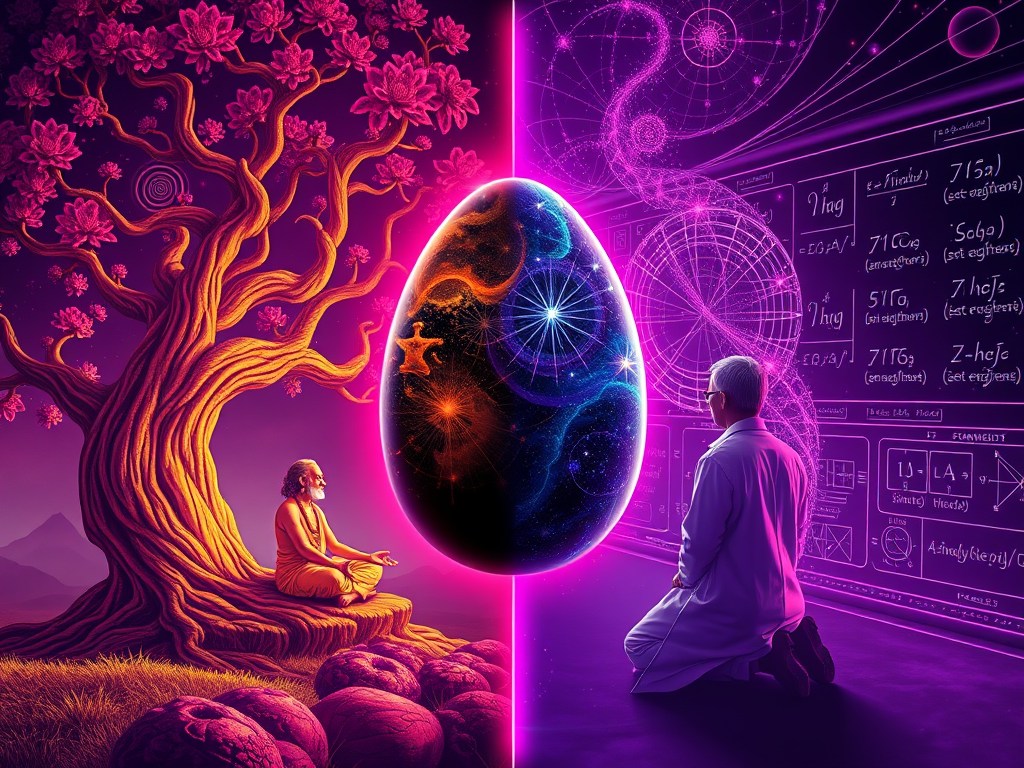

🧵 The Opening Spiral
It started, like most of my existential spirals do, with a spilled cup of chai and a conversation with Sukumar about black holes.
“Monay, if the universe is expanding, where’s it expanding into, ah?” he asked, casually untangling his fishing net like it held answers to the cosmos.
I didn’t have a satisfying reply. Because the more you dive into cosmology—whether it’s Einstein’s space-time ballet or the swirling metaphysical poetry of the Vedas—the more you realize we’re not just peering through a telescope. We’re staring into a mirror.
So today, let’s do something wild. Let’s take the poetic madness of Vedic cosmology and hold it up against the crisp equations of modern physics. Not to say one is right and the other is wrong. But to ask—where do they touch? Where do they whisper the same truths, in two wildly different languages?
🌕 The Cosmic Egg and the Big Bang
In the Rigveda, there’s a creation hymn called the Nasadiya Sukta. It doesn’t begin with gods. It begins with a question. “Then even nothingness was not, nor existence…”
And then—only breath.
A One. A force beyond breath or mind. And from that came the Hiranyagarbha—the golden womb or cosmic egg—floating in a primordial ocean of non-being. From it, the entire universe hatched.
Now hold that next to the Big Bang.
Physics tells us the universe began around 13.8 billion years ago from a singularity—a point of infinite density and zero volume. An infinitesimal dot that somehow contained everything.
An egg. A dot. A singular origin wrapped in paradox. Sound familiar?
Of course, modern physics offers equations and evidence—the cosmic microwave background, redshifts, inflationary models. The Vedas offer metaphor and myth. But both traditions seem to agree: creation didn’t emerge from a divine factory. It emerged from a state so mysterious it defies thought.
And maybe here—just here—you pause. Not to read, but to feel. A silence before all songs.
🔁 Kalpas and the Multiverse
My friend Rakesh (who still hasn’t finished his Python certification, by the way) once asked, “Bro, what if we’re just in Universe 342 out of a thousand?”
I told him he was basically describing a Kalpa.
“See? Told you Python wasn’t my destiny. I was meant for metaphysics,” he said, triumphantly closing Stack Overflow.
In Vedic cosmology, time isn’t a one-way train. It’s a cycle. The universe is created, sustained, and destroyed—again and again—in vast cycles known as Kalpas, each lasting 4.32 billion human years. After a Kalpa, there’s a dissolution (pralaya), and then another universe is born.
Like a cosmic reboot—the screen goes black, but the story isn’t over.
Like the breath of the cosmos—inhale, exhale, repeat.
Now step into modern physics.
You’ve got the Multiverse Theory—an ensemble of parallel universes, perhaps spawned by eternal inflation. Or in string theory, the idea that our universe is one “brane” in a vast higher-dimensional bulk.
Imagine a floating soap bubble among billions, brushing against others in a cosmic sink.
Or my personal favorite—the cosmological bounce models, where the universe doesn’t end in a final crunch or fadeout, but bounces back, over and over.
It’s hard not to hear echoes of the Kalpa in these theories. Cycles. Bounces. Dissolutions. Not a single creation event, but an eternal dance of birth and death.
Maybe the rishis were onto something while sitting under banyan trees long before the James Webb telescope blinked awake.
🎭 Maya and the Holographic Principle
Ambili Chechi once told me, while stirring her sugar too aggressively, “Monay, life is illusion only. One day sweet, next day bitter.”
I nodded. “That’s Maya, Chechi.”
In the Upanishads, Maya refers to the illusory nature of the world. Not in the sense that it doesn’t exist—but that what we perceive is not the whole truth. Reality is a projection, filtered through our senses, veiling the underlying unity of Brahman—the infinite consciousness.
Now peek at the Holographic Principle in modern theoretical physics.
It suggests that everything in our 3D universe might actually be encoded on a 2D surface at its boundary. Like a cosmic hard drive storing the illusion of depth. We might be living in a projection—a hologram.
It’s like watching a 3D movie on a flat screen. Everything feels solid, but it’s projected. Or a mirror that reflects a world that seems real—but isn’t the source.
When I first read that in a paper by Leonard Susskind, I nearly dropped my dosa.
Because if that doesn’t scream “Maya 2.0,” I don’t know what does.
Of course, physicists aren’t talking about divine illusion. They’re working with entropy—basically the universe’s way of saying “chill won’t last forever.” In simpler terms, it’s the cosmic arrow pointing from order to messiness. Black hole thermodynamics and string theory math follow right behind.
Still—how strange that modern physics is brushing up against an idea that’s been floating in the Indian philosophical stew for millennia?
Modern physics isn’t disproving ancient wisdom. It’s catching up to its metaphors.
🎵 Sound and Strings: The Song of Creation
In the Vedas, it wasn’t light, but sound—Nada—that began it all. Creation as vibration. The universe as Nada Brahma, the sound divine.
Modern string theory echoes this beautifully. It says the smallest building blocks of reality aren’t particles, but vibrating strings. As if existence is made not of stuff, but of tone. Vibration. Resonance.
Maybe the universe didn’t begin with a bang. Maybe it began with a song.
👁️ Consciousness and the Observer
Let’s talk about you.
Yes, you, the reader. Because without you, this article doesn’t really exist. Just symbols on a screen.
And quantum mechanics seems to agree. According to the observer effect, a quantum system remains in superposition—a cloud of probabilities—until it’s observed.
Like a coin spinning in mid-air—it’s both heads and tails until it lands.
The act of observation collapses it into a definite reality.
Now take the Vedic concept of Purusha—pure consciousness, the cosmic witness. The universe unfolds through the interaction of Purusha (awareness) and Prakriti (matter). Without the observer, there’s no creation. No manifestation.
Do you see the eerie similarity?
In both cases, awareness isn’t just a passive thing sitting in a skull. It’s a fundamental actor. A participant in the unfolding of reality.
Maybe Descartes had it backwards.
Maybe it’s not “I think, therefore I am.”
Maybe it’s “I witness, therefore the universe is.”
And what if the universe seems just right for us not by accident—but because it needs a witness to become real?
⏳ Time Isn’t What We Think
Venuettan, my favorite auto driver, once refused to pick me up because he claimed he was “stuck in yesterday.”
I laughed. But then I remembered Einstein.
Because in relativity, time isn’t a universal constant ticking the same for everyone. It bends, stretches, and slows. A clock on a fast-moving spaceship ticks slower than one on Earth. Time isn’t absolute—it’s tangled with space, speed, and gravity.
Now let’s rewind to Vedic cosmology.
Time is not linear. It’s not even always real. Some schools describe time as anadi—without beginning. Others say it exists only within the manifested universe—not beyond.
And then there’s Trikala jnana—knowledge of past, present, and future as one integrated whole. A perspective that eerily resembles the block universe theory, where time is a static dimension, and all events—past, present, future—coexist.
As if every moment of your life is a room in a mansion—you’re just walking through it one door at a time.
It makes you wonder: is time something we pass through? Or something we paint with our minds?
⚖️ Where They Diverge—and Why That’s Okay
Now before I go full mystic and start building a shrine to Schrödinger and Shankaracharya, let me acknowledge something important.
Vedic cosmology wasn’t trying to be science. It wasn’t peer-reviewed. It didn’t run simulations. It came from intuition, contemplation, meditation, metaphor. It’s poetry with metaphysical intent.
Modern physics, on the other hand, is rooted in data, math, reproducibility. It aims to model, not to mean.
But here’s the weird part. In chasing the smallest particles and the largest scales, physics has started to sound more like philosophy. And in describing the divine, the Vedas often stumbled onto surprisingly accurate metaphors for things we’re only now beginning to understand.
They may be using different tools. But maybe, just maybe—they’re walking along the same coastline of mystery, staring out into the same ocean of the unknown.
Physics still grapples with unseen forces—dark matter, dark energy. The Vedas call it the unmanifest. Maybe we’re both groping at the same ghost.
🪞 A Thought Before the Next Chai
I’m not here to say the rishis predicted quantum gravity or that ancient texts hold the key to the Theory of Everything.
But I am saying this: sometimes, truths echo.
Sometimes the questions we ask under banyan trees, or while arguing with a fisherman over sambhar packets, align with the questions asked in CERN’s particle tunnels or on whiteboards filled with tensor equations.
Maybe, Sukumar, it’s not expanding into space.
Maybe it’s expanding into meaning.
And what if the Egg, the Illusion, the Observer—they’re not different truths, but the same story wearing different names?
So the next time you look up at the stars, remember: someone 3,000 years ago looked up too. And they didn’t just see dots of light.
They saw a dance. A rhythm. A story.
Turns out, the cosmos wasn’t out there. It was reflecting us all along.
And maybe—just maybe—you’re part of it too.
As Ambili Chechi says—some truths aren’t meant to be solved. Just served hot, with a side of wonder.
“Entammo,” Venuettan would mutter, shaking his head and tapping the meter, “even the best engines need a push-start.”
💬 Join the Wonder
If this sparked a moment of stillness—or made your brain hum with new questions—leave a comment, pass it along, or underline your favorite line. And remember: the universe doesn’t always need to be understood. Sometimes, it just wants to be heard.
📚 Related Reading
🔗 The Observer Effect: Can AI Shape Reality?
🔗 Keto. Paleo. Vedic? How to Spot a Diet Disguised as Spirituality
🔗 Synesthesia: When You Can Taste Colors
🔗 Intermittent Fasting vs Vedic Fasting
🔗 Does the Universe Need Us to Exist?


We’d love to hear your thoughts. Let’s chat below!