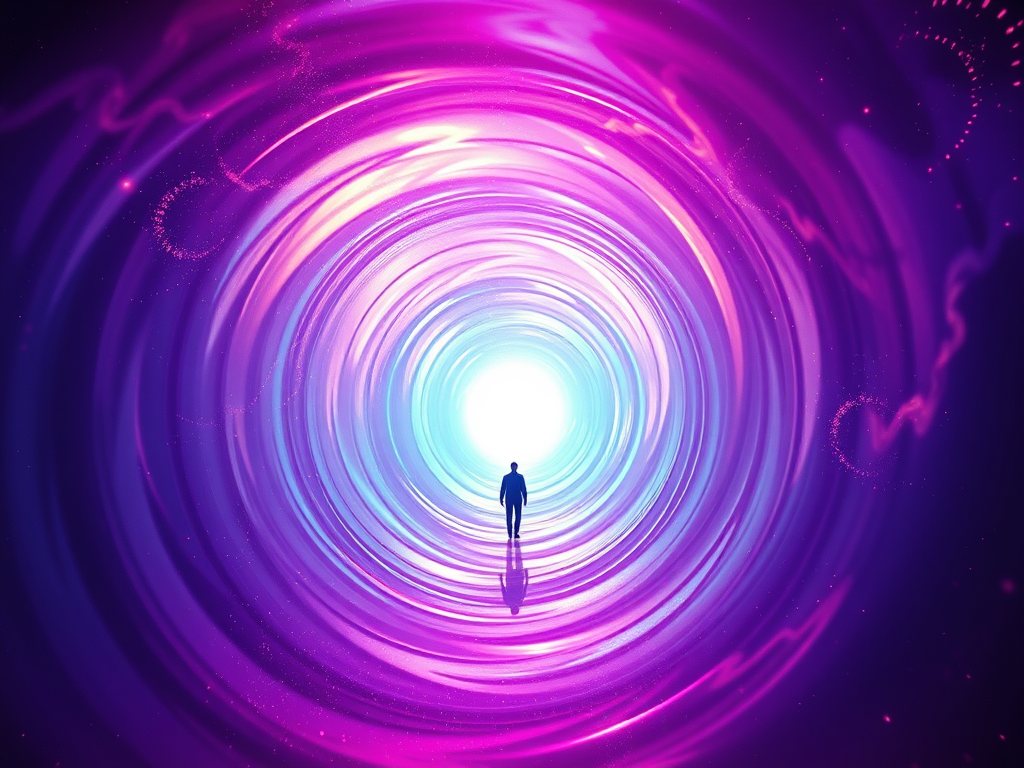

Last Thursday evening, right around the time Ambili Chechi handed me a dangerously hot cup of cardamom chai and muttered something about Jupiter being in retrograde, I had one of those odd little brain storms. Not the lightning-bolt kind, but the slow drizzle kind—the type that starts with a random thought and before you know it, you’re waist-deep in spacetime.
“What would it actually feel like to travel through a wormhole?”
I don’t mean in a textbook sense. Not the mathematical gymnastics of Einstein-Rosen bridges or the throat-flaring diagrams we see in physics journals. I mean the raw, sweaty, goosebump-loaded sensation of being there. The sound of it. The taste in your mouth. The feeling in your bones.
Would it be like falling? Like flying? Or something we don’t even have a word for yet?
Let’s dive in.
Step One: Forget Everything You Know About “Travel”
See, wormholes—at least theoretically—aren’t just tunnels. They’re shortcuts. Literal folds in spacetime. Imagine you’re holding a sheet of paper. Point A is one end of the galaxy. Point B is the other. If you fold the paper so those two points touch, and poke a hole through it—that’s your wormhole.
But here’s the kicker: when you move through a wormhole, you’re not moving in the conventional sense. There’s no up or down, no engine roaring, no sense of speeding through the cosmos like the Millennium Falcon. You’re not accelerating through space. You’re warping the very structure of reality.
Which means… would you even feel motion?
Maybe not in the traditional sense. But let’s not get ahead of ourselves.
The Entry: A Cosmic Pulse in Your Gut
Let’s say you’ve found one. A real wormhole. Stable enough to enter (somehow), and wide enough for a ship. You’re floating toward it, held in the nothingness of space. No sound. No resistance. Just this… gaping, circular void ahead of you—black as burnt sugar, but somehow rippling like it’s breathing.
I imagine the moment before entry would feel oddly familiar—like standing on the edge of a cliff with your toes curling against the wind. That deep, vibrating hum in your chest. The same one I get when I stand near the railway tracks as a train approaches. It’s not fear exactly. It’s anticipation—coded into our biology.
And then, entry.
Some physicists argue that tidal forces would rip you apart—spaghettify you into an atom-thin noodle of existence before you could even blink.
But I like to imagine a scenario where the wormhole is traversable. That some ultra-advanced civilization has wrapped it in exotic matter (yes, that’s a real thing—matter with negative energy density) to keep it stable and safe. Physicist Kip Thorne—whose equations inspired Interstellar—proposed that stable wormholes might be possible using negative energy density (Thorne, 1988). A cosmic seatbelt, if you will.
In that case, I imagine the entry would feel like dropping through warm molasses. A brief moment of sensory inversion—your ears ringing, your skin tingling like it’s turning inside out. Not painful, but… unfamiliar. Like sneezing with your whole body.
Inside the Throat: Welcome to Nowhere
Once inside, things get weird.
You’re no longer “in” space. You’re between it. Not flying through a tunnel, but falling across dimensions.
I picture it as being surrounded by shimmering patterns—like oil floating on water, or the way colors dance when you rub your eyes too hard. But there’s no wind, no sound. Just a sense that your body is being gently unfolded and refolded, like origami made of meat and thought.
Time? That gets funky too.
Because here’s the thing: in a wormhole, time isn’t guaranteed to flow the way we expect. One side could be minutes ahead. The other, a thousand years behind. Your watch might tick normally, but outside the tunnel, empires could rise and fall in the span of your heartbeat.
And then, a flicker: the smell of my childhood pillow, the taste of mango pickle, my grandmother humming outside the bathroom door. Gone in a blink, like a radio tuning past frequencies I didn’t know I missed.
I once argued with Rakesh (midway through an appam-and-stew breakfast) about whether we could use wormholes to send messages to the past. He said no, causality would collapse. I said maybe. After all, reality seems weirdly okay with paradoxes—just like Sukumar says: “Some days the fish swim backward.”
But back to the feeling.
I think your sense of self would start to bend inside the wormhole. Not just your body—but your mind. Like dreaming while awake. Memories bleeding into sensations. You’d feel nostalgia like a flavor. Regret like a texture. Maybe you’d even see flickers of possible versions of yourself—ones that took different paths.
All those “what ifs” stretched out like constellations.
The Exit: Reassembly Required
Emerging from a wormhole, I imagine, would be like birth—but from the inside out.
One second you’re in the infinite kaleidoscope of spacetime’s belly. Like falling through a shattered mirror made of stars and memory. The next—snap—you’re floating above a completely different star system, watching twin suns rise over a crimson ocean.
But nothing would feel real at first.
Your brain would lag behind your senses. Colors too saturated. Sounds echoing before they arrive. Maybe gravity feels slightly wrong—like someone nudged Newton’s apple sideways.
And here’s the big question: Would you still be you?
Because even if your atoms survived intact, your mind may not. After all, identity is just continuity across time. And if time unspooled, looped, and glitched during the journey… who’s to say your thoughts didn’t get scrambled into a new pattern?
That’s the danger of playing with the plumbing of the universe. You might make it through the pipes—only to realize you’re not the same water.
A Local Thought Experiment
Okay, picture this.
You’re standing at the end of Fort Kochi beach. The tide’s low, the air smells of fried prawns and salt. You see two points on the shore—one near the old lighthouse, one by the ferry stand.
Now imagine drawing a straight line through the earth to connect them. Not over the sand. Through the crust, the molten core, the whole shebang.
That’s what a wormhole is to space.
And suddenly, your perception of “here” and “there” becomes useless.
That’s what a journey through a wormhole would do to your self.
The Philosophy of Feeling
This is where physics starts to fray into something else—into psychology, even spirituality.
Because maybe the feeling of going through a wormhole isn’t physical at all. Maybe it’s existential.
Like feeling your place in the universe recalibrate. Realizing that your understanding of distance, of cause and effect, of presence—was a beautifully consistent illusion.
One moment you’re thinking in kilometers. The next, in concepts.
It reminds me of when I first learned that all the atoms in my body were forged in ancient stars. For a brief second, I felt dizzy. Not from the knowledge—but from the scale of it. Like my brain had briefly glimpsed a bigger operating system and couldn’t quite reboot.
What if a wormhole doesn’t take you somewhere else—but takes you deeper into your own potential?
I think a wormhole would feel like that.
But a thousand times more intimate.
So… Would I Go?
If someone offered me a chance to step into a real wormhole—no guarantees, no return ticket—I think I’d take it.
Not because I’m fearless. (Machane, I scream like a goat when I see centipedes.)
But because… how could I not?
To feel the architecture of the cosmos. To sense spacetime flex and fold around you. To understand—viscerally, not just intellectually—that the universe is not flat, but curious.
And maybe, just maybe, on the other side, I’d find not just a new star system, but a new version of myself. One that had felt the pulse of the universe from inside its veins.
What would you feel inside a wormhole?
If this sparked a weird daydream, a curious tingle behind your ears, or a sudden urge to stare at the night sky for answers—drop a comment. Or share it with a fellow wonder-chaser.
And next time you’re sipping chai under the stars, ask yourself: What if “here” and “there” are just illusions we haven’t outgrown yet?
Maybe I’ll ask Ambili Chechi next Thursday, over another chai. She’ll scoff, call me mad, and hand me a biscuit. But for a moment, I’ll see the wormhole in her eyes—just a glint of starlight in the steam.
Until then—stay curious.
After all, what if curiosity itself is the only thing that survives the trip?
✨ Related Reading
• Synesthesia: When You Can Taste Colors
• The Science Behind Firefly Synchronization
• AI as the Ideal Space Companion: A New Perspective
• Everyday Life on a Generation Ship: The Chai Chronicles
We’d love to hear your thoughts. Let’s chat below!