
“If you control the oil, you control nations.” — Henry Kissinger (perhaps apocryphal, but apt)
Bhola paused mid-dusting the globe in my study, squinting suspiciously at the slanted crescent of Iran. “So, this tiny curve,” he said, “started the mess?” I smiled. Not the geography, Bhola. The greed beneath it.
Let me take you back—not centuries, but to the steamy, suspicious corridors of 1953. The Cold War was fresh out of the freezer, every country a potential domino. And in Iran, a democratically elected leader named Mohammad Mossadegh committed what Western powers considered an unforgivable sin: he nationalized his country’s oil.
Yes, you read that right. Iran’s oil wasn’t really Iran’s. It belonged—on paper, pipelines, and bank ledgers—to the British. Specifically, the Anglo-Iranian Oil Company (AIOC), the elegant colonial alias for what we now know as BP. For decades, Britain siphoned oil wealth out of Iran while paying Iranians a pittance. Mossadegh, a secular nationalist and Time magazine’s Man of the Year in 1951, decided it was time to end that arrangement.
Britain, predictably, was apoplectic. Winston Churchill, already brewing brandy-laced rage at 10 Downing, began plotting. But here’s the twist: when Britain first appealed to the U.S. for help, President Truman said no. He saw Mossadegh as a legitimate leader, not a Soviet pawn.
Then came Eisenhower. And with him, a new worldview: if you weren’t with the West, you were with the Reds. The domino theory rolled into town.
And that, dear reader, is where the CIA came in—young, brash, and ready to test its covert muscles. They joined hands with MI6, and together, they cooked up Operation Ajax—a plan to oust Iran’s elected prime minister and reinstall the Shah, Mohammad Reza Pahlavi, as an obedient monarch.
Let that sink in. The world’s most powerful democracies colluded to crush another democracy… to keep cheap oil flowing.
How to Stage a Coup 101
Kermit Roosevelt Jr. (yes, a grandson of that Roosevelt) was the CIA’s man on the ground. He operated under aliases, held meetings in smoke-filled rooms, and shuffled money—lots of it—to street gangs, clerics, politicians, and newspapers. If you’ve ever wondered how to manufacture a revolution, Ajax is your sordid template.
They paid thugs to pose as communists and terrorize neighborhoods. Then paid other thugs to pretend to fight the fake communists. They forged anti-Islamic statements in Mossadegh’s name and had mosques read them aloud. They printed fake headlines, bribed military officers, and incited mobs.
When I told Bhola that fake mobs were paid to riot and counter-riot, he squinted.
“So they hired people to fight themselves?”
I nodded.
“Sir, this sounds less like history and more like a badly rehearsed street play.”
He went back to dusting. “At least in our mohalla, the fights are free.”
Imagine a puppet show—but the strings pulled real people, and the blood spilled was not theatrical.
Mossadegh, ever the gentleman reformer, didn’t crush the chaos with brute force. He believed in Iran’s democratic soul. But democracies, like porcelain, shatter easily when struck with clubs wrapped in propaganda.
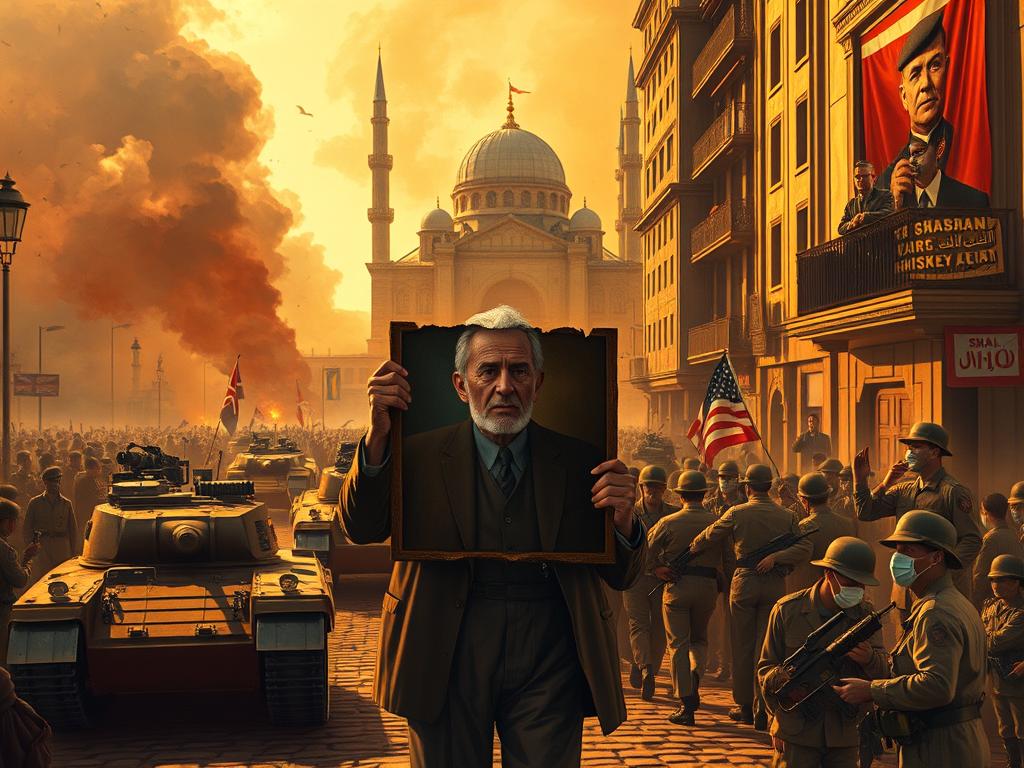
On August 19, 1953, as tanks rolled through Tehran, the air reeked of petrol, sweat, and burning tires. Loudspeakers crackled with propaganda. Somewhere, a mosque bell rang out of rhythm—its call to prayer drowned by the rumble of betrayal.
Mossadegh was arrested. And just like that, Iran’s young democracy died—not with a vote, but with a bribe and a bayonet.
Enter the Shah… Again
The Shah returned from exile, gliding in like a Hollywood monarch, his rule now propped not by public will, but by Western willpower. He would reign for 26 more years—an era of glittering palaces and secret police.
And yes, British and American oil companies got a seat at the new table. Iran’s wealth flowed West again. The democratic experiment was buried beneath petrochemical profits.
When I told Bhola this, he shook his head. “All this drama… for oil?”
Indeed. But it wasn’t just oil. It was the fear that a free Iran might align itself with the USSR, or inspire other Middle Eastern nations to reclaim their resources. Mossadegh wasn’t a communist, but in the paranoid chessboard of the Cold War, nuance had no seat.
Echoes Through Time
If you’re wondering why this story matters in 2025, here’s why: every tremor in modern Iran—from the Islamic Revolution of 1979 to today’s geopolitical hostilities—has roots in that single coup.
When the Shah’s regime collapsed, it wasn’t just religion that surged in. It was resentment. It was the rage of a people whose democratic dream had been strangled by foreign hands. The Ayatollahs didn’t just overthrow a king—they overthrew a Western puppet.
That’s the irony. In trying to prevent a red Iran, the West helped create a theocratic one.
And the CIA? They called Operation Ajax a “success.” It became a blueprint—copied in Guatemala (1954), Chile (1973), and elsewhere. Mossadegh, once honored by Time, died under house arrest, his name scrubbed from Iranian textbooks for decades.
But he remains a hero—quiet, incorruptible, and tragic. A reminder that even noble intentions, without muscle, can be crushed beneath imperial ambition.
Two Versions of the Same Story
Now, I must pause—because Bhola insists I always offer two sides. He says, “Sir, history is like biryani. You can’t just eat the meat and call it a meal. Smell the rice too.”
Fair. Some argue that Mossadegh’s nationalization, while morally justified, was economically reckless. They say he alienated allies, mismanaged the economy, and flirted too closely with populist zeal. That without the coup, Iran might have tilted toward chaos anyway.
But here’s what history teaches us again and again: let a nation stumble on its own terms. Don’t trip it to save your balance sheet.
One Dinner Party, One Domino
Remember how my love for history began—with a footnote about a dinner party? Well, the metaphor fits here too. In August 1953, Iran’s fate was decided not by parliament, but in embassies and hotel lobbies, behind silver trays and whispered toasts. Oil and fear sat at the table. Democracy was not invited.
And so, the dominos fell.
A Final Thought
I often wonder what Mossadegh would say if he were here now, watching the world still untangle the knots of 1953. Perhaps he’d quote Hafiz. Or perhaps, like Bhola, he’d simply sigh and say, “Some histories aren’t written—they’re rewritten.”
But here’s one that deserves to stay inked in truth.
In trying to silence one man’s dream of freedom, the West ignited generations of fury.
And that’s the great irony of history: coups kill leaders, yes—but they often give birth to legends.
If this story stirred something in you—if it made you angry, thoughtful, or just a bit more curious about the strange scaffolding of our world—share it. Let it travel.
And if you’ve ever wondered whether history repeats itself… perhaps it’s because we keep burying the parts that should have warned us.
🧠 Related Reading
• Smiling Buddha: How India Outsmarted the CIA
• The Secret Diaries of Scandalous Royals: What They Never Taught You in School
• Why Vikings Wore Persian Perfume
We’d love to hear your thoughts. Let’s chat below!