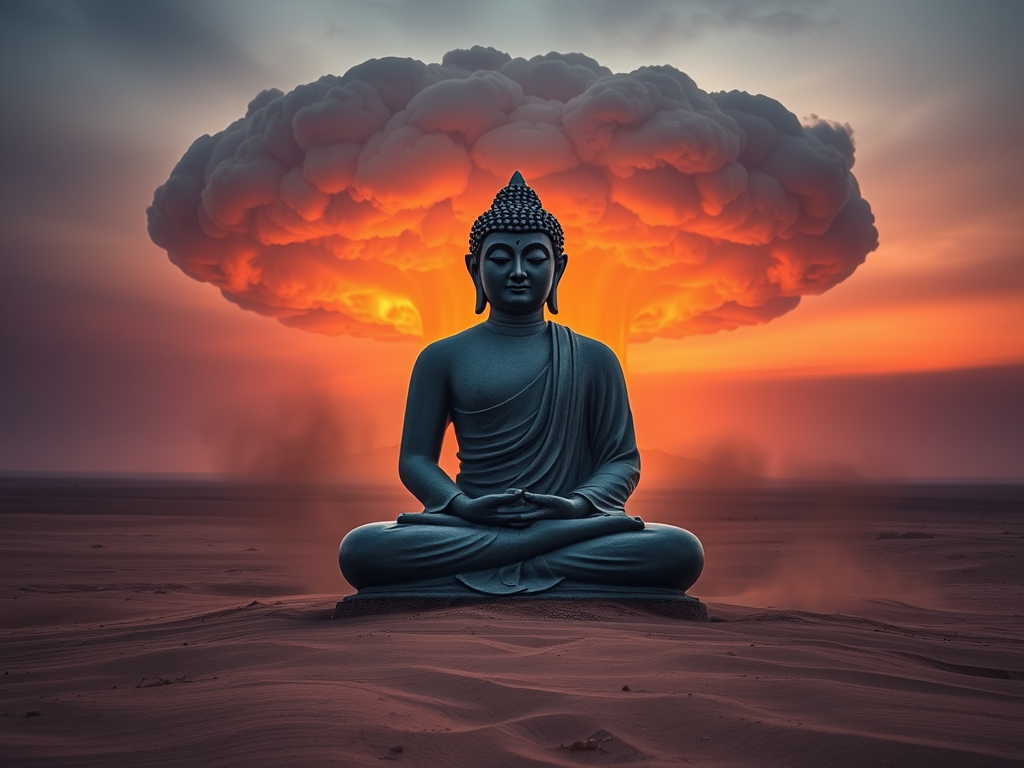

“The loudest explosions sometimes come from the quietest places.”
— From a note taped to the inside of Indira Gandhi’s file cabinet, 1974 (possibly apocryphal)
Bhola was wiping down the globe in my study—the one that still shows the USSR in red and Ceylon instead of Sri Lanka—when he asked, “Sir, did India ever try to surprise the world?”
I smiled. “Once. And it worked so well, even the Americans didn’t hear it coming.”
He blinked. “Which surprise?”
“The one that went boom, Bhola. Right in the middle of the Thar desert. May 18th, 1974.”
Let me take you there.
The Desert Blooms
In the blistering heat of Pokhran, Rajasthan, an unusual stillness hung over a fenced-off patch of earth. The sand shimmered. The birds, perhaps sensing something ancient and wrong, stayed away. Buried beneath, silently waiting, was India’s first nuclear device—code-named Smiling Buddha. A poetic name, if not a little ironic. Because this Buddha was not meditating. He was about to awaken.
At exactly 8:05 a.m., the earth shook.
For the first time, India had joined the nuclear club—not by invitation, but by sheer strategic will. The smiling, serene Buddha atop the explosion’s paperwork now carried a different kind of enlightenment.
But how did this come to pass?
A History Written in Ashes
India had witnessed the horror of Hiroshima and Nagasaki just like the rest of the world. But for a newly independent nation in 1947, nuclear capability was, at best, a distant scientific dream—something for the superpowers to quarrel about.
Jawaharlal Nehru, ever the philosopher, called nuclear weapons “evil,” but still authorized the peaceful development of atomic energy. A classic Nehruvian tightrope: abhor violence, but prepare for it. Under his watch, the Atomic Energy Commission was formed, with the formidable Homi J. Bhabha at its helm—a man who could recite Sanskrit poetry as easily as he could sketch a nuclear reactor.
Bhabha dreamed big. He envisioned a three-stage nuclear program that would one day make India self-reliant in nuclear power—without ever needing foreign uranium. But he also understood the geopolitics: the “peaceful atom” was always a few turns of the screwdriver away from a bomb.
His sudden death in a mysterious 1966 plane crash (conspiracy theorists still whisper “CIA sabotage”) was a blow—but not the end.
The Trigger: 1971
If Bhabha was the mind, Indira Gandhi was the will.
The 1971 Indo-Pak war—especially the American fleet moving into the Bay of Bengal during Bangladesh’s liberation—was a sobering lesson for India. Washington had backed Pakistan, Beijing had grumbled darkly, and India realized that moral high ground doesn’t deflect aircraft carriers.
So Indira decided it was time to develop a “peaceful nuclear explosive.” The phrase was, of course, a diplomatic fig leaf. The Buddha might smile, but he had teeth now.
How to Build a Bomb in Plain Sight
Here’s where the story becomes deliciously improbable. Because India didn’t just build a bomb—it built it without tipping off the most powerful intelligence agency on Earth.
The CIA, at the time, believed it had eyes everywhere. Spy satellites, double agents, intercepted cables. And yet, Smiling Buddha went off under their nose like a firecracker at a surveillance convention.
How?
Three reasons: secrecy, compartmentalization, and chai.
Yes, chai. But let’s start with secrecy.
The operation was codenamed “Operation Smiling Buddha.” Only a handful of people—perhaps less than 75 across the entire Indian state apparatus—knew what was truly going on. The Prime Minister’s file on the test was kept in her personal custody. Not even some of her own ministers were fully in the loop.
The nuclear device itself was developed at the Bhabha Atomic Research Centre (BARC), under the direction of Raja Ramanna, a man who could discuss neutron reflectors and raag Darbari with equal flair. His team worked mostly at night, under fake project names, using parts sourced from entirely “civilian” programs.
Then came the compartmentalization. No one person outside the top circle knew the whole picture. Components were tested separately, paperwork was kept deliberately vague, and military personnel working on logistics were told they were preparing for a “high-yield explosive trial.” Which, technically, wasn’t a lie.
Finally—chai. Or rather, Indian informality. American surveillance worked best when operations followed protocols. India, famously, did not. People met at roadside dhabas. Test materials were shipped in plain trucks. Even the shaft that housed the bomb—codenamed White House (a cheeky touch, that)—was drilled under the guise of a seismic research study.
At one point, a sandstorm delayed a key convoy. There was talk of postponing the test. One truck went missing for three hours and was later found parked under a khejri tree—the driver had wandered off in search of water.
And in a drab office in Langley, one analyst did raise a quiet alarm. A spike in BARC logistics, unusual military movement near Jaisalmer. His memo, according to legend, was buried under a larger report—on India’s rice export subsidies.
Bhola says that if the CIA had simply stationed a retired Indian uncle at a Jodhpur chai stall, they might’ve known everything months earlier.
The Blast Heard Around the World
On May 18th, the device was detonated. The yield: around 8 kilotons. Not enormous by Cold War standards, but enough to send shockwaves through the diplomatic world.
Indira Gandhi’s government didn’t gloat—but neither did it downplay. They called it a “peaceful nuclear explosion,” echoing language America itself had once used to justify similar tests.
The Americans were furious. How had they missed it?
One CIA memo from June 1974 reportedly described it as “a catastrophic failure of surveillance”—and some even blamed analysts who had considered India too “chaotic” and “transparent” to hide something so big.
Meanwhile, back in India, newspapers carried jubilant headlines. Some showed Buddha statues with mushroom clouds behind them. (Bhola still swears he saw one where the Buddha was wearing Ray-Bans.)
Fallout—Political, Not Radioactive
The test reshaped the global order. The Nuclear Non-Proliferation Treaty (NPT), already a controversial club of “haves” and “have-nots,” now had an unexpected gatecrasher.
India refused to sign the NPT, calling it discriminatory. It wanted recognition not as a rogue actor but as a sovereign nation asserting its strategic autonomy. That argument still echoes today in international forums.
But Smiling Buddha had another effect—it provoked. Pakistan’s then-Prime Minister, Zulfikar Ali Bhutto, famously vowed, “We will eat grass, but we will get the bomb.” And so began the South Asian arms race.
Beneath the Cloud, A Prayer
Somewhere in Bombay, a young technician watched the sky and whispered a prayer—for his daughter, for the future, for peace. He had spent months building a switch he hoped would never be used again. As the shockwave reached his lab’s instruments, he closed his eyes. The numbers were perfect. The future? Still uncertain.
The Quiet Legacy
Today, India sits at the table of nuclear-armed states—not with bravado, but with a quiet understanding of the responsibility it carries. No Indian government since has shown the same willingness to test again, preferring strategic ambiguity and no-first-use policies.
But May 1974 remains a moment of remarkable ingenuity. A moment when a newly independent country, battered by war and dismissed by superpowers, decided to show the world that it wasn’t to be underestimated.
All without firing a shot.
Postscript
Bhola just poked his head in. “Sir, you’re not going to write a book called The Smiling Bomb, are you?”
“No, Bhola. But I might just tell the story again over dinner. It tastes better that way.”
The Buddha may have smiled.
But the world, from that day, listened a little differently.
Fifty years later, that echo still shapes every room India walks into.
🌐 Related Reading
• Cartography’s Oddities: The Case of Two Moons Above India
• Absurdity and Espionage: Failed CIA Plots Against Castro
• Discover Fermented Foods for Gut Health
• Synesthesia: When You Can Taste Colors
• Magnesium: The Hidden Key to Combatting Anxiety
We’d love to hear your thoughts. Let’s chat below!