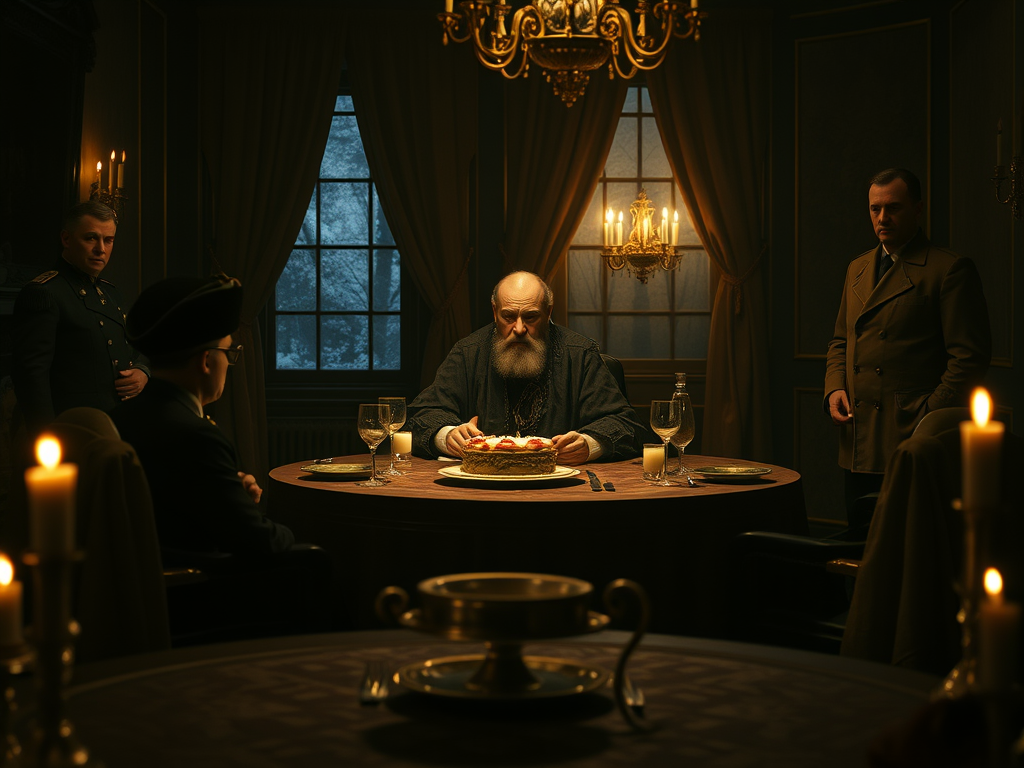

“This man must die, or Russia will perish.”
—Prince Felix Yusupov
History often hides its loudest echoes in the margins of its grandest headlines. And few stories echo more strangely than the night Rasputin died—or rather, refused to die. It’s a tale soaked in poison, gunpowder, aristocratic panic, and possibly, a shadowy intervention by British spies. If this wasn’t a history lesson, I’d call it a Bond film written by Dostoevsky.
Let’s begin in imperial Russia, 1916—a country unraveling.
🍷 The Mad Monk and the Tsarina’s Ear
Grigori Rasputin was not a monk in the traditional sense. He wore robes, yes, but also reeked of fermented honey and scandal. A Siberian peasant turned mystic, Rasputin wormed his way into the Romanov court by doing something no doctor in Europe could: easing the hemophilic pain of Tsarevich Alexei, the heir to the Russian throne.
Was it hypnosis? Herbal concoctions? Or, as Bhola once said when I described Rasputin’s methods, “Maybe the child just got better because the others stopped poking him with royal needles.”
Regardless, Rasputin gained the unshakable trust of Tsarina Alexandra. To Russia’s nobility, this was intolerable. Here was a bearded peasant influencing foreign policy, whispering into the ear of the Empress while ministers were dismissed like chess pawns.
The elite wanted him gone. And by “gone,” they didn’t mean reassigned to Siberia. They meant dead.
🏰 A Plot Brews in a Palace Basement
Enter Prince Felix Yusupov, heir to one of Russia’s richest families, husband to Tsar Nicholas II’s niece, and—crucially—a man who considered Rasputin a direct threat to the empire’s survival. In late December 1916, Yusupov and a band of aristocratic conspirators invited Rasputin to the Moika Palace under the pretext of a midnight snack.
Bhola once asked, “Why would a man accept a dinner invite from those who hate him?”
To which I replied, “Because when you believe God is on your side, you stop checking who’s in the kitchen.”
☠️ Cyanide, Cakes, and Confusion
Rasputin was served cakes and wine laced with enough potassium cyanide to kill several men. And yet—he smiled, ate, and asked for more.
Now here’s where our story starts slipping into the surreal. According to Yusupov, Rasputin showed no signs of poisoning. Was the cyanide neutralized by baking? Did Yusupov lie to dramatize the tale? Or—one theory claims—the cyanide was swapped for harmless powder by a co-conspirator who balked at murder.
When poison failed, Yusupov did what any desperate noble might: he shot Rasputin in the chest.
Rasputin collapsed. The assassins celebrated.
But then—cue horror movie music—he stirred.
🧟♂️ The Monk That Wouldn’t Die
Accounts differ, but Yusupov later claimed Rasputin rose, staggered out into the courtyard, and had to be shot again. And again. One bullet even entered his forehead at close range.
Finally, they wrapped his body in a carpet and tossed him into the frozen Neva River. An autopsy later revealed water in his lungs—suggesting he was still breathing when he went in.
Now, the historian in me must pause here.
Much of this narrative comes from Yusupov’s memoirs—written after the Revolution when embellishment was safer than accuracy. But even if half of it is fiction, the question remains: why did they fear Rasputin so much? And why the overkill?
Here’s where it gets murky. And fascinating.
🎩 Enter British Intelligence: From Empire to Espionage
Buried in the British archives—specifically a 1969 letter from intelligence officer Stephen Alley referencing Oswald Rayner—lies the shadowy testimony that raises the plot from domestic drama to global intrigue.
Rayner had links to the conspirators. He was close friends with Yusupov. He dined with him. He stayed at Moika Palace days before the murder. And some reports—carefully redacted—suggest he may have been present during the assassination.
Why would Britain care about Rasputin?
Because Rasputin was pushing for peace with Germany.
And if Russia exited World War I early, it would free up German troops to slaughter British forces on the Western Front. A prolonged Russian engagement was vital to the Allied war strategy.
According to certain declassified files, British intelligence may have encouraged the assassination—or, if you believe the more dramatic claims, carried it out directly.
🕵️ The Smoking Gun (Quite Literally)
One detail stands out like an oil smudge on a royal document: the fatal shot to Rasputin’s head may not have matched the caliber of the gun Yusupov claimed to use.
British sidearms, however, did match.
Even Bhola, who usually rolls his eyes at my spy theories, said, “That’s either a coincidence or the laziest murder cover-up in royal history.”
Some authors argue that Rayner himself fired the final shot. Others suggest he merely provided the pistol. Either way, British fingerprints linger.
This wasn’t just a panicked Russian nobleman’s plot. It was a geopolitical chess move.
📜 Folklore, Fog, and the Fallout
Russian legends immortalized Rasputin’s death as a kind of supernatural tale—the mad monk who defied poison and bullets. He became both a martyr and a monster. Folk ballads called him “the devil priest who could not die,” while others saw in him the last gasp of a dying monarchy clinging to spiritual talismans.
But behind the myth lies a tragic truth.
His murder did nothing to save the Romanovs. Within two years, the entire imperial family was executed by Bolsheviks. The aristocrats who killed Rasputin were exiled, their estates seized, their legacies smeared.
And Britain?
Well, Russia stayed in the war—just long enough for Britain to hold the line in France. Then came revolution.
Whether Rayner pulled the trigger or merely whispered encouragement, Rasputin’s death bought Britain time—and blood—on the Western Front.
🧾 History or Theatre?
Every time I tell this story in class, someone inevitably asks: “Do you believe Rasputin was killed by British spies?”
And I say this:
While some historians still debate the depth of British involvement, growing scholarly consensus agrees their fingerprints are hard to ignore. But if it walks like a duck, sounds like a duck, and carries a Webley revolver…
History is rarely black and white. It’s sepia-toned and water-stained. Motives blur. Memoirs lie. Autopsies omit.
But the idea that a strange mystic’s death in a frozen courtyard echoed in the trenches of France? That’s not fantasy. That’s history doing what it always does: showing us how far the ripples travel.
🛎️ Final Footnote
Bhola, ever the realist, muttered, “So basically, MI6 had Rasputin on their to-do list before Bond was even born.”
I just smiled. “Exactly. And no martinis needed.”
Dear reader, if this tale made you glance twice at the quiet footnotes of empires, do leave a like—or pass it along to that one friend who thinks history is boring. Remind them: the past isn’t past. It’s just badly archived.
And as always, if you have your own favorite tangled tale from history—an unsolved death, a diplomatic blunder, a missing jewel—send it my way. Who knows? Bhola and I might just dig into it next week.
☠️ Related Reading
• The Shortest War: Lessons from the Anglo-Zanzibar Conflict
• Understanding the Mandela Effect: Memories and Reality
• The Fall and Rise of Cleopatra VII: The Woman Who Played Rome
• Absurdity and Espionage: Failed CIA Plots Against Castro
• Did Ashoka Really Renounce Violence Overnight?

We’d love to hear your thoughts. Let’s chat below!