
The First Language We Ever Spoke
When my niece Chinni was born, the first thing she responded to wasn’t a word—it was my mother’s hands.
I still remember watching Amma gently stroke her tiny back in rhythmic circles, and like a magic switch, the baby stopped crying. That was when I realized: touch is our first language, and perhaps our most enduring one.
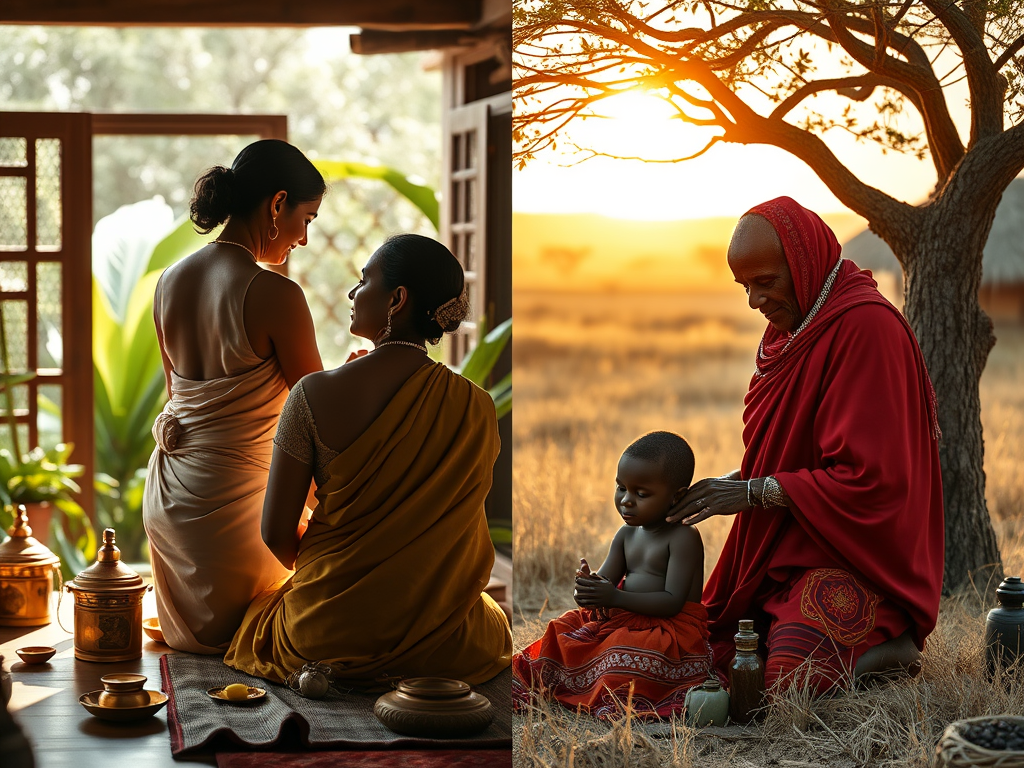
From the steaming oil massages of Kerala to the rhythmic hand presses of the Maasai in Kenya, cultures across the globe have preserved this silent grammar of healing.
But touch is not just comfort.
It’s code—a biological, cultural, and emotional lexicon we are only beginning to re-translate.
🌿 Kerala: Ayurvedic Massage as Healing Ritual
In Kerala, the tradition of abhyanga—the Ayurvedic oil massage—isn’t just a treatment. It’s a philosophy poured into practice.
Every movement of the masseuse’s hands carries centuries of knowledge:
- where the marma (energy points) lie,
- how to coax circulation without agitation,
- when to use cooling oils like coconut and when to bring in warming sesame.
But what struck me most during my training in Thrissur wasn’t the technique—it was the intent.
“Massage,” said my teacher, “isn’t about fixing. It’s about remembering.”
And it’s true. As warm hands move across tense shoulders or aching feet, the body begins to remember its own capacity to heal.
Muscles unclench.
Breath deepens.
Thought slows.
It’s as if the nervous system itself bows down in gratitude.
Modern science agrees.
A study from the University of Miami’s Touch Research Institute found that massage not only lowers cortisol (the stress hormone) but boosts serotonin and dopamine—our body’s natural mood elevators [1].
But here’s the twist: while we’re busy scanning barcodes of essential oils in high-end spas, we forget that this wisdom was never meant to be commercial.
It was communal.
In Kerala, abhyanga is often performed at home—by mothers, grandmothers, and sometimes by entire communities during pre-wedding rituals or postpartum care.
Touch, in that context, wasn’t bought.
It was given.
Freely.
Sacredly.
🌍 Kenya: Communal Massage and Ancestral Care
Several years ago, during a research exchange in Nairobi, I spent time with a healer from the Kikuyu community.
His hands—strong yet soft—moved across the backs of villagers with a rhythm I recognized. Not from Ayurveda, but from instinct.
Here, too, massage wasn’t isolated to the clinical.
It was embedded into the social fabric.
- Children were massaged daily to boost immunity.
- Pregnant women were massaged to align posture and spirit.
- The elderly received massage not as luxury but as remembrance—that their bodies still mattered.
I remember asking him, “How did you learn this?”
He laughed,
“From watching. And from listening—not with ears, but with my hands.”
Isn’t that beautiful?
Listening with hands.
Neurologically, this isn’t poetic fluff.
Touch activates the insular cortex—the same area that lights up when we process empathy and self-awareness.
When you press gently into someone’s tense neck, you’re not just easing muscle—you’re signaling safety.
You’re telling the body:
“You are not alone.”
🇹🇭 Thailand: Nuad Thai and Spiritual Bodywork
Across Southeast Asia, touch takes on a different rhythm. In Thailand, Nuad Thai—traditional Thai massage—is both an art and a spiritual discipline.
Unlike the oil-rich massages of India, Nuad Thai is performed fully clothed, on a mat, with no oils at all. The practitioner uses palms, thumbs, elbows, and even knees in a slow, meditative sequence of pressure and stretch. It’s been called “lazy man’s yoga,” but in truth, it’s a form of body prayer.
Rooted in Buddhist philosophy and influenced by Ayurveda and Chinese medicine, it works on Sen lines—channels believed to carry life energy. A skilled Thai masseuse doesn’t just ease muscle tension; she helps restore energetic harmony.
It’s no surprise that Nuad Thai has been recognized by UNESCO as a cultural treasure. It’s precise, mindful, and deeply human.
🌐 A Universal Language with Many Dialects
This language of touch doesn’t belong to any one culture. It speaks softly in many dialects—across continents and generations.
In the Philippines, Hilot is a diagnostic massage passed through generations of folk healers, who balance the body’s internal “hot and cold” using skilled touch and herbal oils.
In China, Tui Na presses into muscles along energetic meridians to move Qi—vital life force. In Japan, Shiatsu uses finger pressure on precise points to restore emotional and physical balance.
In Hawai’i, Lomi Lomi is a flowing, wave-like touch meant to integrate body, mind, and spirit. And in West Africa, deep herbal-infused bodywork passed down through families still serves as sacred healing touch.
I haven’t studied all these systems. But in each of them, I recognize the same ancient truth:
touch, when given with presence and love, becomes medicine.
🧠 The Neurobiology of Nurture
Let’s detour for a moment into the brain.
Researchers have identified a specific set of nerve fibers called C-tactile afferents, found in hairy skin. These fibers are uniquely tuned to gentle, caressing touch—and they respond not to pressure, but to affection.
In other words, the body can tell when it’s being cared for.
And it responds.
Studies in Sweden have shown that this kind of touch activates the brain’s social bonding centers, not just the somatosensory cortex [2].
It’s the same circuitry that fires when we feel loved.
And this isn’t limited to babies or couples.
Elderly patients with dementia, autistic children, trauma survivors—all show improved markers of calm, connection, and even cognition after consistent therapeutic touch.
Massage, then, isn’t simply a treatment for the body.
It’s a conversation with the soul, written in skin.
🧴 But What About the Oils, Asha?
Ah yes, the oils.
Mr. Raghavan, my neighborhood spice and oil vendor in Pune, swears by mustard oil for winter.
“It wakes up the bones,” he says.
But come summer, he switches to coconut:
“Cool as the moon.”
While his reasoning is poetic, it’s also scientific:
- Mustard oil contains allyl isothiocyanate—a compound that stimulates blood flow and provides warmth.
- Coconut oil, rich in lauric acid, has anti-inflammatory and antimicrobial properties—perfect for soothing heat rashes and fungal skin conditions.
In Kenya, I saw similar wisdom.
The Maasai use a handmade blend of animal fat and herbal ash—a combination that:
- protects from sunburn,
- heals wounds,
- and, believe it or not, repels insects.
Different continents. Same logic.
Oils are not just mediums—they are messengers.
They carry:
- the intent of the healer,
- the memory of the land,
- and the chemistry of comfort.
🌐 Touch in a Touchless World
Post-pandemic, something odd happened.
We began craving hugs like we once craved sugar.
Elbow bumps and Zoom waves couldn’t substitute the primal affirmation of a warm clasp or a mother’s palm on your forehead.
Isolation showed us what absence of touch feels like—and how deeply we depend on it for:
- regulation,
- bonding,
- and resilience.
Even in tech-forward spaces like Japan, where social touch is limited, innovations like HuggyBots—robots designed to mimic human embrace—are being explored to combat loneliness.
Isn’t that a little heartbreaking?
That we have to simulate touch, when for centuries, it was the most natural medicine?
🧘🏽♀️ A Challenge, a Ritual, a Return
So here’s my invitation.
This week, choose one moment—just one—where you use touch consciously.
- Maybe it’s massaging your own feet before bed.
- Maybe it’s applying oil to your child’s hair with reverence.
- Or maybe it’s simply holding someone’s hand longer than usual, letting your palm say what words cannot.
Ask yourself:
“What language am I speaking through my hands?”
Because from Kerala to Kenya, from Chiang Mai to the Cordilleras, we’ve always known:
Touch is not secondary. It’s sacred.
💬 Share Your Story
Did something in this article stir a memory or insight?
Maybe a ritual your grandmother taught you or a healing touch you once received?
Share it below—or pass this article along.
Wellness grows when stories are shared.
And if your grandmother had a ritual of touch, tell us.
Because in this scattered world, shared memory is medicine too.
🔍 References
[1] Field, Tiffany. Massage therapy effects. International Journal of Neuroscience, 2002.
[2] McGlone, F. et al. Discriminative and affective touch: Sensing and feeling. Neuron, 2014.
🌿 Related Reading
• Discover Fermented Foods for Gut Health
• A Day in the Life of a Mayfly
• Magnesium: The Hidden Key to Combatting Anxiety
• Can We Heal Anxiety with Ritual?
• Why the Mongols’ Diet Terrified Their Enemies
We’d love to hear your thoughts. Let’s chat below!