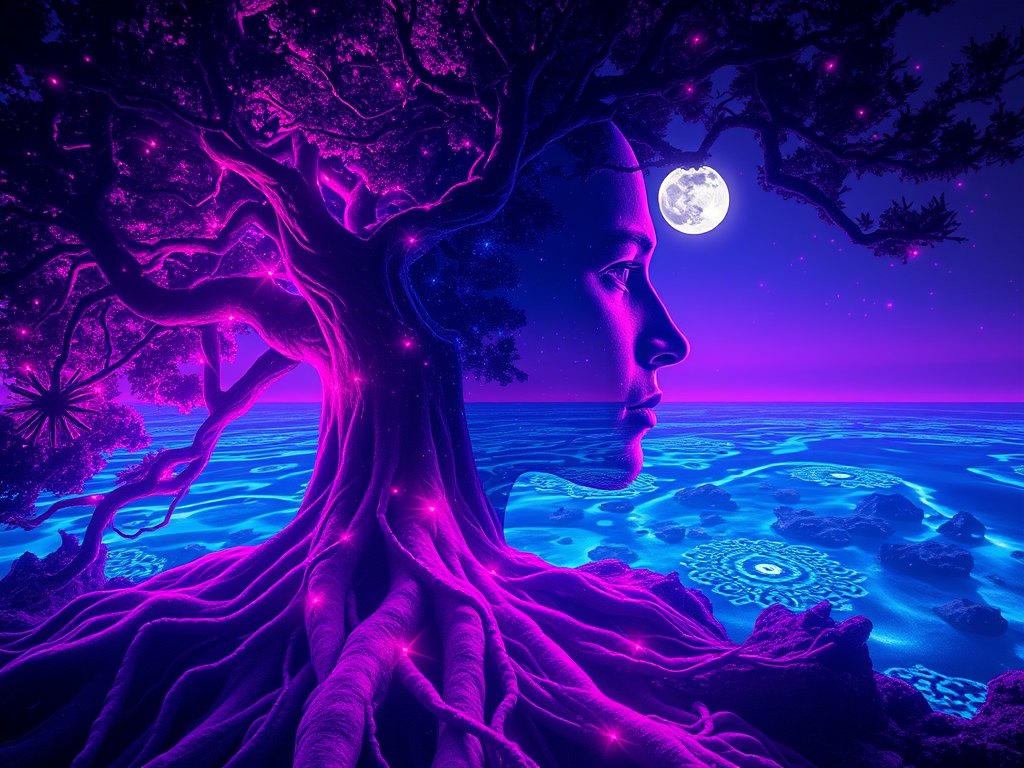

From RNA Whispers to Ancestral Echoes
Last week, while sorting through the dusty old trunk in my ajji’s attic (the one that smells of mothballs, turmeric, and time), I found something odd—a tiny shell with a neatly scribbled note:
“Found during school trip, 1963.”
It was my mother’s. She would’ve been just ten.
I sat there for a moment, holding that little shell in my palm. And something stirred.
Not just memory. Something deeper. A strange tug—as if a part of me remembered something it never lived.
It felt less like nostalgia—and more like inheritance.
But what is memory, really? A trace? A tether? A trick of biology—or something older?
And it got me wondering:
What if memory isn’t just stored in brains and neurons?
What if—wait for it—memory is older than the brain itself?
Sounds wild, I know.
But science, that sneaky storyteller, might just back me up.
🧠 Memory Without Minds?
When we think of memory, we think of neurons firing away, right?
Synapses forming, connections strengthening—like paths etched through a forest of thought.
But here’s the twist:
Creatures with no brains at all seem to “remember.”
Take slime molds.
Yep, those gooey, single-celled blobs that look like spilled rasam.
Scientists have shown they can navigate mazes, anticipate events, and avoid unpleasant conditions.
All this—without a nervous system.
Closer to home—literally, under your balcony tiles—planarian flatworms have made headlines.
Chop one in half (for science, boss—not at home!), and each half grows into a full worm.
But here’s the kicker:
If the original worm was trained to avoid light, the new ones remember that trick.
Even after regrowing their heads.
Wait, what?
Somehow, information survives outside the brain.
As if it’s encoded in the very molecules of life.
🔬 RNA: The Ancient Whisperer
That brings us to our prime suspect: RNA.
Think of RNA as DNA’s chatty cousin—the messenger who runs around cells, carrying instructions.
But new research suggests RNA might be more than a postman.
It might be a librarian of memory.
In one jaw-dropping 2018 experiment, scientists at UCLA transferred RNA from trained sea slugs into untrained ones.
The recipient slugs responded to stimuli as if they had the same memories.
Let me repeat that:
They injected memory-like behavior—using RNA.
And here’s the part that haunts researchers:
No one fully understands how the RNA carried those memories.
The mechanism is still elusive.
As if memory—like language or love—refuses to reveal all its blueprints.
This isn’t Hogwarts.
It’s molecular biology.
And it raises dizzying questions:
Can memories be encoded chemically?
Could we one day “upload” them?
Or… have we been doing that all along, just very, very slowly?
🧬 Inheritance Beyond Genes
You’ve probably heard of DNA—our biological blueprint.
But there’s a quieter player: epigenetics.
Think of DNA as a cookbook.
Epigenetics decides which recipes get cooked and when.
Sometimes, trauma, stress, or even diet can leave tiny chemical bookmarks on this cookbook.
Bookmarks that can be passed on.
One study found that male mice trained to fear a certain smell passed on that fear to their pups and grandpups—
Even though they never encountered the smell themselves.
The scent? Acetophenone.
Smells like almonds. Or, perhaps, legacy.
Could our ancestors’ memories—of war, famine, migration—
Echo in our preferences, our fears, even our dreams?
Across the Pacific, Polynesian navigators speak of ‘te lapa’—
Flashes of memory-light guiding them across oceans.
Not taught. Felt.
Passed not through lessons, but lineage.
And if so…
How many of our emotions are really ours?
🚦 What Bangalore Streets Taught Me
Okay, time for a detour.
Ameen Bhai, my favorite auto driver, once told me—
While we were stuck near Majestic in a traffic jam that smelled like exhaust and roasted peanuts—
That he always knows when it’s going to rain.
“The ants tell me,” he said, pointing to a crack in the sidewalk where ants marched with unusual urgency.
“Arre, even they remember last week’s flooding,” he laughed.
We chuckled, but I kept thinking:
Do ants remember?
Or is memory somehow embedded in the system—
In chemical trails, environmental cues, inherited responses?
In a way, Ameen Bhai had a point.
Memory might not be locked inside heads at all.
It might be distributed—across generations, molecules, even colonies.
🌊 Stories in Our Cells
Ravi Uncle, my retired physics-neighbor with the ever-folded newspaper and the perpetually leaking pen, once told me something strange about coral polyps.
“Did you know,” he said, while sipping his third coffee,
“that some coral colonies are thousands of years old?
They grow and die, one polyp at a time—but the structure remembers.”
The living tips build upon the skeletons of the dead.
Architecture as memory.
Trees, too.
Some studies show trees remember past droughts and adjust their root systems accordingly.
Not conscious memory, of course—but a kind of slow, embodied wisdom.
And isn’t that what memory really is?
Not just recall, but adaptation.
Learning. Persistence.
🧩 Memory Is a Pattern, Not a Place
What if we’ve been looking at memory all wrong?
We assume it lives somewhere—in a brain region, a neuron, a synapse.
But perhaps memory is not a place at all.
Maybe it’s a pattern.
A rhythm encoded in molecules.
A trace etched into proteins.
A behavior passed through generations.
A shift in the way a plant folds its leaves at dusk.
Shalini, my bright-eyed 12-year-old from science club, once said:
“Akka, memory is like those rangoli designs that keep changing but use the same white powder.”
I swear, I nearly dropped my dosa in awe.
What if every living thing is part library, part echo chamber—
Remembering not just for itself, but for everything that came before it?
Maybe she’s right.
🕯️ Then What Are We Remembering?
This all raises a quietly thrilling question:
When you feel a tug at the sight of an old banyan tree…
Or a chill when someone calls your name in a certain tone…
Or dream of oceans you’ve never seen—
Are you remembering something… or someone?
Could there be imprints in our cells—
Echoes of moments that weren’t ours but were left for us to carry?
Not in a mystical, reincarnated soul kind of way (though who am I to say?),
But in the very real, very biological sense of inherited patterns and molecular echoes.
🔁 So What Now?
If memory can exist without brains…
If RNA can whisper across species…
If trauma can leave bookmarks in sperm and egg…
Then maybe we’re more than individuals.
Maybe we’re living libraries—
Walking tapestries woven from the lives of countless creatures before us.
You, reading this, might carry whispers of an ancestor who survived a flood.
Or who learned which plants to eat.
Or who simply loved the sound of monsoon rain on clay roofs.
Maybe memory was never just about recall.
Maybe it’s how life remembers itself.
Not to preserve the past, but to continue it.
🌱 Final Thought
Next time you find yourself crying at a song you don’t understand…
Or dreaming of oceans you’ve never seen…
Or touched by a kindness that feels strangely familiar—
Maybe you’re not just remembering.
Maybe you’re continuing something ancient.
A memory not stored in neurons,
But in salt.
In seed.
In story.
🧠 Related Reading
• Black Holes: The Universe’s Recycling Bins
• Why Butterflies Remember Being Caterpillars
• How Would We Handle a First Contact with an Alien Civilization?
• Understanding the Mandela Effect: Memories and Reality
• The End of Death: Digital Afterlives and Memory Forever
We’d love to hear your thoughts. Let’s chat below!