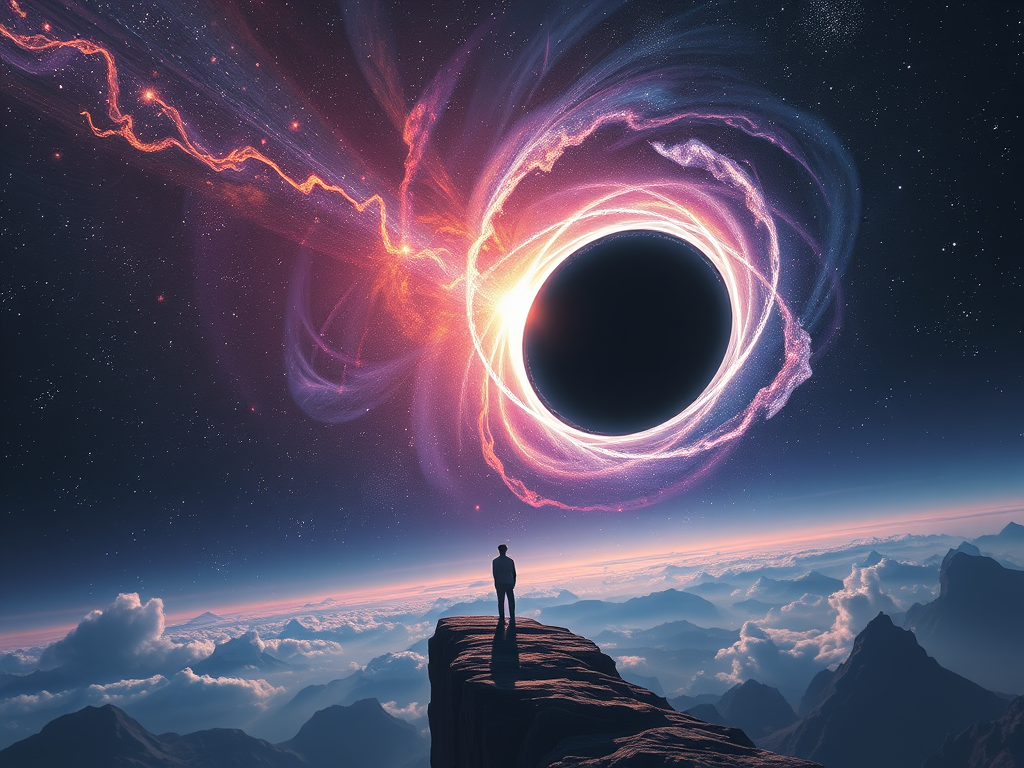

A poetic exploration of entropy, memory, and why the darkest places in the cosmos might be where stories begin again.
☕ Chai, AI, and a Black Hole Whisper
Somewhere between my third cup of Ambili Chechi’s cardamom chai and Rakesh’s latest rant about AI alignment, a random headline slipped through my brain:
“Stephen Hawking once said black holes might not be black.”
That’s the kind of sentence that grabs you by the collar and whispers,
“You’re not ready for what I’m about to say.”
And it got me thinking—not about the color, but the purpose.
Everyone keeps asking what black holes destroy.
But what if we’ve been asking the wrong question?
What if black holes don’t just erase stuff—they repurpose it?
Could they be, in some wildly cosmic way… the universe’s recycling bins?
🕳️ The Cosmic Shredder—or So We Thought
We’ve long treated black holes like the trash compactors of the cosmos.
Stars collapse under their own gravity.
Light, matter, time itself—swallowed whole.
Nothing escapes, not even information.
At least, that’s what we thought before Hawking radiation entered the party and kicked over everyone’s neat little models.
Stephen Hawking famously proposed that black holes emit tiny amounts of radiation, gradually losing mass until they evaporate entirely.
Wait—what? These things aren’t permanent death traps?
They’re more like extremely delayed pop rocks?
It gets weirder.
If black holes can slowly release radiation, then theoretically they’re not destroying information—they’re just making it really, really hard to recognize.
Kind of like grinding a love letter into powder and mixing it into the Arabian Sea.
The information might still be somewhere in the waves…
but good luck reconstructing the words.
🔍 Information Doesn’t Die—It Just Gets Weird
There’s a rule in quantum mechanics (yes, one of those) that says information can’t be destroyed.
You can change it, scatter it, compress it, entangle it—
but you can’t un-exist it.
So when we chuck entire stars into black holes, the universe has a bit of a legal problem.
It needs to keep the receipts.
This is the famous black hole information paradox.
And it’s not just a fun brain teaser—physicists have been arguing about it for decades like it’s a family recipe no one wrote down.
Some believe the information is stored on the event horizon—the edge of the black hole—in what’s called the holographic principle.
Like a crime scene chalk outline that captures only the edge of what was,
the surface of a black hole might preserve the full story of what fell inside—
even if the inside seems gone.
Think of it like the cosmic version of a QR code:
the information of everything that fell in is smeared on the surface,
waiting for some hypothetical god-tier scanner to decode it.
Others think the info is encoded in the Hawking radiation itself,
like a whisper escaping from the abyss.
And me?
I think Sukumar said it best last week when he shrugged at a broken fishing net and muttered,
“Some things come back different.”
📓 A Memory That Still Echoes
I once dropped my childhood diary into a well.
Pages inked with secrets, drawings, things I’ll never fully recall.
And yet, sometimes when I hear the sound of water,
it feels like some part of it survived—just not in the form I knew.
It isn’t lost. It’s changed.
🌱 Black Holes as Cosmic Composters
So what if black holes aren’t cosmic shredders, but cosmic composters?
You know, those stinky bins your eco-conscious neighbor keeps outside?
You toss in banana peels, old newspapers, dead leaves—
and weeks later, boom: rich, nutritious soil.
It doesn’t look like the original stuff, but it’s not gone.
It’s transformed.
Maybe black holes do the same.
They take old stars, broken physics, rogue photons,
memories of ancient civilizations (if we’re being dramatic)—
and they churn, collapse, compress, warp.
What comes out isn’t the same, but it’s not nothing either.
It isn’t lost. It’s changed.
Some theories suggest black holes might even birth new universes.
Picture this:
every black hole, deep inside its singularity, spawns a big bang of its own.
A new spacetime, with new rules, unfolding in a direction we can’t access.
If that’s true, then black holes aren’t just garbage bins—they’re wormholes to new realities.
Dimensional wombs, not tombs.
I mean, what if our own universe began inside a black hole in someone else’s?
Some physicists now believe black holes may not even have interiors.
That what we think of as “inside” is just a fold in the information on the surface.
If that’s true, then everything we fear disappearing
may never go anywhere at all.
Take a breath.
I’ll wait.
♻️ Entropy, Order, and the Strange Art of Reuse
Here’s where things get oddly poetic.
Entropy—the measure of disorder in a system—always increases, right?
That’s why eggs don’t un-crack and chai never reheats with the same taste.
The universe, we’re told, is on a one-way street to heat death.
But black holes? They mess with that story.
When something falls into a black hole, its entropy doesn’t disappear—
it gets encoded in the black hole’s surface area.
That’s wild.
It’s like saying the mess of your room isn’t gone,
it’s just compressed into the pattern of your wallpaper.
As if the universe, even at its most chaotic, refuses to forget—
even the mess has meaning, coded into the wallpaper of space.
It isn’t lost. It’s changed.
It makes me wonder—maybe the universe isn’t a careless artist flinging stars like paint.
Maybe it’s a meticulous recycler, always trying to reclaim, reorder, and remix its own materials.
Like a DJ with only one playlist but infinite remixes.
🔄 Looping Universes and Bouncing Realities
Let’s take this one step further.
There’s a branch of cosmology that suggests our universe didn’t just begin with a bang—
it’s part of an endless cycle.
Expansion, contraction, bounce.
Over and over.
In this view, black holes could be the nodes—the “save points” between cycles.
They store the old data and feed it forward.
Like cosmic USB drives.
Or imagine this:
what if consciousness itself, in some abstract way, gets reprocessed through these nodes?
I’m not saying you’ll wake up remembering your past life as a quasar,
but if information never dies, maybe the patterns that define you—
your thoughts, your quirks, your quiet 3am fears—aren’t lost either.
Maybe they’re part of the compost too.
It isn’t lost. It’s changed.
It’s speculative, I know.
But hey, I’m not the only one playing in this sandbox.
Roger Penrose has toyed with conformal cyclic cosmology.
Lee Smolin dabbles with black hole-generated universes.
And somewhere, probably right now, some kid is scribbling their own theory
on a napkin in a dusty teashop in Kozhikode.
☕ The View from Ambili Chechi’s Chai Stall
I was halfway through this thought spiral
when Ambili Chechi handed me another cup, raising an eyebrow.
“Still thinking about those black holes, monay?”
I nodded.
She leaned in conspiratorially.
“Maybe the universe does recycle. Even people.
Just look at Sukumar. Third time he’s started fishing again this year.”
And I couldn’t help but laugh.
Because maybe that’s the secret—everything returns,
just not as we remember it.
Maybe we’re never ready for what black holes whisper.
But maybe that’s the point—
readiness is just another way of saying
“I haven’t broken enough yet to understand.”
🔁 So… Are They Recycling Bins?
Maybe.
Maybe black holes are where the universe stores its mysteries
until it’s ready to use them again.
Maybe they’re the engines of rebirth, not just the ends of stories.
Maybe they’re both—composters and shredders, graves and wombs.
Or maybe—like some great cosmic editor—
the black hole isn’t deleting your draft.
It’s just waiting for the rewrite.
If that thought sparked something—leave a like,
or pass it along to someone who still believes in cosmic second chances.
And if you’ve got your own theory about black holes, compost bins,
or the strange way the universe remembers—drop it in the comments.
Because hey—
maybe your idea is the next thing the universe wants to recycle.
🌿 Related Reading
• You Don’t Need a Supplement, You Need a Spice Cabinet
• How Elephants Remember Watering Holes
• Chaos in a Tuxedo: The Science and Seduction of Roulette
• The Face That Wasn’t Mine: Deepfakes and the Ghost of Memory
We’d love to hear your thoughts. Let’s chat below!