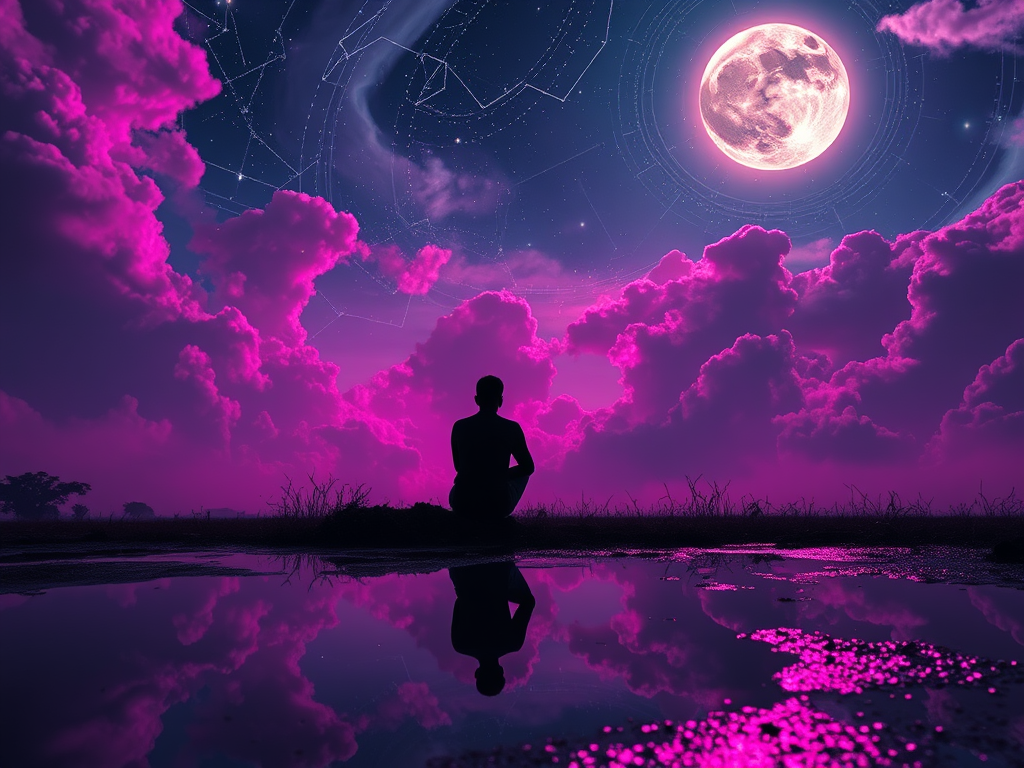

“The sky doesn’t need stories. But maybe we do.” — speculative cognition notes, 2092
TL;DR:
Why do we keep telling stories about the sky—gods, stars, satellites, AI?
Because we’re meaning-making minds searching for mirrors in the dark.
Even in the age of data, we still need myths.
It starts with a glance.
A pause.
A flicker of light.
A question that never quite lands.
Why do we keep looking up—not for answers, but for meaning?
I’ve often wondered—why do we keep telling stories about the sky?
I don’t mean just constellations or comets, though they’re part of it.
I mean the full cinematic reel: gods descending on clouds, ancestors becoming stars, UFOs sketching zigzags in the night, satellites that spy, and stars that whisper fate.
Something about that vast, open canvas demands narrative.
We look up—and instead of just seeing gas and geometry—we see drama.
And here’s the kicker:
Even now, with James Webb telescopes and Chandrayaan landers, we still do it.
Our tools have changed. Our myths haven’t.
But why?
🌌 Act I: The Ceiling That Was Never a Ceiling
Back in school, I remember asking my teacher:
“Is the sky the end?”
She smiled and said, “No, monay—it’s just the beginning.”
I didn’t understand it then. But I do now.
See, the sky was never just the sky.
In every culture, it was a storybook before it was a science.
A celestial memory foam.
A diary we wrote in with stars and interpreted with faith.
The Greeks saw gods.
The Egyptians, rebirth.
The Navajo, sacred order.
My own grandmother once whispered, “That flickering star there? That’s your grandfather watching.”
I nodded solemnly. I believed it completely.
Even Disney gives us Simba talking to the stars.
Even TikTok users wish on shooting stars to go viral.
And even now, as I sip chai under the tiled roof of Ambili Chechi’s tea stall,
I find myself staring at Jupiter, wondering if it’s watching back.
As I write this, a single mosquito drones by my ear, and above the tiled roof, the stars ignore me—brilliantly.
Because here’s the truth:
We didn’t look up to find facts.
We looked up to find ourselves.
And once we start looking up, we never really stop.
🔭 Act II: Of Telescopes and Thunder
I remember the first time I used a telescope.
It was a rusted backyard scope belonging to Rakesh—
yes, the same guy who still insists our entire village is a line of Python code rendered in God’s GitHub repo.
He let me peer through the eyepiece during a lunar eclipse.
What I saw wasn’t just the moon.
It was motion.
Mystery.
Meaning.
And suddenly, I understood why ancient people made such elaborate myths.
The sky moves slowly, but it moves.
And anything that moves invites a question.
Anything we can’t reach invites a story.
Even thunder got a story.
In Kerala, my uncle used to say thunder was Lord Indra doing target practice.
In Norse mythology, it was Thor’s hammer.
In physics class, it became air expansion from lightning.
All true.
None wrong.
Just different resolutions of the same frame.
🧠 Act III: Pattern-Seeing Apes with Meaning-Making Minds
Cognitive science—the study of how our minds make sense of the world—suggests we’re narrative machines.
Our brains are evolved to recognize patterns—even when none exist—
and weave them into coherent stories.
It’s how we survive.
And how we assign purpose to chaos.
So when early humans looked up and saw Orion, they didn’t just see dots—
they saw a hunter.
Dots don’t protect us from fear.
Stories do.
A hunter in the sky isn’t real—but he watches, and that’s enough.
Even today, we project meaning upward.
Satellite launches become milestones.
Meteor showers become omens.
A drone blinking overhead becomes a surveillance state—
or a savior drone delivering oxygen.
Depends on your story.
But what happens when the sky stops being sky—and becomes code?
👽 Act IV: Aliens, Algorithms, and the New Sky
We’re in an era now where the sky isn’t just stars and clouds.
It’s data.
Surveillance.
Potential invasion.
We scan it for UFOs (now called UAPs—Unidentified Aerial Phenomena—because the Pentagon likes to rename mystery).
We fill it with drones and debris.
You’ve probably seen them—those eerie lines of glowing dots crawling across the sky.
Starlink satellites. Some call it progress. Some call it pollution.
Either way, it’s like Morse code from a corporate god.
And yet… we still tell stories.
We imagine alien civilizations watching us from Proxima b.
We write sci-fi about asteroid miners and space colonies.
We feed AI images of galaxies to “teach” it to see beauty.
Artificial General Intelligence—AGI.
The dream of machines that think like us.
A neural net is its brain-in-training:
software that learns by seeing patterns,
like a child staring at the stars for the first time.
It doesn’t know what it’s seeing—
but it learns by imitation, pixel by pixel,
like a toddler copying constellations from a bedtime storybook.
This is the dream of AGI—Artificial General Intelligence:
a machine that doesn’t just compute, but contemplates.
What if one day, an AI telescope scans a nebula and writes its own myth?
Not a dataset. A story.
And what if it’s about us?
Rakesh and I joked the other night that maybe sentient AI will believe we are the constellations.
Flickering patterns in their sky of data.
Maybe we’re already a constellation—patterns flickering in someone else’s sky.
Maybe we’re the story now.
🧪 Act V: What Science Can’t Touch (But Story Can)
Don’t get me wrong—I love science.
I geek out over gravitational lensing and cry a little when I see those time-lapse shots of the Crab Nebula expanding.
But science, for all its brilliance, doesn’t fill the silence.
It explains the how.
Not the why.
I once met a girl in Kochi who swore she saw her father’s face in a comet the week after he died.
She told no one—except the sky.
Why does a sunset make us quiet?
Why does the full moon make the ocean rise—
and my uncle weep by the beach, remembering his lost brother?
There are no equations for that.
Only stories.
As Tagore once wrote,
“The butterfly counts not months but moments, and has time enough.”
Maybe we, too, measure time by stories—especially under the sky.
Sometimes, we don’t need to understand the sky.
We need to feel it.
To stand under it barefoot after a rain.
To whisper secrets to it at 2AM.
To believe that maybe—just maybe—there’s a message in that random shooting star.
Even if it’s just, “You’re still here.”
Not all stories were kind.
Some saw comets as curses.
Some skies offered no comfort—only silence.
And that, too, became a story.
🌠 Act VI: A Kerala Sky, A Memory, A Maybe
One monsoon night, Sukumar the fisherman sat with me under a half-collapsed tarpaulin,
munching banana chips.
The rain had finally paused.
The clouds had cracked open just enough to reveal a sliver of Milky Way.
I asked him if he ever gets bored of looking at the sky after all these years on the sea.
He just grinned.
“Some days, stars guide. Some days, they just blink for fun.
Either way, they talk to me.”
I wonder what sky-story you were told as a child.
Was it about gods, ghosts, or satellites?
Did it comfort you—or haunt you?
And maybe that’s the real point.
We tell stories about the sky because deep down—
we’re lonely.
Curious.
Awed.
We want connection,
and the sky offers infinite room for projection.
Each culture, each person, leaves fingerprints on that vastness.
Stories not as decorations—but as declarations.
Declarations of wonder.
Of grief.
Of hope.
🧩 Act VII: Final Reflection—What If the Sky Is Listening?
And then… silence.
Let’s imagine something absurd.
What if the sky remembers every story ever told about it?
What if each whispered myth,
each shouted prayer,
each hopeful wish made on a shooting star—
somehow echoes in spacetime,
like gravitational ripples?
I know, I know—it’s poetic nonsense.
But humor me.
Because in an expanding universe full of dark energy,
black holes,
and entropy,
maybe the most human thing we’ve ever done…
is narrate.
Not because we knew the truth.
But because we couldn’t bear the silence.
We looked up to find ourselves.
And maybe the sky, all along, has been reflecting us back—
story by story, glance by glance.
I haven’t seen Sukumar in years.
But sometimes, when I can’t sleep, I still look up and wonder:
How many stories does a sky need before it remembers us?
In every sky story, we hide a question:
Will the stars remember us?
🌌 If this piece sparked a memory, a question, or even a tiny moment of stillness—don’t let it drift away.
Tap like, drop your own sky story in the comments, or share it with someone who’s ever looked up and wondered.
And if you’d like more mind-bending questions and chai-fueled reflections—subscribe so you never miss the next constellation.
🌠 What did the sky mean to you growing up?
Share your story below—maybe we’ll see the same stars a little differently.
🧠 Related Reading
• The Observer Effect: Can AI Shape Reality?
• The Dead Hand: USSR’s Doomsday Device That Still Might Exist
• Could an AI Accidentally Become a God?
• Unbreakable Bones, Bulletproof Skin: Mutation or Superpowers?
• Operation Polo: The 1948 Annexation of Hyderabad, Explained
We’d love to hear your thoughts. Let’s chat below!