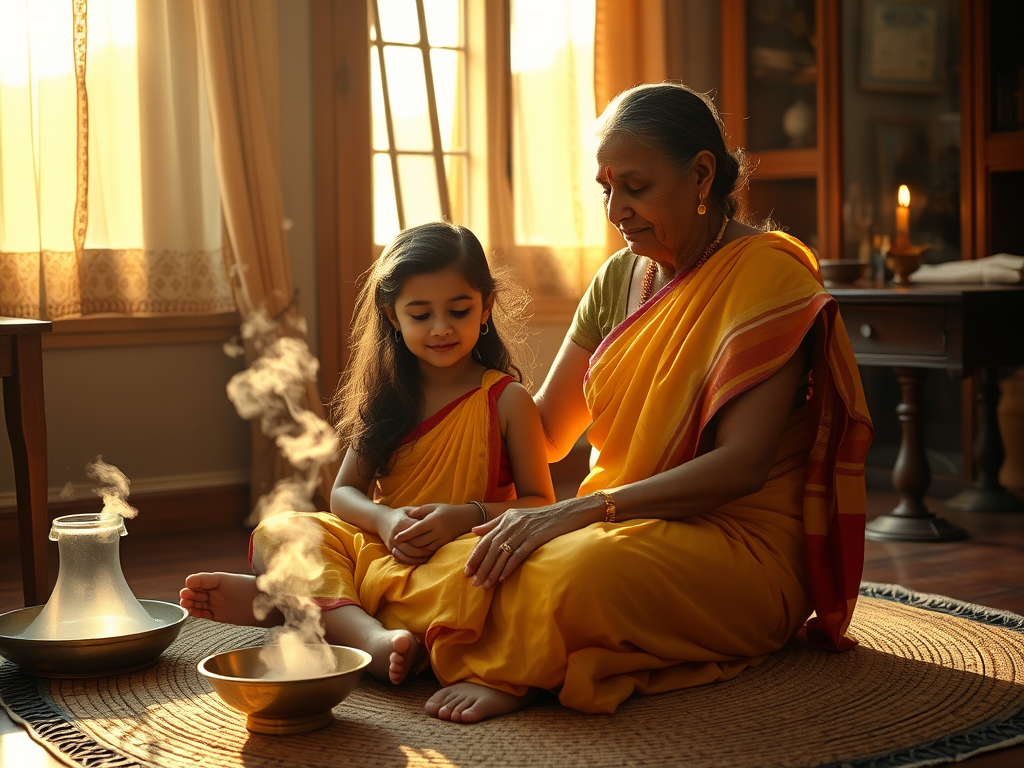

It always began the same way.
A slow creak of the cane chair, the scent of jasmine oil warming on the stove, and my grandmother’s voice, humming something between a lullaby and a prayer.
I’d sit cross-legged on the floor, hair unbraided, and she’d begin—long, slow strokes, her fingers mapping the landscape of my scalp like she was reading an old story written in oil.
“Close your eyes, Asha,” she’d say.
“This is not just for your hair. It’s for your heart, your mind… even your future children.”
Back then, I rolled my eyes. Now, I run clinical studies.
And lately, I’ve been asking the question she never needed to ask:
Does a hot oil hair massage actually promote healthy hair—or is it just another cozy placebo wrapped in nostalgia?
Let’s comb through the science, the stories, and the senses.
💆🏽♀️ Tradition in a Bottle
In Indian households, hair oiling isn’t a beauty ritual—it’s a birthright.
Coconut, sesame, amla, bhringraj, fenugreek, castor… each family has their own sacred recipe.
Some oils are sun-infused with herbs for 40 days, some are bought from the spice vendor’s cousin who swears by a “secret forest source.”
And the massage? It’s almost ritualistic.
Sometimes I’d peek into the other room and see Ma, eyes closed, head in Ammamma’s lap, as the same jasmine oil traced the same path.
But is there more to this tradition than memory and muscle?
🧬 The Biology of the Scalp
The scalp is richly vascular—meaning it has an abundance of blood vessels that feed the hair follicles oxygen and nutrients.
Studies suggest that gentle mechanical stimulation (read: massage) can increase blood flow to the scalp.
A 2016 study published in Eplasty found that just four minutes of daily scalp massage over 24 weeks significantly increased hair thickness in participants.
The proposed mechanism? Stretching of dermal papilla cells in the hair follicles, which may lead to gene expression associated with hair growth.
🌀 Hair Has a Natural Cycle
Hair itself follows a natural cycle with three primary phases:
- Anagen (growth)
- Catagen (transition)
- Telogen (rest and shedding)
Oils and massage may help prolong the anagen phase by improving follicle environment, reducing inflammation, and stimulating circulation.
A 2020 meta-review in Dermatologic Therapy found preliminary support for topical herbal oils in improving hair density and scalp health—especially in cases of telogen effluvium and age-related thinning.
Researchers noted a need for larger, placebo-controlled trials to confirm long-term efficacy.
Still, massage alone doesn’t tell the whole story.
🌴 The Oil Matters
Let’s talk about the stars of the show—the oils.
These aren’t just greasy fillers; they’re potent bioactive cocktails.
🥥 Coconut Oil
Backed by several peer-reviewed studies (including a pivotal one published in the Journal of Cosmetic Science), coconut oil is one of the few oils shown to penetrate the hair shaft.
Rich in lauric acid, it reduces protein loss in both damaged and undamaged hair.
🌿 Bhringraj (Eclipta alba)
Known in Ayurveda as “Kesharaja” or “King of Hair,” bhringraj has shown promising results in animal studies.
One 2009 study found it to be more effective than minoxidil in promoting hair growth in albino rats.
While human trials are limited, early clinical evidence hints at its ability to prolong the anagen phase and reduce shedding.
🍇 Amla (Indian Gooseberry)
Packed with vitamin C and antioxidants, amla is revered in both traditional medicine and cosmetic research for improving scalp health and reducing hair fall caused by oxidative stress.
💦 Castor Oil
High in ricinoleic acid, castor oil has anti-inflammatory and antimicrobial properties.
While direct hair growth evidence is sparse, one 2021 human trial published in the International Journal of Trichology found that castor oil helped reduce scalp dryness and breakage in 68% of participants over a 12-week period.
Together, these oils create a triple action:
Protect, nourish, and stimulate.
✋🏽 Warm Hands, Calm Mind
“Warm it first, beta,” my grandmother would say.
And science agrees.
Warm oil improves viscosity, making it easier to absorb—not just into the scalp but also into the strands.
But there’s more: the act of massage, the warmth, the scent—it engages the parasympathetic nervous system.
Translation: it calms you down.
Chronic stress is a known trigger for hair loss—specifically telogen effluvium, a condition where stress pushes hair prematurely into the shedding phase.
By triggering a relaxation response, oil massages may indirectly help retain more hair on your head and less in your comb.
And yes, Grandpa’s hair massage counted too—whether to strengthen roots or soothe a long day.
💡 Myth vs. Fact: Time for a Little Busting
Let’s debunk a few persistent myths:
“Oiling overnight is better than 30 minutes.”
❌ Not necessarily. Most penetration happens within the first hour. Leaving oil overnight can clog pores for some and lead to dandruff.
“Hair oiling prevents greying.”
🚫 No scientific evidence confirms this. Greying is primarily genetic and linked to the loss of melanin-producing cells.
“More oil = more growth.”
🙅🏽♀️ Excess oil can attract dirt, lead to fungal buildup, and even increase hair fall if not washed out properly.
Wisdom lies in balance—not in drowning your scalp in castor oil thick enough to patch a leaky boat.
🌍 A Global Ritual
India is not alone in its oiling heritage.
The Fijians use dilo oil, the Ethiopians swear by black seed oil, and Moroccan women have passed down argan oil rituals for centuries.
Even in modern Japanese beauty routines, the “head spa”—a deep scalp cleanse and oil massage—is a coveted practice that blends Shiatsu pressure points with botanical oils.
There’s something almost universal about humans rubbing oils into their heads.
Maybe it’s because somewhere deep down, we all remember—
Healing often begins at the root.
🧪 What About Modern Alternatives?
Today’s shelves are lined with serums, ampoules, and silicone-laced glosses. These have their place.
While modern serums seal the hair shaft with silicone-based films that offer instant smoothness, traditional oils go deeper—literally and symbolically.
Oils nourish the follicle, support scalp microbiome balance, and connect us to something synthetic droplets rarely can: meaning.
That said, not every scalp loves oil.
For those with seborrheic dermatitis or extremely oily scalps, over-oiling may worsen flakiness or inflammation.
Always patch-test and tailor your routine to your unique scalp terrain.
🧠 Hair, Identity, and the Invisible Thread
Let me step out of the lab coat for a moment and back into that cane chair.
Because even if the molecules in the oil didn’t do their magic (and clearly, many of them do), the act of hair oiling still performs a kind of alchemy.
Not the test-tube kind—but the kind that weaves connection, memory, and identity.
In my practice, I’ve seen women break down while talking about hair fall—not because of vanity, but because of what it represents.
Loss of control.
Loss of health.
Loss of heritage.
And the simple act of reclaiming that through an oil massage—whether done by a grandmother, a partner, or by your own hands in the mirror—becomes a ceremony. A remembering. A return.
🌿 Final Reflection
So, does grandma’s oil massage really promote healthy hair?
Yes—and more.
It’s part treatment, part therapy.
Part science, part story.
And maybe that’s what makes it so powerful.
Hair may be dead protein, but what we do with it—the rituals we wrap around it—are alive with meaning.
Next time you reach for that bottle of oil, I invite you to slow down.
Feel the warmth.
Let your fingers learn the shape of your own scalp.
Thank your ancestors.
And remember:
You’re not just massaging your hair.
You’re massaging a lineage.
You’re passing on a ritual.
You’re coming home.
The clink of oil bottles, the hiss of mustard seeds, the flicker of stove light—these are not just sensory echoes.
They are memory itself, suspended in scent and rhythm.
If you grew up with oil-in-the-hair Sundays, or if you’ve recently rediscovered this ritual—tell me about it.
I’d love to hear your memories, your recipes, your questions. Leave a comment or pass this on to someone whose roots deserve a little love.
Because sometimes, wellness isn’t about reinventing the wheel.
It’s about remembering that it once turned gently across your scalp, guided by hands that loved you.
🌿 Related Reading
• The Night Plate: Foods for Sleep, Skin, and Digestion
• Discover Fermented Foods for Gut Health
• Unveiling Golden Milk: The Journey of Haldi Doodh
• The First Sip: A Ritual Guide for Mornings That Heal
• How Elephants Remember Watering Holes
We’d love to hear your thoughts. Let’s chat below!