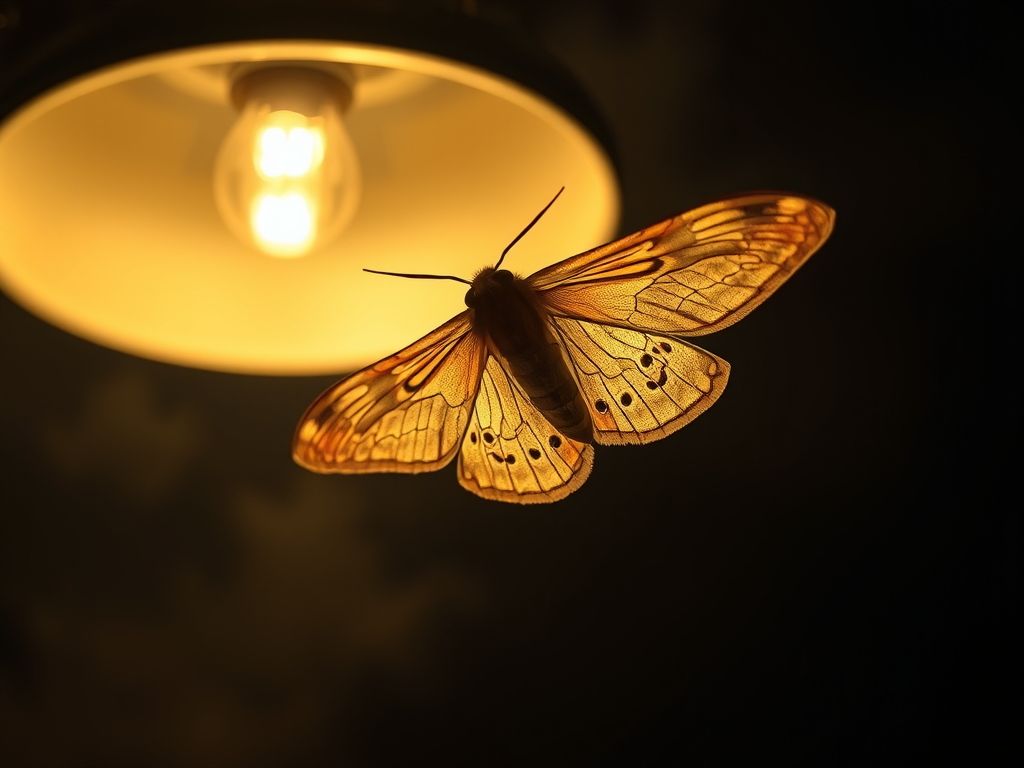

Last night, just outside the old bakery on 8th Cross, I stopped for my usual evening walk and a fresh coconut bun. But what caught my eye wasn’t the snack—it was a swirl of tiny winged shapes dancing madly around the glowing sodium lamp above the gate.
There were dozens of them. Moths. Swooping, fluttering, colliding into each other like tipsy revelers at a monsoon wedding.
And I’ll admit it: I used to think moths were just clumsy. Random. A little foolish, even.
But watching them that night—there was something oddly graceful about their chaos. Like maybe it wasn’t chaos at all.
So I found myself wondering: why?
Why do moths throw themselves at lamps like it’s a rave for insects? What are they seeing in that orange halo of light? And more curiously—what do we miss, standing on the street below, watching this insect ballet from a very human perspective?
Let’s follow the wings and find out.
🔍 First, What Is a Moth?
Quick detour (don’t worry, we’ll come back): not every fluttery creature near your tube light is a moth. But most of them probably are.
Moths are close cousins of butterflies. In fact, they belong to the same scientific order—Lepidoptera, meaning “scaly wings.” But while butterflies usually flit about by day, dressed in bright saris of color, moths are more the night owls of the insect world. They come in subtler shades—dusty browns, creams, silvers—and their nightlife is positively wild.
Over 160,000 species of moths are known, and likely many more go unnoticed in the folds of banana leaves or the corners of our verandas. They’re masters of camouflage, tricksters of mimicry, and carriers of ancient navigational wisdom passed down through millennia.
Which brings us back to our question: what draws them to streetlights like iron filings to a magnet?
💡 The Myth of “Loving Light”
First, let’s clear up a myth. Moths aren’t “in love” with the light. It’s not some poetic attraction or tragic yearning like those old poems claim—“like a moth to a flame.”
It’s actually a case of navigational hijacking. 🧭
You see, for millions of years, before we filled the world with halogen and LED, moths evolved to navigate by natural light sources—primarily the moon. 🌕
Now here’s the key bit: the moon is incredibly far away. So the light rays coming from it are basically parallel, no matter where a moth is flying.
So moths—genius little aviators that they are—learned to maintain a constant angle between themselves and the moon’s light. This helped them fly in straight lines over long distances. Kind of like following a fixed star to guide your canoe.
But then… humans happened. 💡🏙️
We began dotting the planet with artificial lights—bulbs, streetlamps, neon signs, motion sensors, phone screens, you name it. And while these lights may seem similar to us, to a moth, they’re far closer than the moon. Crucially, they’re not infinitely far away.
So when a moth tries to follow a lamp like the moon, it spirals inward instead of flying straight. 🔄 That’s why they loop around lights again and again—like a plane trying to follow the moon but ending up stuck in a holding pattern.
Sometimes they get too close and burn. 🔥
Sometimes they exhaust themselves. 😓
Sometimes they just flutter, confused, against your windowpane like a creature caught in a dream. 🪟💤
👁️ But Wait—What Do They See?
This is where it gets even more delightful (and a bit surreal). ✨
We humans see a very narrow slice of the electromagnetic spectrum—what we call visible light, from violet to red. But moths? They see a different palette altogether. 🌈
Many species of moths are exquisitely sensitive to ultraviolet (UV) light—light that’s invisible to us. Some also see into the infrared. Their eyes are made up of thousands of tiny lenses—called ommatidia—giving them compound vision that detects motion, flicker, and subtle gradients of contrast we can’t even imagine.
To a moth, a simple bulb might appear like a glowing supernova surrounded by pulsing halos of UV brilliance. 🌟 They may mistake it for moonlight—or for the UV shimmer of nectar-rich flowers. 🌺
Think about that for a second. While we see a plain white LED, a moth might see a disco ball of UV cues, radiant and irresistible. 🪩 No wonder they go into a frenzy.
🚫 The Twist: Not All Moths Are Attracted to Light
Here’s your curveball: not all moths are actually drawn to light. Some species are repelled by it. ❌💡
In fact, researchers have noticed that in urban zones with heavy light pollution, certain moth populations are starting to evolve—developing darker wing colors to avoid detection and changing their behavior to avoid lit areas entirely. 🦠
Some are becoming less phototactic (light-seeking) over generations. 🔄
Even the plants that rely on moths for pollination—like jasmine and yucca—are in trouble. In some cities, their pollination rates have dropped simply because their tiny night-time allies can’t find their way in the glowing maze we’ve built. 🏙️🌱
The nightlife of nature is quietly changing. And we barely notice. 🌌
💘 Could It Be a Mating Signal?
Now here’s a curious theory I once heard from Ravi Uncle, my retired physics teacher neighbor, as we were sipping filter coffee outside his flat. ☕
He said, “Maybe the moths think the light is a female.”
And you know what? He’s not completely off.
Some moth species communicate using pheromones—chemical perfumes released by females to attract mates from great distances. 💨 But others use light, especially subtle flashes of bioluminescence, like the way fireflies do. 💡✨
So in the confusion of modern lighting, it’s possible that moths misinterpret the glow of a bulb as a signal—a potential partner, a safe haven, or even a rival.
The result? Chaos. Misfires. Winged heartbreaks. 💔🦋
It’s like being on a dating app where every profile picture is just a flashlight. 📱🔦
🔦 Not All Lights Are Equal
Here’s something I only noticed after a late-night dosa run in Shivajinagar: moths don’t swarm every lamp equally. Some they seem to love. Others they ignore completely.
Turns out, the type of light matters.
Traditional bulbs, like incandescent and mercury vapor lamps, emit a broad spectrum that includes plenty of UV—catnip for moths. 🧲
LEDs, especially those that emit cooler or warmer tones with reduced UV, are less attractive to insects. That’s why newer streetlights in cities like Bangalore tend to attract fewer winged visitors. 🏙️
Some researchers have even begun experimenting with moth-friendly lighting—narrow-spectrum bulbs that reduce insect attraction while still keeping our streets lit. 💡🌃
It’s a small step toward making our urban environments a bit less confusing for nocturnal flyers.
🌙 A Thought at the Street Corner
That evening, as I stood on the footpath with my coconut bun half-forgotten, I watched one particularly determined moth keep flinging itself at the same bulb. Over and over. Like it had a mission. 🎯
And it struck me: maybe the moth isn’t clumsy at all. Maybe it’s precise, persistent—chasing what it believes is the moon, or a mate, or a flower. 🌸
And aren’t we the same?
We, too, spiral around things that glow. We chase careers, relationships, ideals—thinking they’re the light we need. 💼💖🌟
Sometimes they are.
Sometimes they’re just bulbs.
Maybe, in the end, we’re all moths—fluttering through the dark, drawn to something bright, hoping we haven’t mistaken it for the moon. 🌌🦋
Even if, like that night outside the old bakery, it turns out to be just a bulb above a gate. 🧱💡
So next time you see a moth spiraling around your porch light, take a moment. Watch it. Marvel a little. 👀
Because in that simple, fluttering shape lies an ancient intelligence, a forgotten way of moving through the dark, and a mirror—quietly reflecting our own longing to find direction, to find light. 🔍✨
☕ If you’ve ever paused to watch a moth dance or wondered about a shadow on your windowpane, tell me below. I’d love to hear the little science stories hiding in your neighborhood.
📚 Related Reading
🔗 Why Butterflies Remember Being Caterpillars
🔗 The Butterfly Effect: Small Actions, Big Changes
🔗 The Lunar Pull: How Moon Phases Affect Us
🔗 Cartography’s Oddities: The Case of Two Moons Above India
🔗 The Science of Sixth Sense
We’d love to hear your thoughts. Let’s chat below!