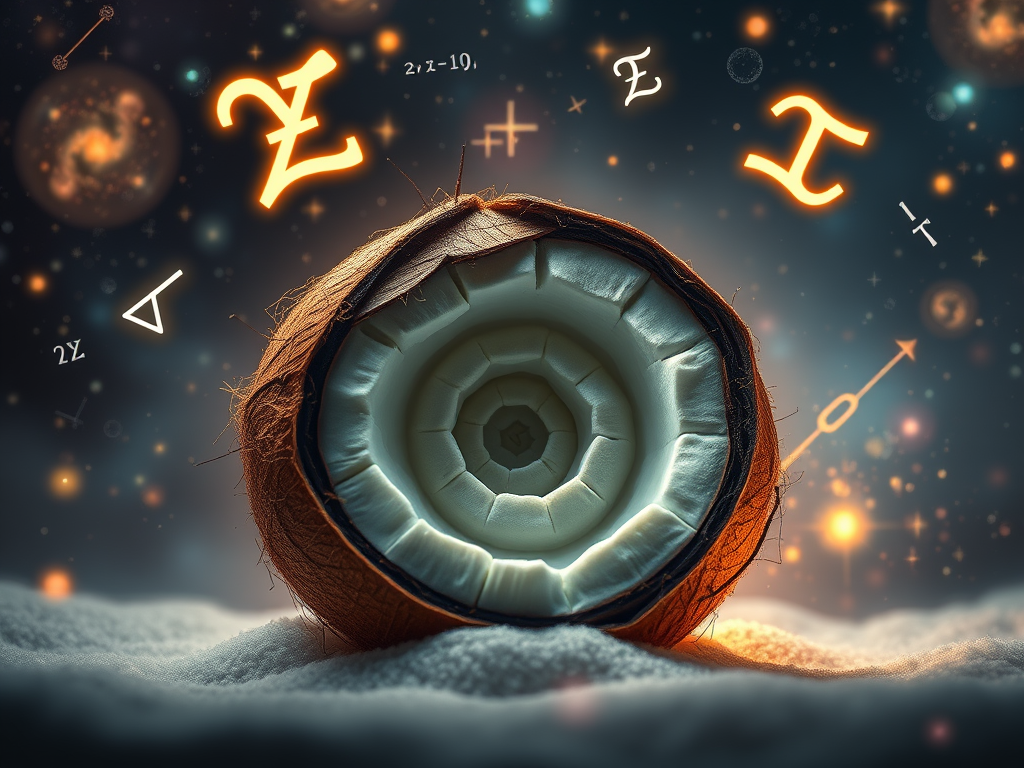

🥥 A Spiral and a Sickled Coconut
It started with a coconut shell.
I was ten, sitting on the tiled verandah of my grandmother’s house in Thrissur, breaking open a dried coconut with a rusty sickle, when my cousin casually asked, “Da, did you know the spiral pattern on the shell is a Fibonacci sequence?”
I blinked. Fibonacci? Was that a brand of chocolate?
He explained it like it was some secret code behind nature—petals, shells, galaxies. And just like that, math wasn’t just homework. It was… everywhere. On every leaf, in the way waves curled, even in the squiggly grooves on the back of my hand.
But here’s the thing. If math shows up so naturally in the universe, does that mean it’s embedded in reality itself? Or are we humans just so wired to look for patterns that we can’t help but turn everything into equations?
That’s the rabbit hole I’ve been tumbling through ever since. So grab a cup of chai. We’re about to poke at the divine (or perhaps very human) nature of mathematics.
🌌 The Case for the Divine Blueprint
There’s a famous quote—often misattributed to Galileo—that says,
“Mathematics is the language in which God has written the universe.”
Look around, and it’s hard not to nod along.
📏 Equations That Built the World
The laws of physics—from gravity to electromagnetism—are written in precise mathematical form. Maxwell’s equations describe how light moves. Schrödinger’s equation tells you how quantum particles evolve.
It’s the math behind a particle’s probability cloud—the poetry of maybes that defines quantum life.
Einstein’s field equations reshape the very fabric of spacetime.
None of these are just poetic guesses. They work. They predict. They build rockets, simulate black holes, and design microchips.
It’s as if the universe has a secret operating system, and math is the source code. A code that’s eerily efficient.
🔢 The π Question
Why, for instance, should the digits of π appear not just in circles but in probability theory, quantum mechanics, even the distribution of prime numbers?
It turns out, the entropy—or information capacity—of a black hole depends on its surface area. And somehow, π, the circle constant, sneaks into that equation. Like the universe signed its equations with a swirl.
🌀 Imaginary Numbers and Hidden Rhythms
And why do imaginary numbers—yes, the ones involving √−1 that we mocked in school—turn out to be essential in quantum mechanics?
“√−1” might sound like math’s version of a prank—but in quantum physics, it’s the rhythm behind how particles dance.
It’s like we’re not inventing math at all. We’re discovering it. Uncovering pieces of an ancient architecture. Which raises the cosmic question: Who—or what—built it?
🧠 Plato’s Hidden Dimension
Some thinkers believe math lives in its own timeless realm—what Plato called the “world of forms.” When we discover equations, we’re not creating—we’re glimpsing that otherworld.
🧠 Or Is It Just How Our Minds Work?
Now, let’s pull back. Maybe math feels universal because it’s how our brains are wired to process complexity.
Think about it. Our species survives by spotting patterns. “That rustle in the grass? Pattern = possible tiger.” We’re basically walking prediction engines.
So we abstract. We simplify. We say, “This apple plus that apple equals two apples.” Then we stretch that logic to calculate the orbits of moons and the dynamics of fluids. But maybe the abstraction isn’t reality. It’s a map. A very good map. But not the terrain.
🔬 Tegmark vs Smolin
Physicist Max Tegmark argues that the universe is a mathematical structure.
Tegmark thinks we don’t just use math—we are math.
Smolin says math is more like a paintbrush—helpful, but not the canvas itself.
🌍 What If Math Is… Optional?
Here’s where it gets weird: Even our concept of numbers may not be universal. Some Amazonian tribes only have words for “one,” “two,” and “many.” To them, “five” isn’t a quantity—it’s noise. Their reality functions perfectly without it.
👽 If Aliens Don’t Count
Aliens, if they’re out there sipping neutron tea, might think in patterns we can’t even imagine. Not numbers. Not logic trees. Maybe color shifts. Or geometric pulses. Maybe for them, prime numbers are as meaningless as the smell of turmeric is to a stone.
🪞 The Anthropic Puzzle
Some say the universe has to look mathematical—because only minds that can recognize math would ever notice it. A cosmic chicken-and-egg puzzle.
🧲 But Then There’s the Unreasonable Effectiveness
Eugene Wigner called it “the unreasonable effectiveness of mathematics.” Why should math—an abstract mental construct—describe the physical world so well?
You create a function on paper… and boom, it predicts the behavior of electrons.
You scribble equations in a dusty lab… and satellites launch flawlessly into orbit.
It’s like dreaming of a key and waking up to find it fits a real lock.
⚛️ The Higgs Was Just Chalk Until It Wasn’t
In the 1960s, physicists used chalkboard math to predict the existence of the Higgs boson. Decades later, we smashed particles at nearly the speed of light… and it showed up. As if the math summoned it from the void.
🧶 Fractals: One Rule, Infinite Depth
Like fractals—those swirling shapes that repeat endlessly—math can turn a simple equation into infinite beauty. One rule. Infinite depth.
🎯 Precision That Feels Too Perfect
One explanation is that we selectively remember only the successes. There are millions of equations that don’t describe anything. But when one works, we put it on a pedestal. Survivor bias.
Still, the precision of it all is uncanny. Predicting the magnetic moment of the electron to 14 decimal places? That’s not just lucky. That’s suspiciously precise.
📊 Even Chaos Has a Rhythm (Benford’s Law)
Even randomness has preferences.
In huge collections of real-world numbers—like electricity bills, river lengths, population sizes, file sizes, even the energy released by gamma ray bursts—you’d expect the first digit to be spread out randomly. 1 through 9, right? Equal chance.
But no.
The number 1 shows up as the first digit about 30% of the time. And the higher the digit, the less likely it is to lead. 9 barely gets a look in.
It’s not some bug in the system. It’s a feature of how nature grows.
Real-world numbers tend to spread out over large scales—1 to 100, 100 to 1,000, 1,000 to 10,000. And each time the range increases, 1 gets a head start.
From 1,000 to 1,999? All start with 1.
From 10,000 to 19,999? Still all 1s.
But 9? It only gets 9,000 to 9,999.
This pattern is called Benford’s Law, and it’s so reliable that accountants use it to detect fraud.
Because when people invent numbers, they imagine the digits should appear evenly.
But the universe doesn’t think that way.
Nature, it seems, prefers to start small.
Even chaos has a rhythm.
🎣 When I Asked Sukumar…
Last week, I asked Sukumar—the local fisherman and unofficial philosopher of my lane—what he thought about all this.
He took a drag from his beedi and said, “Chetta, when I throw my net, sometimes I get fish. Sometimes I get shoes. You call that probability. I call it Tuesday.”
He was right, in a strange way. Probability is just math’s way of formalizing luck. But life… life doesn’t always follow the formula.
Maybe Sukumar was right. Maybe the universe really is just a string of Tuesdays with probability sprinkled on top.
🧩 Gödel’s Whisper and the Limits of Logic
Just when math was starting to feel like the perfect language—something that could explain everything—along came Kurt Gödel with a quiet little bomb.
He proved that any math system complex enough to describe basic arithmetic will always contain truths that can’t be proven using its own rules.
Imagine writing a perfect grammar book—one that explains every rule of language.
And then discovering there are some sentences that are true, but can never be written using those rules.
That’s what Gödel showed us.
Even in a flawless system, there are truths that live just outside the fence.
Like trying to describe the shape of your own eye—from inside the eye.
If math were the language of God, then even God’s language has grammar gaps.
🧃 Maybe It’s Both. Or Neither.
What if math feels divine because we’re stitched from the same logic that we use to describe the universe?
We are, after all, made of atoms obeying those same equations. We didn’t come into the universe like foreign tourists. We grew out of it. We are the universe thinking about itself. So naturally, our thoughts—our logics—mirror its structure.
Some say the universe has to look mathematical—because only minds capable of seeing math would evolve here in the first place.
The Anthropic Principle—like a mirror that only reflects what’s looking into it.
Or maybe that’s just my post-Onam-sadya brain talking.
The point is: maybe it’s not a choice between “math is divine” or “math is human.” Maybe it’s both. A bridge between the mind and the cosmos.
Like Ambili Chechi’s cardamom chai. You don’t need to know the molecular structure to taste the perfection. But if you do, you realize there’s chemistry—and perhaps even divinity—in every sip.
🌀 So… Final Answer?
I don’t have one.
But here’s what I believe: Mathematics isn’t the voice of God. It’s the echo.
It’s how the universe leaves fingerprints on consciousness.
And how we—curious, wondering, pattern-craving creatures—try to follow those prints home.
Whether we reach a divine hand, or just the limits of our own neural wiring, is still unknown.
But the journey? That’s the magic.
Whether we’re chasing spiral shells or quantum dreams, the trail feels strangely familiar.
What do you think?
Is math discovered, invented, or something stranger still—an emergent echo from a universe trying to understand itself?
If this piece made you pause mid-chai, or sparked a tiny Big Bang of thought in your mind, leave a comment—or pass it on to someone who still remembers their high school math teacher fondly (or traumatically). Either way, let’s keep asking the questions that keep us wonderfully human.
📚 Related Reading
🔗 Can Humans Create a Universal Language for Aliens?
🔗 Can You Think Without Language? Exploring Wordless Thought
🔗 Could an AI Accidentally Become a God?
🔗 Why the Universe Might Look Random—But Isn’t
🔗 Chaos in a Tuxedo: The Science and Seduction of Roulette


We’d love to hear your thoughts. Let’s chat below!