
🍋 The Lemon Rice Heist
The first time a monkey stole my lunch was at a temple in Chikkamagaluru. I was eight, holding a banana leaf parcel of lemon rice, when a swift little hand snatched it from under my nose and leapt onto the temple roof.
The monkey sat there, legs dangling, munching, eyes locked with mine—as if to say, “Welcome to the jungle, yaar. It just happens to have Wi-Fi now.”
I laughed then. But these days, I find myself thinking about that moment with a tinge of awe—and maybe, just maybe, a pinch of existential dread.
Because here’s the thing: monkeys aren’t just surviving in our cities anymore. They’re learning. Adapting. Evolving. And in some cases, outsmarting us.
🌇 The Urban Jungle Gym
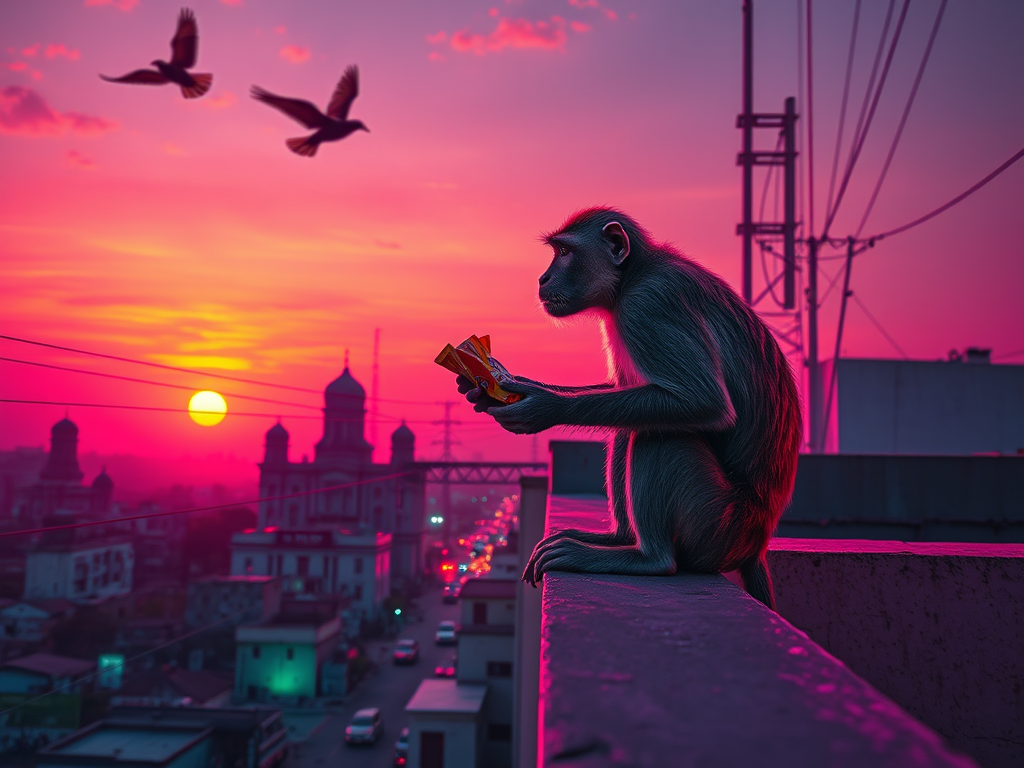
Walk through almost any Indian city and you’ll spot them—macaques leaping across electric wires like tightrope walkers, langurs sitting on boundary walls like stone guardians, and sometimes even bonnet macaques swiping Pepsi bottles from roadside stalls with the precision of a seasoned pickpocket.
They’ve learned traffic patterns. (Yes, really. Some wait for the signal before crossing.)
They know which buildings have the tastiest leftovers, which shopkeepers throw out overripe bananas, and which apartment balconies have soft cushions just waiting to be napped on.
In places like Delhi’s Lutyens zone, Varanasi’s ghats, or Bangalore’s outskirts near Bannerghatta, monkey populations have learned to exploit a brand-new ecosystem: us.
Our roads. Our plastic. Our habits. Our garbage.
And this isn’t just scavenging. This is adaptation at turbo speed.
🔬 Evolution in Real Time
Now, here’s where the science gets spicy.
Evolution is often imagined as something glacial—millions of years, slow mutations, beak shapes changing over generations like an artist refining a sketch.
But urban environments create what scientists call high selection pressure. That means traits that help survival get passed on faster.
Imagine a monkey troop where one clever fellow learns to open a dustbin lid. Suddenly, food is ten times easier to access.
That trait—curiosity, dexterity, boldness—gets rewarded. And if he has babies (which he probably does, because confidence is attractive in every species), those babies inherit not just his genes, but the social learning too. His whole troop might copy him.
In cities, this loop is supercharged. There’s more danger, yes—vehicles, power lines, angry uncles waving brooms—but also more reward.
Junk food. Shelter. Relative safety from predators.
This cocktail accelerates what we call behavioral evolution.
Some scientists argue that urban monkeys might eventually diverge into their own subspecies. Separate enough in behavior, even in biology, that they become genetically distinct.
Imagine: Macaca urbanensis. Sounds absurd? Maybe. But we once thought pigeons couldn’t live without cliffs.
🛎️ Monkey See, Monkey HACK
One of my favorite stories comes from Shimla, where monkeys have learned to mimic the sounds of doorbells. Yes, you read that right.
Locals report monkeys pressing doorbells, then hiding, waiting for someone to open the door—and darting in to grab food. Like little simian pranksters.
Another case in Rajasthan involved langurs who observed temple rituals so closely, they started copying the motions—ringing bells, dipping their hands in water, sitting patiently through aarti before grabbing prasadam.
What’s happening here isn’t just mimicry. It’s social learning—the foundation of culture.
And that’s not a term we usually associate with animals. But increasingly, biologists are rethinking that.
Because if culture is “behavior learned and passed on socially,” then monkeys in cities are building cultures of their own.
One troop might specialize in stealing from tourists. Another might become adept at opening water taps. Some even learn which human facial expressions mean danger—and which mean “I have chips.”
Agustín Fuentes, a primatologist who studies human–nonhuman primate interactions, once described this kind of behavioral flexibility as “the hidden engine of evolution.” In urban monkeys, that engine is revving at full throttle.
🤳 Are We Changing Them—Or Are They Changing Us?
This is where I paused mid-sip at my favorite Shivajinagar filter coffee stall last week, watching a macaque balance on a satellite dish while eating a chocolate wrapper. (No chocolate, just wrapper. Tragic.)
I asked Mr. Murthy, the stall owner, “Don’t you think monkeys are becoming too smart for their own good?”
He shrugged. “They’re just learning from us, no? Half the time, they behave better than people.”
And he’s not wrong.
As monkeys adapt to our habits—timing their raids to school lunch hours, recognizing food delivery bags, navigating elevator lobbies—we’re adapting too.
We monkey-proof our windows. Install fake langur recordings. Carry slingshots. Some people even feed them daily, creating relationships and territories.
We’re becoming part of each other’s ecosystems—not just in terms of space, but behavior.
In a way, our adaptations mirror theirs—just dressed differently.
Where they learn to open dustbins, we learn to scroll past ads.
Where they wait for lunch bells, we wait for dopamine hits.
They mimic aarti rituals; we mimic Instagram ones.
They get obese; we get anxious.
Who’s evolving whom, really?
They’re not just part of our ecology anymore.
They’re creeping into our myths again—starring in temple gossip, CCTV reels, even political metaphors.
One viral video at a time, the monkey becomes a symbol of everything unruly and unstoppable in modern India.
🥤 The Gut Check: What Are They Eating?
Now here’s a curious thread I pulled on, thanks to Shalini from my science club.
She asked: “Akka, if monkeys are eating Kurkure and Coke, is it changing their bodies?”
Good question.
Studies from urban India show that city-dwelling monkeys often have higher body fat, altered gut microbiomes, and more tooth decay than their forest cousins.
Like us, they’re developing problems associated with processed food—obesity, malnutrition, even behavioral changes linked to sugar consumption.
A 2022 study from the National Institute of Mental Health and Neurosciences found that urban monkeys had significantly altered gut microbiomes—eerily similar to humans on high-junk diets.
It’s ironic. They’re becoming “more human” in diet—and facing the same health consequences.
But it also raises deeper questions:
Are these changes reversible if their diet changes?
Or is their biology slowly shifting to accommodate this junk food era?
Are we witnessing a live experiment in gut evolution?
🧠 The Brain Rewiring
The most fascinating piece? Their brains.
Urban monkeys show increased problem-solving ability, memory retention, and even tool use compared to rural populations.
In some experiments, city monkeys outperform their wild cousins in tasks involving spatial memory and pattern recognition.
It’s not that their brains are growing larger overnight—but they’re using them differently.
Neural plasticity—the brain’s ability to rewire based on experience—is being shaped by the city itself.
Think of the city as a gym for monkey brains.
Every cable wire, every dosa cart, every plastic bin is a puzzle, a potential jackpot.
Solving it means survival.
And over generations, that may mean more than just smarter monkeys. It could mean brains that prioritize certain skills over others—like problem-solving over foraging.
The city is no longer just a jungle of concrete—it’s a classroom.
And the monkeys? They’re not mischief-makers.
They’re urban apprentices in a grand evolutionary experiment.
🚨 What Happens When the Joke Isn’t Funny?
Of course, it’s not all charming doorbell pranks.
In many cities, escalating encounters have led to injuries, broken windows, and retaliatory attacks.
Some municipalities deploy monkey catchers or sterilization drives.
But the line between coexistence and conflict grows thinner by the day—raising thorny questions about who belongs where, and at what cost.
Do we intervene? Do we stop feeding them?
Or do we continue dancing around this coexistence experiment, unsure where it leads?
🔮 So What Does This Mean for Evolution?
We usually think of evolution as “survival of the fittest.”
But in cities, it’s becoming “survival of the most adaptable.”
And monkeys—clever, curious, chaotic—are rising to the occasion.
They’re not just being shaped by the city; they’re shaping it right back.
Altering how we design balconies, dispose of waste, even worship.
They’re becoming part of our folklore, our fears, our daily lives.
They’re changing what it means to be wild.
And maybe, just maybe, they’re hinting at what future evolution might look like: not in the forests or the oceans, but in alleyways and traffic jams.
🌗 A Final Thought on the Terrace
Last Sunday, I watched a young macaque sitting on the water tank of our apartment.
He wasn’t raiding anything. Just watching.
Head tilted, eyes tracking the movement of a pigeon, a child’s kite, a pressure cooker whistle far below.
That monkey in Chikkamagaluru who stole my lemon rice?
I wonder what he’s teaching his grandkids now—maybe how to scan QR codes.
Maybe evolution isn’t just about changing bodies or brains.
Maybe it’s about changing stories.
And right now, in the terraces and temples of our cities, the story of monkeys is being rewritten—in real time, with concrete and cable wires for ink.
Maybe the future doesn’t just belong to the smartest species—but to the ones who learn to dance with each other’s chaos.
🐾 Your Turn
🍌 Got a monkey memory that made you smile, cringe, or think twice about evolution?
Tell me below.
Or just pause next time one stares back at you—you might be looking at tomorrow’s Darwinian daredevil.
📚 Related Reading
🔗 The Fungi That Hijack Minds: Nature’s Strangest Hackers
🔗 Ancient Night Rituals for Better Sleep: A Modern Guide
🔗 You’re 60, Banana and 100 Years Story
🔗 Genghis: The General Who Burned a Map Into Memory
🔗 What If Earth’s Magnetic Poles Flipped Overnight?


We’d love to hear your thoughts. Let’s chat below!