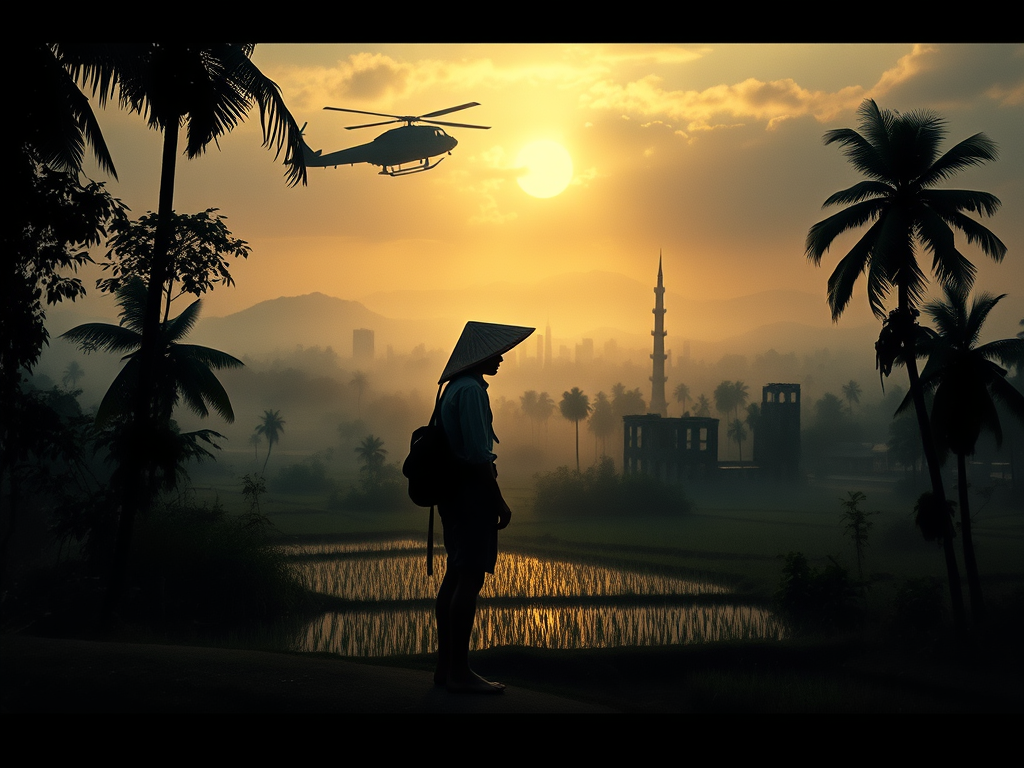

“They told us we’d be home by Christmas. They just forgot to mention the year.”
— A U.S. soldier’s graffiti in a Saigon latrine, circa 1969
Opening Silence
There are wars that end with treaties.
Some with surrender.
And then there are those that end with silence—the kind of silence that hums with the sound of helicopters lifting off embassy rooftops, as papers burn and promises evaporate into the tropic night.
The Vietnam War didn’t just end badly for the United States. It ended existentially. For a nation that believed itself invincible after World War II, the image of barefoot fighters in conical hats humbling a nuclear superpower wasn’t just strategic embarrassment—it was narrative heresy.
But America didn’t arrive in Vietnam overnight. It arrived in pieces: first with aid, then with advisors, then with excuses. The justification was simple: communism was a fire, and Vietnam the first spark. Let one nation fall, they said, and the whole region would burn.
Let’s rewind.
A War That Wasn’t Supposed to Be One
The seeds were sown in colonial mud. Vietnam, before it became America’s quagmire, was France’s burden. For nearly a century, the French had tried to “civilize” Indochina—a euphemism, Bhola once pointed out, for extracting rubber and rice while mispronouncing local names.
After WWII, the Vietnamese independence movement, led by the wiry, ascetic Ho Chi Minh, saw an opening. “The French are weakened. The Japanese are gone. Now is our moment.” Ho, interestingly, had once written to U.S. President Truman asking for support. No reply came.
So, the Vietnamese turned inward—and communist.
In 1954, the Geneva Accords split Vietnam at the 17th parallel. The North would be Ho’s—communist and hardened. The South, America’s new project. With elections delayed and Diem installed, Vietnam became not a nation, but a fault line.
France left in silence. After Điện Biên Phủ, the tricolor came down, and American flags went up in its place—quietly, without ceremony. Diem stepped in, backed by Washington and bloated with anti-communist certainty. The South was no longer a colony, but it wasn’t quite sovereign either. It was being built, brick by shaky brick, in America’s image.
America’s Cold War Math
America’s foreign policy in the 1950s had a simple math problem:
Communism anywhere = Threat everywhere.
When France lost the battle of Điện Biên Phủ in 1954—oh, a story in itself, with parachuted toilets and trench lines drawn in monsoon mud—it wasn’t just a colonial exit. It was a vacuum. And nature (and geopolitics) abhor a vacuum.
The Decade Between
The Geneva Accords were supposed to be a pause. Elections were promised in 1956 to reunify the country. But those elections never came.
Ngo Dinh Diem, backed by America and emboldened by Catholic elitism, refused to hold the vote. He feared—and rightly so—that Ho Chi Minh would win. Washington agreed. Better no election than a communist victory.
Diem ruled with paranoia. He jailed opposition, crushed dissent, and raided Buddhist temples. Monks burned themselves in public squares. Families disappeared. The South didn’t feel liberated—it felt cornered.
In response, the National Liberation Front formed in 1960—known to the U.S. as the Viet Cong. These weren’t just Northerners sent down. Many were Southern farmers, students, teachers—disillusioned by Diem, radicalized by his repression.
American advisors began arriving in force—16,000 by 1963. Bases were built. Helicopters multiplied. Officially, the U.S. wasn’t at war. Unofficially, it was training one.
In 1963, Diem was assassinated in a coup led by his own generals—while the CIA stood aside. He was their man, their creation. But by then, he had become an embarrassment. The Buddhist crisis had set the world on fire, and Diem’s regime had lost the South before the North even arrived.
Washington didn’t order the hit—but it gave the nod. The South fractured. Power changed hands like poker chips. And America watched its puppet unravel—not because he failed the people (which he did), but because he failed the optics.
When the Gulf of Tonkin incident occurred a year later, it didn’t start the war. It simply gave Washington a clean headline. The escalation had already begun—quietly, steadily, and without a vote.
The Gulf of Tonkin and the Green Light to Invade
In 1964, a U.S. destroyer—the USS Maddox—cruised close to the North Vietnamese coast, listening in. Behind it, South Vietnamese commandos—backed by the CIA—were slipping ashore, raiding radar posts and supply lines. To the North, the Maddox wasn’t a bystander. It was a spotlight for the blade.
They fired first. The Maddox fired back.
Two nights later, under lightning and confusion, came word of a second attack. No ships were hit. No torpedoes confirmed. But it didn’t matter. What mattered was that Washington heard what it wanted to.
Congress handed Lyndon Johnson a blank check: the Tonkin Resolution.
Just like that, America went from advisor to invader.
They came armed not just with guns, but with a plan. Quick strike, heavy fire, secure the South and head home by election season.
But the jungle, the people, and the war itself—none of them read the blueprint.
Helicopters landed, boots followed, and the sky soon burned.
Blueprints and Body Counts
Victory would not be measured in land gained, but in corpses counted. ‘Search and destroy’ became the doctrine—burn villages, count bodies, declare success. Helicopters dropped men into mazes and lifted them out in bags.
They used bulldozers to erase forests. Sprayed chemicals to strip leaves. Believed that airpower could smother rebellion.
But you can’t bomb loyalty out of a people.
And the jungle doesn’t sign surrender documents.
The Land That Refused to Behave
Here’s where it gets interesting. The American war machine, sleek and industrial, thought in terms of firepower and metrics. Body counts, supply lines, kill zones.
But Vietnam didn’t play by the script.
The Vietnamese jungles whispered secrets. The rivers shifted loyalties. Villages were burned and rebuilt overnight. The enemy wore no uniform. The famous “Ho Chi Minh Trail”—actually a network of shifting, camouflaged footpaths through Laos and Cambodia—functioned like a living organism, regenerating faster than it could be bombed.
The jungle didn’t just hide the Vietnamese. It helped them. It muffled helicopters. It devoured trails. It was both shield and sword—mud and mosquitoes as much a weapon as bullets.
Soldiers walked single-file through forests that swallowed sound. The Viet Cong laid punji sticks—bamboo spikes soaked in filth—beneath leaves. Mines made from Coke cans. Grenade traps triggered by tripwire. A foot wrong was a limb lost.
And when they reached a tunnel? Often the first entrance was a trick. The real tunnel was two meters down and twenty meters long—with vents disguised as termite mounds, and exits behind enemy lines.
One U.S. general reportedly asked:
“If we kill ten of theirs for every one of ours, why are we losing?”
To which a Vietnamese officer later replied:
“Because you care about your ten. We care about our one.”
Propaganda wasn’t just dropped—it was planted. The Vietnamese understood that morale was a front line too. A single booby trap could do what a thousand bullets couldn’t: make a soldier afraid of his own shadow.
Brutal. And painfully true.
The Propaganda War Back Home
Unlike WWII, where war correspondents were censored and footage sanitized, Vietnam came home raw and bleeding every night at 6 pm.
Bhola, watching grainy clips on my old Doordarshan set years later, once asked,
“Sir, are these films or real war?”
“Both,” I said.
Americans saw burning monks, crying children (remember Phan Thi Kim Phuc, the ‘napalm girl’?), and returning body bags. Trust eroded. First in the press. Then in the people. Finally, in the government itself.
In 1971, The Pentagon Papers revealed what many suspected—American leaders had long known the war was unwinnable. Yet they kept sending sons into the grinder. The outrage wasn’t just about the war. It was about the lie.
Lyndon Johnson once told an aide:
“I don’t think it’s worth fighting for, and I don’t think we can get out.”
But they didn’t stop. Because no one wanted to be the president who lost Vietnam.
At Kent State, four students died with hands raised. In Detroit, whole blocks burned in protest. And on campuses nationwide, the chant rose:
“Hey hey LBJ, how many kids did you kill today?”
Televisions flickered with death. Napalm by dinnertime. Body counts during weather forecasts.
Why the Giant Tripped
In hindsight, the U.S. lost for many reasons:
They misunderstood nationalism. To many Vietnamese, communism was a means, not an end. What mattered more was freedom—from any foreign power.
They overrelied on technology. You can’t strafe loyalty from the sky.
They underestimated culture. The Vietnamese had centuries of resisting invaders—Chinese, Mongols, French. The Americans were just next.
But perhaps most fatally, they treated it as a military problem. It was a political, cultural, and psychological one.
They dropped bombs by the ton and still the trail reappeared by dawn. Intelligence briefings grew quieter. Morale rotted. One general described it as fighting ghosts with a flamethrower.
The harder they pushed, the faster the enemy disappeared. Victory was always one hill away—until the hills started pushing back.
Viet Cong Resistance: The Cat-and-Mouse War
“But sir,” Bhola asked once, frowning as he stirred chai,
“how can farmers beat the Americans?”
“Same way ants move mountains, Bhola. One bite at a time. And barefoot.”
At night, the jungle shifted. Villages that saluted Americans by day harbored guerrillas by dusk. Paths looped. Trails lied. One squad would walk into a clearing—and not walk out.
They didn’t fight to win ground. They fought to make America bleed until it left.
Some of what we’ve heard about the tunnels teeters between strategy and myth. But make no mistake—the core is real. One story goes like this: tunnels so complex they had kitchens with chimneys that dispersed smoke kilometers away. American GIs would bomb a tunnel entrance, only to find three more behind it.
“We were not fighting Americans,” a former NVA soldier told me.
“We were fighting ghosts who didn’t know our language and didn’t want to.”
Rajesh’s Folklore Disclaimer:
Yes, some of these tunnel legends are embroidered. But the tunnels themselves? Very real. I’ve been in one. It felt like crawling through the earth’s memory.
In Vietnamese villages, they still say:
“The jungle remembers what men forget.”
The South Vietnamese: Shadows and Silence
And what of the South Vietnamese? Not just generals and politicians, but shopkeepers, students, mothers. Some feared communism, others just wanted peace.
Many had served with American forces—as translators, officers, drivers, informants. Not out of ideology, but out of survival. Out of hope. But caught between bombs and ideologies, they became shadows in their own story.
When Saigon fell, the map was unified—but the people were not. For many in the South, independence didn’t arrive. Retribution did.
Today, few remember them. Even fewer ask.
“We packed our lives in one suitcase,” a man from Da Nang told me.
“Not because we thought we’d live—but because we didn’t want to die in silence.”
“My son wore no uniform,” a woman in Can Tho told me.
“But he still didn’t come home.”
They waited on rooftops, clutching old passports and baby shoes. But the helicopters didn’t land. The embassy gates closed. The allies America promised to protect were left behind—to re-education camps, to punishment, to silence.
After 1975, thousands fled—by air, by foot, by sea. The “boat people” of Vietnam became one of the largest refugee movements of the 20th century. Some found new homes. Others found the sea less forgiving than war.
Prisoners of the North and Those Who Came Home Broken
In Northern prisons like the ‘Hanoi Hilton,’ American POWs endured years in darkness. Some returned home to cheers. Others to silence.
Senator John McCain was one of them. He came back broken in body, not in voice. And yet, he rarely spoke of the torture. He spoke of forgiveness.
Sometimes history is carried not in books—but in bones.
“We weren’t patching up soldiers,” one nurse told me.
“We were patching up ghosts.”
Some came home and built lives. Others couldn’t. They drank, or drifted. Some died years later in alleyways, their dog tags still around their necks.
1975: The Rooftop Farewell
On April 30th, 1975, as North Vietnamese tanks rolled into Saigon, U.S. Marines scrambled to evacuate personnel from the embassy rooftop. Desperate locals clung to helicopters. The world watched.
America, the colossus that stormed Normandy and rebuilt Europe, was now… retreating.
Some historians call it a “strategic withdrawal.” Others, more candidly, call it a defeat.
I prefer Bhola’s phrasing:
“Sir, even the biggest elephant slips if it charges into rice fields without knowing the mud.”
Pilots flew their own families out and left soldiers behind. Civilians clung to helicopter skids. On aircraft carriers, they shoved choppers into the sea to make room for more.
It wasn’t a withdrawal. It was an unraveling.
Echoes That Still Haunt
Vietnam changed everything.
The Vietnamese, north and south, bore decades of pain.
In the years that followed, Vietnam became a graveyard laced with secrets. Bombs that didn’t explode in 1969 waited until 1995. Children lost limbs in rice paddies. Farmers dug up history — and it exploded in their hands.
Some wounds passed through bloodlines. Children born decades later — blind, twisted, gasping — never saw the war but were shaped by it. The forest grew back. The genes didn’t.
They rebuilt in isolation, shunned by the West. No trade. No aid. Just scorched fields and decades of self-reliance. They didn’t just survive war. They survived the punishment after.
Landmines still lurk in the countryside.
Agent Orange still affects generations.
And yet—Vietnam moved on. Today, it’s a rapidly growing economy, a complex society of memory and ambition. Ho Chi Minh’s portrait still watches over the capital that bears his name. But the youth wear jeans, use TikTok, and sell iced coffee stronger than Bhola’s opinions on GST.
“Nothing is more precious than independence and freedom,” Ho once said.
It wasn’t just a slogan—it was a heartbeat stitched into every soldier’s pocket.
War museums in Vietnam speak not of “victory” but of “liberation.” But outside, in pho stalls and motorbike rides, the war lives quietly—not in glory, but in absence.
“The jungle never slept,” said a U.S. vet I once met in Kolkata.
“You’d think it was silent, but it had teeth. And it remembered your footsteps.”
“We told our children the sky was angry, not the Americans,” an old woman near Hue told me.
“Because it’s easier to forgive the rain.”
Today, Vietnam exports more coffee than Colombia. Its cities hum with scooters and startup pitches. But the past whispers.
War museums show rusted tanks.
The locals? They don’t talk about the war.
They pour another pho broth and let you figure it out.
So, What Was It All For?
That, dear reader, is the cruel question history often refuses to answer.
58,000 Americans died. Over 2 million Vietnamese civilians and soldiers perished. A nation was torn, rebuilt, and torn again. Political careers rose and crumbled. And in the end, the war that was meant to stop communism in Asia didn’t even stop communism in Vietnam.
But here’s a quieter truth:
History isn’t just made by victories.
Sometimes, it’s the defeats that echo louder—reminding empires that not all power is visible, and not all resistance wears boots.
They fought barefoot, but we left bleeding.
They hid in tunnels, but we drowned in confusion.
They lost lives. We lost certainty.
Maybe the real loss wasn’t Vietnam. Maybe it was the myth that power guarantees victory—that empires win because they’re empires
Maybe no one won.
Not the Americans who came home broken.
Not the Vietnamese who buried generations.
Maybe the jungle was the only witness.
And even it, in time, forgot.
Somewhere in Vietnam, a tree still grows from a bomb crater.
Somewhere in Ohio, a mother still sets a place at the table.
Maybe the worst wars don’t end in defeat.
They end in forgetting.
The kind that leaves no flag, no funeral, no lesson.
Just noise—and then a quiet that makes your ears ring.
Final Note from Rajesh’s Desk (and Bhola’s Broom)
If this story stirred something in you—perhaps a curiosity about a forgotten war, or a newfound respect for the tenacity of small nations—do pass it along.
History breathes best when shared.
And those boys who were told they’d be home by Christmas?
Some made it.
Most didn’t.
But Vietnam did what even Christmas can’t always promise—it remembered.
I once passed that same Saigon latrine years later—cracked tiles, wild grass pushing through. The writing was gone.
But the silence remained.
And if you ever visit Vietnam, don’t just see the war museums.
Talk to the elders.
Eat at the roadside pho stalls.
Listen to their stories.
You’ll find that memory doesn’t always march—it sometimes walks barefoot, through rice fields, humming songs of survival.
And that, my friend, is history worth remembering.
📚 Related Reading
🔗 Kashmir: A Home That Once Was
🔗 The Fermi Paradox: Are We Really Alone in the Universe?
🔗 Unbreakable Bones, Bulletproof Skin: Mutation or Superpower?
🔗 Journey to the Center of the Earth—for Real
🔗 Zimmermann Telegram: The Blunder That Changed History
We’d love to hear your thoughts. Let’s chat below!