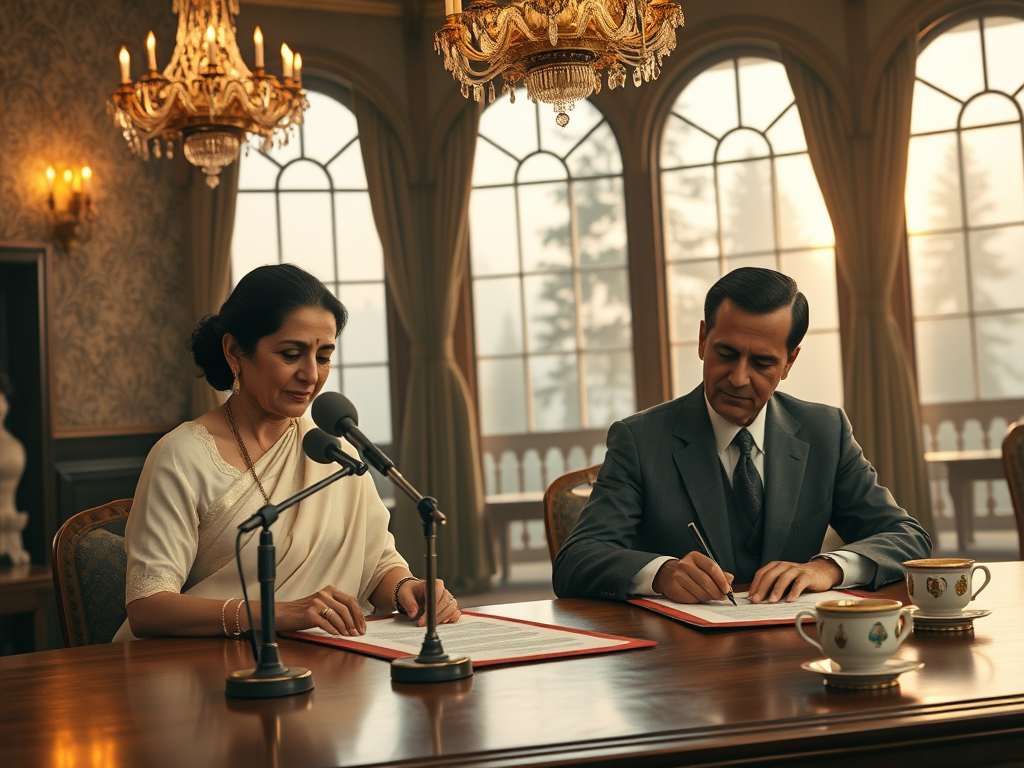

“History rarely ends with gunfire. More often, it pauses—bewildered—at a negotiating table cluttered with tea cups and territorial maps.”
🌩️ The Day After the Storm
When wars end, silence doesn’t follow immediately.
First, there is the disorientation of victory and the humiliation of defeat.
Then comes the paperwork.
In July 1972, in the quiet Himalayan hill town of Shimla—better known for its British-era charm and errant monkeys than high-stakes diplomacy—two weary nations sat across from each other:
- India, fresh from a spectacular military victory that had birthed a new country
- Pakistan, licking the wounds of a split subcontinent and the surrender of 90,000 soldiers
But if you imagine this as a scene of triumphant swagger on one side and bitter concession on the other, you would be wrong.
Because what happened at Shimla was not a post-war chest-thumping session.
It was something far more intricate:
A recalibration of South Asia’s future disguised as a bilateral agreement—
one whose shadows linger even today, like unclaimed baggage in a train station of geopolitics.
👻 The Ghost of Dacca
Bhola, my ever-curious housekeeper, once asked me,
“Saab, if India won so clearly in 1971, why didn’t we just settle everything then and there?”
Ah, Bhola.
Because victory is not the same as resolution.
And in South Asia, nothing is ever settled “then and there.”
The 1971 Bangladesh Liberation War was swift and stunning.
In less than two weeks, Indian forces, in alliance with the Mukti Bahini, overran East Pakistan—
resulting in the creation of Bangladesh and the surrender of Lieutenant General A. A. K. Niazi’s Pakistani troops on December 16, 1971.
For India, it was a moment of unparalleled strategic advantage.
But the very scale of that success made the next steps even trickier.
India now held nearly 90,000 prisoners of war.
Pakistan had lost not just a region—but its ideological claim to be a homeland for all South Asian Muslims.
West Pakistan’s credibility was in tatters.
Yet, peace was not automatic.
No formal treaty.
No borders redrawn in ink.
Just a colossal question mark hanging over:
- Kashmir
- Recognition of Bangladesh
- The very future of bilateral relations
Enter Shimla.
🔐 Behind Closed Doors: July 2, 1972
The Shimla Agreement was not born from a room full of diplomats.
It was born from an intensely personal dialogue between two leaders:
- Indira Gandhi
- Zulfikar Ali Bhutto
Indira, steely-eyed and self-assured after her landslide electoral victory and military triumph, could have extracted a harsher settlement.
Bhutto, on the other hand, had just taken over a fractured nation.
He had charisma, yes—but little leverage.
Yet the Shimla Agreement was not humiliating to Pakistan.
Why?
Because Indira Gandhi played the long game.
She didn’t demand formal recognition of the Line of Control (LoC) as an international border—though Indian generals wanted it.
She didn’t demand the Kashmir issue be closed forever—though Indian public opinion would have backed it.
And she didn’t insist on retaining the 90,000 POWs as bargaining chips beyond moral decency.
Instead, she bet on stability.
Bhola, when told this, muttered,
“So… she left the tiger with its teeth?”
“Yes,” I replied.
“Because she thought the tiger would turn into a cat if given a bowl of milk and time.”
It didn’t.
“Clause IV of the agreement—signed under the chandeliers of Barnes’ Court—quietly promised ‘respect for each other’s national unity, territorial integrity and sovereignty.’ An elegant phrase, yet pregnant with future ambiguity.”
📌 (Cambridge ILM archives, cross-referenced with MEA Record, July 1972)
📜 What Did the Agreement Actually Say?
Now let’s get technical—
but just enough to keep Bhola awake.
The Shimla Agreement laid down five key principles:
1. Respect for Sovereignty and Territorial Integrity
A vow not to alter each other’s borders by force—a lesson seared in after 1971.
2. Peaceful Resolution of Bilateral Issues
No third-party mediation (bye-bye, United Nations) and no further war.
Everything—especially Kashmir—was to be resolved bilaterally.
3. Conversion of Ceasefire Line into Line of Control (LoC)
The de facto border in Kashmir was named and formalized, but not legalized as an international boundary.
4. Mutual Repatriation of Prisoners and Property
India agreed to return the POWs, and both sides would discuss the fate of civilians and others stranded in the other country.
5. Future Dialogue Framework
An ambiguous yet optimistic clause about continuing dialogue and resolving “differences by peaceful means.”
“Official records don’t mention what was served that night—but Bhola insists it was brandy. Between his speculations and my footnotes, you’ll find the real story.”
🎭 Indira’s Gamble, Bhutto’s Bluff
Some Indian critics still argue that Indira Gandhi gave away too much.
That she had Pakistan cornered and could’ve forced a Kashmir settlement.
That Bhutto’s eloquent promises—made late into the night, some say over brandy and tears—were nothing but performance.
But Rajesh’s rule of post-war politics #3 (the one I scribbled in my notebook in 1986) says this:
“The day after a war is the worst time to design a peace. You’re still bleeding, gloating, or plotting.”
Indira Gandhi wasn’t naïve.
She knew permanence could not be forced.
She believed—perhaps wrongly—that Bhutto would stabilize Pakistan and that a stable Pakistan would be less aggressive.
Bhutto, meanwhile, bought time.
He needed the POWs returned to secure domestic legitimacy.
He needed international breathing room.
And he knew India wouldn’t risk being seen as an occupier.
“Ironically, Pakistan recognized Bangladesh only in 1974—two years after Shimla. By then, the POWs had already returned. A gesture of goodwill? Or a pawn sacrificed too soon?”
❄️ The Cold Storage of Hope
The Shimla Agreement’s biggest legacy isn’t what it resolved—
but what it froze.
For decades, both nations have clung to its wording like children arguing over who gets more mango slices.
- India uses it to block foreign mediation on Kashmir.
- Pakistan invokes its spirit whenever it wants to revisit unresolved “core issues.”
Meanwhile, Kashmir still bleeds.
Dialogue stalls, then restarts, then collapses.
And the LoC remains a boundary that isn’t quite a border—
like a scar that keeps reopening.
Every time tensions rise—
Kargil in 1999, Uri in 2016, Pulwama in 2019—
Shimla is dusted off like a family will no one wants to read.
🍳 Bhola’s Final Verdict
“So, Saab,” Bhola said last week, while flipping rotis,
“this Shimla thing—did it work or not?”
I paused.
“It worked just enough to prevent a fourth full war.
And failed just enough to make sure we never stopped preparing for one.”
He frowned.
“Sounds like a bad marriage, not an agreement.”
I nodded.
“Exactly.
But in this neighborhood, even a bad marriage is better than arson.”
🏛️ A Footnote in Frost
The building where the Shimla Agreement was signed—Barnes’ Court—is now the Himachal Pradesh Raj Bhavan.
Tourists stroll by, unaware that one of South Asia’s most consequential documents was negotiated beneath its colonial beams.
“The wallpaper at Barnes’ Court, they say, still peels like it’s unsure whether the empire ever truly left.
Or whether the subcontinent ever truly healed.”
History doesn’t forget agreements.
It just waits to see if nations remember them.
📜 Postscript for the Curious
🧾 For the curious:
The full text of the Shimla Agreement is archived in India’s Ministry of External Affairs record, July 1972.
Bhutto’s handwriting?
That’s harder to trace—
but the legacy is etched across every flare along the LoC.
And if this tale made you think—or chuckle—leave a like.
Or tell me what history you’d like Bhola and me to unpack next.
Because the past doesn’t sleep.
It just waits for someone to ask the right question.
Related Reading
• The Shortest War: Lessons from the Anglo-Zanzibar Conflict
• Understanding the Mandela Effect: Memories and Reality
• The Fall and Rise of Cleopatra VII: The Woman Who Played Rome
• Absurdity and Espionage: Failed CIA Plots Against Castro
• Did Ashoka Really Renounce Violence Overnight?

We’d love to hear your thoughts. Let’s chat below!