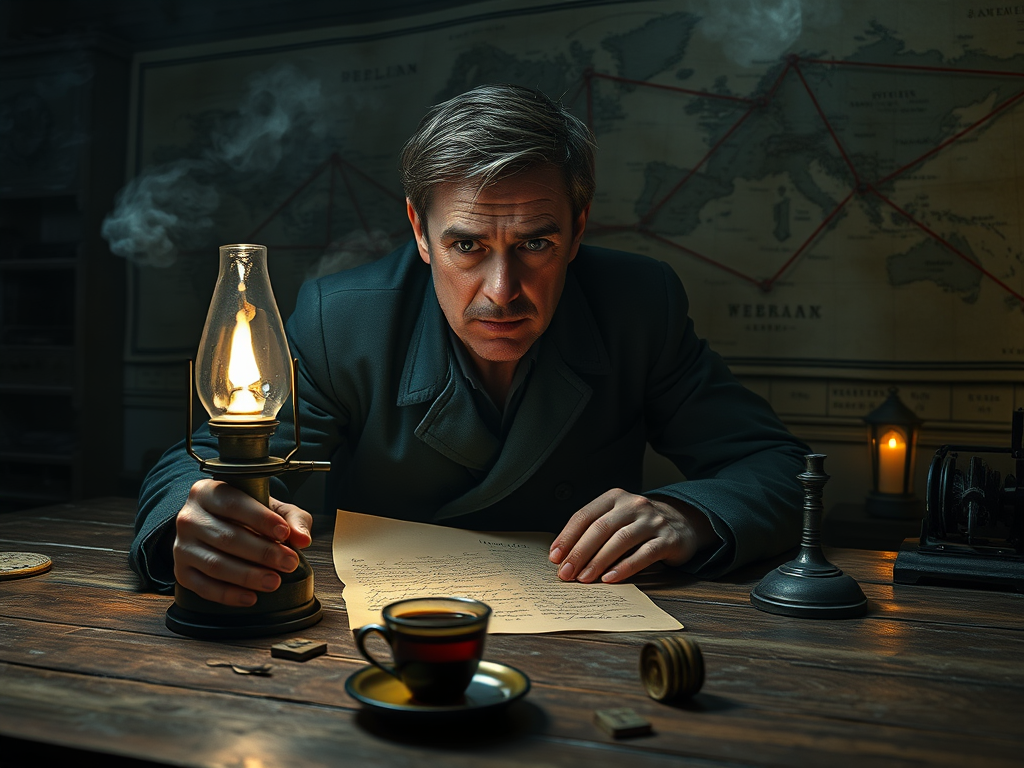

“If this is true, it is enough to bring America into the war.”
— British Naval Intelligence, January 1917
Somewhere in Berlin, a diplomat dips his pen in ink—thinking he’s reshaping the world.
He’s not wrong. Just not in the way he hopes.
History often turns not on battles or treaties, but on blunders.
And one of the most deliciously catastrophic blunders in modern history came in the form of a German telegram—coded, ambitious, and wildly optimistic—that somehow managed to offend three nations at once, redraw diplomatic loyalties, and drag an isolationist America into the bloodiest conflict the world had ever seen.
Yes, I’m talking about the Zimmermann Telegram.
Now, Bhola—who still refers to the World Wars as “the big fights where everyone forgot chai breaks”—once asked me,
“How can a single letter cause such a fuss, saab? Even the landlord’s eviction notice didn’t move me.”
To which I said,
“Ah Bhola, but this wasn’t just a letter. It was a diplomatic grenade. One that exploded before it even reached its intended hands.”
Let’s unravel this telegram—not just what it said, but why it mattered, who decoded it, and how a German gamble across the Atlantic led to the U.S. dropping its policy of polite distance and stepping into the mud of World War I.
✉️ The Message: Bold or Bonkers?
On January 16, 1917, the German Foreign Secretary Arthur Zimmermann composed a secret diplomatic note.
It was addressed to Heinrich von Eckardt, Germany’s ambassador in Mexico, and sent via coded transmission.
The message read (once decoded):
“We make Mexico a proposal of alliance on the following basis: make war together, make peace together, generous financial support, and an understanding on our part that Mexico is to reconquer the lost territory in Texas, New Mexico, and Arizona…”
In short: Germany was asking Mexico to invade the United States—in exchange for the return of lands lost in the Mexican-American War of the 1840s.
Oh, and by the way, Germany would resume unrestricted submarine warfare against Allied ships, fully expecting this would tick off the U.S. enough to join the war. Hence, the need for a little southern distraction.
It was the diplomatic equivalent of lighting your neighbor’s curtains on fire and offering the arsonist half your garden.
📡 Sent Through Whom, Exactly?
Now here’s the part that would make even Bhola raise an eyebrow.
Germany sent this top-secret note via British-controlled cables.
Why? Because their own communication lines were unreliable, and they had a peculiar confidence that coded messages—especially ones with mind-boggling stakes—would remain confidential.
To make matters even more absurd, they routed the telegram through American diplomatic channels.
That’s right. The United States, which Germany knew would be angry about submarine warfare, unknowingly helped transmit the very message that would eventually bring them into the war.
This, dear reader, is why I say history isn’t always written by the victors—it’s sometimes written by the baffled.
🧠 Enter Room 40: The Codebreakers Strike Gold
The British Admiralty’s cryptographic unit, known as Room 40, was already adept at intercepting German communications.
They had cracked many of Germany’s diplomatic codes, often by exploiting reused cipher patterns and sheer linguistic brilliance.
When the Zimmermann Telegram came through, it was intercepted and decoded by British intelligence. Initially, they couldn’t believe their luck.
This wasn’t just evidence of German belligerence—it was an open invitation to stir up war on American soil.
The British, eager to draw the U.S. into the war on their side, now held a smoking gun.
Room 40 later helped crack naval codes that would tip the scales during major Allied offensives—including helping locate the German fleet before the Battle of Jutland.
But this telegram? It was their most explosive catch.
But there was a problem.
🎭 How Do You Reveal a Secret Without Revealing the Secret?
If Britain told the Americans outright,
“Look what we found in Germany’s diplomatic laundry,”
the Germans would know their codes had been cracked.
So the British cooked up a clever backstory: they pretended to have stolen the message in Mexico.
Meanwhile, they gave the U.S. the decoded version, with enough corroborative detail to validate its authenticity.
In late February 1917, the U.S. government received the decoded note.
President Woodrow Wilson—whose campaign slogan had been “He kept us out of war”—read it. Then read it again. Then turned pale.
The decrypted page trembled slightly in his hand, its coded symbols now laid bare—black ink on white paper, quietly detonating a world war.
Wilson later told his private secretary:
“We are dealing with a gang of madmen. We cannot ignore this.”
On March 1, 1917, the front page of The New York Times blazed:
“Germany Seeks Alliance Against U.S.; Asks Mexico to Join Her in War”
Public outrage followed. Fast.
🇺🇸 A Reluctant Giant Stirs
To understand the shockwave this telegram caused, you must remember: America had no intention of joining World War I.
Wilson had declared strict neutrality.
The public was exhausted by European squabbles and preferred to worry about homegrown matters like the price of bread or women’s suffrage.
But the idea that Germany was encouraging Mexico to attack the U.S.?
That was a different matter entirely.
Even those skeptical of war felt the sting of betrayal. A foreign power using America’s neighbor as a pawn? That hit too close to home.
Zimmermann—bafflingly—confirmed the note’s authenticity at a press conference in March.
One can imagine Bhola shaking his head here:
“Arre saab, even a burglar doesn’t announce on loudspeaker before robbing!”
⚔️ The Die Is Cast
Just weeks later, on April 6, 1917, Congress voted overwhelmingly to declare war on Germany.
The Zimmermann Telegram, coupled with the resumption of unrestricted submarine warfare, had done what years of Allied diplomacy could not.
And so, America joined the war—not because it wanted to, but because it was pushed, insulted, and finally provoked into action.
From that point on, the tide began to turn.
American troops, resources, and morale reinvigorated the war effort.
The dominoes that led to the 1918 armistice began falling—with one telegram at the root.
🤔 But What If It Hadn’t Been Intercepted?
Historians love this question.
Some argue the U.S. would have eventually joined the war regardless.
Others say it may have stayed neutral longer, leading to a vastly different post-war world—perhaps even a negotiated peace with Germany still intact.
One professor I met in Prague claimed that if the telegram hadn’t been intercepted, Mexico might have actually considered the offer—if only to posture for regional leverage.
For a Mexico still recovering from revolution, the telegram read less like a promise—and more like a poison pill disguised as a treaty.
Bhola’s take?
“If Mexico had attacked, America would have built a wall much earlier—and made Germany pay for it.”
🗝️ The Moral, If There Is One
Never underestimate the power of a letter. Especially one laced with arrogance, ambition, and terrible timing.
The Zimmermann Telegram is a masterclass in how not to conduct diplomacy.
It’s also a tale of how empires often trip over their own cleverness.
Germany assumed it could manipulate Mexico, outwit Britain, and contain American outrage.
It did none of those things.
Instead, it gave the Allies their most effective piece of wartime propaganda.
It turned whispers of war into thunder.
And it reminded the world that sometimes, the most explosive weapons are made not of gunpowder—but of words.
The age of encrypted DMs may be here, but the stakes of saying the wrong thing to the wrong person? Timeless.
Have a favorite unsent letter, intercepted whisper, or historic misfire of your own?
I’m always listening. Leave a comment, share a tale, or pass this along to a fellow lover of overlooked hinges in history.
After all, history—like a good telegram—is best when delivered… and devastating.
Bhola, of course, had the last word:
“So… basically Germany got ghosted and punched. Not a great day for them, huh?”
📚 Related Reading
• When Nixon Killed the Gold Dollar: The Night Money Became Faith
• The Shortest War: Lessons from the Anglo-Zanzibar Conflict
• Are We Living in a Simulation?
• Could a Galactic Federation Actually Exist?
• Smiling Buddha: How India Outsmarted the CIA
We’d love to hear your thoughts. Let’s chat below!