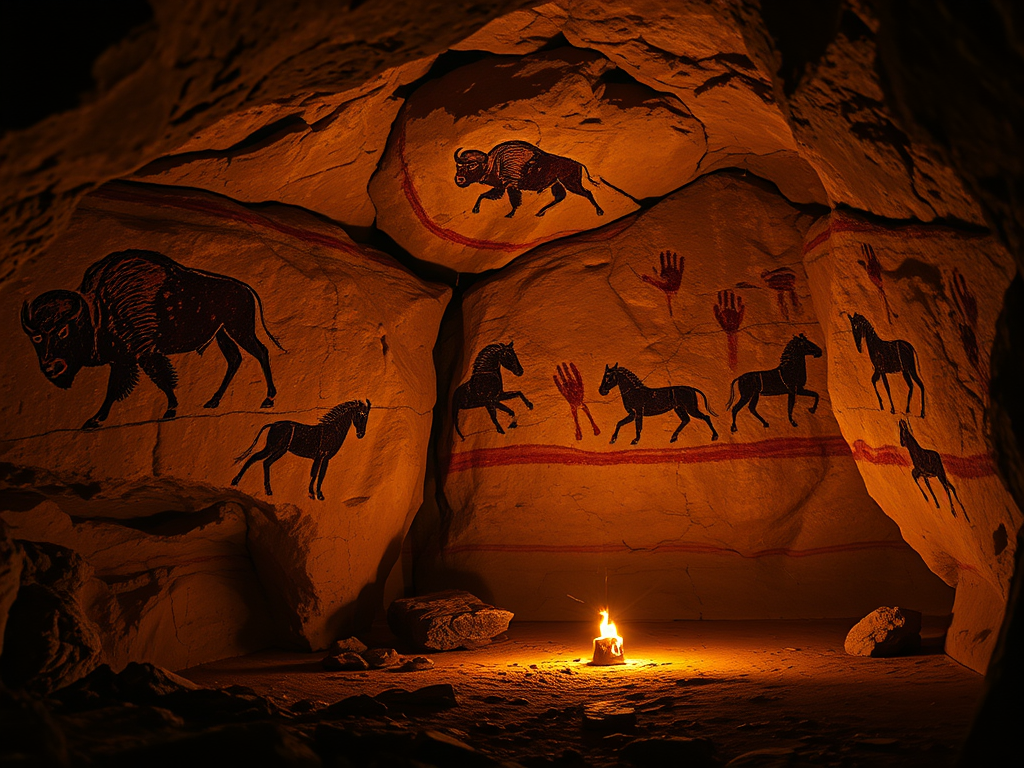

It’s funny how often the past whispers through the smallest cracks.
Last weekend, while rummaging through a stack of old books at a secondhand store near Malleswaram, I stumbled upon a page about the Chauvet Cave in France. And just like that—bam!—I was gone.
Lost down a rabbit hole of ochre, charcoal, and mysteries older than memory.
Tell me honestly:
Have you ever thought about what the world smelled like 30,000 years ago?
Not just what it looked like—though we’ll get to that—but the air inside those caves.
Damp limestone. Smoky torches.
Maybe even the lingering breath of the last person who left a handprint on the wall.
I imagine it was cold.
Not the Bangalore “I need a shawl” kind of cold—but the sort that makes your breath curl out in silver ribbons.
And somewhere, crouched beside a flickering flame, was someone mixing earth and ash with spit, carefully grinding the world into color.
🎨 The First Artists—or the First Scientists?
Let’s get one thing straight.
These cave painters weren’t doodling for fun during their lunch break.
The images they left behind—bison with bulging muscles, lionesses mid-leap, mysterious horned beings—are not just art.
They are observation.
They are memory.
They are wonder carved into stone.
Look at the way they captured motion.
Horses with multiple legs to suggest a gallop.
Animals overlapping as if herds were surging forward.
Some researchers believe these were early attempts at animation.
Animation, boss!
Before electricity, before pencils, before even the concept of “a drawing,” they were experimenting with time and movement using nothing but soot and stone.
Now doesn’t that sound like science?
I like to think of them as the first notebook-keepers of the imagination.
The original documenters of data—only their “data” was the shape of a deer’s thigh muscle or the pattern of stars they saw outside the cave.
Maybe they were asking the same questions we do:
What is that light in the sky? Why does the moon disappear? What happens when we die?
🖐️ Hands That Echo Across Time
And then there are the handprints.
Oh, the handprints. Have you seen them?
Some are outlines—stencils blown around the hand like reverse graffiti.
Others are imprints pressed into clay or pigment.
I saw one image from the El Castillo cave in Spain—tiny, delicate fingers reaching outward.
Possibly a child.
Possibly our ancestor.
Possibly… you?
There’s something electric about those prints.
Like a spark jumping species and millennia.
They say, I was here. I mattered. I wondered.
And isn’t that what science is at its core?
A refusal to let mystery go unasked?
🌍 What Did Their World Feel Like?
Let’s time-travel together for a second.
You’re crouched at the mouth of a cave.
The sun has just dipped below the horizon.
The sky is smeared in hues of ochre and blood—the same colors you mixed earlier from iron-rich rocks.
A faint animal musk hangs in the air.
Outside, hyenas screech and some shadowy predator moves through the underbrush.
You’ve got your torch in one hand and your other fingers are raw from grinding pigment.
Still, you crawl back into the dark.
Why?
Maybe you saw something you couldn’t explain.
Maybe you dreamed of a god shaped like a stag.
Or maybe—just maybe—you noticed the way bison gather before a storm and wanted to remember it.
And so you painted.
✨ The Science of the Stuff Itself
Oh, and don’t even get me started on the materials.
The pigments weren’t just scribbled on like sidewalk chalk.
These early creators experimented.
They tested different minerals—manganese oxide for black, hematite for red, kaolin for white.
Sometimes they even heated the rocks to change the color.
That’s thermal decomposition, yaar!
And their “brushes”?
Twigs. Feathers. Fingers.
Sometimes even chewed sticks to make fine lines.
Some used hollow bones or reeds to spray paint around their hands.
Imagine discovering airbrushing before you discovered writing!
Boss, I can barely get my phone camera to focus on my filter coffee.
These people were building art-tech hybrids before “tech” even had a name.
🦌 Were They Painting Gods, Dreams—or Data?
Here’s where it gets deliciously weird.
Some of the creatures painted in caves don’t match any known species.
They have horns that curve like antennae. Eyes like orbs. Body shapes that seem… off.
One such image shows a stag with the antlers of a deer but the snout of a bird—part dream, part diagram.
Could these have been gods? Spirits?
Or were they hallucinations sparked by flickering firelight and low oxygen?
Maybe they were drawing their dreams.
Or maybe they were early pattern seekers—our scientific ancestors—trying to make sense of what they saw in the stars, in their sleep, in the wild.
After all, what is mythology if not our first theory of everything?
🚧 Modern Street Art, Same Human Urge
Now hold this in your mind:
A teenager in Bangalore spray-painting a phoenix on a flyover pillar at 2 AM.
Risking a fine, a chase, or worse—but doing it anyway.
Why?
Because humans must mark.
We must record.
From cave ceilings to bathroom stalls, from pyramids to science notebooks, we’re a species obsessed with memory.
It’s not just rebellion—it’s memory.
A nervous system demanding permanence.
I still remember Shalini—this kid from my science club—who once drew the solar system on her tiffin box with a marker.
Not because anyone asked.
Just because she had to.
Those cave painters?
Same species. Same itch.
📓 Caves as the First Lab Notebooks
If you look closely, these caves aren’t just museums.
They’re labs.
The first places where humans asked:
What if I record what I saw? What if I show others? What if I test this vision with pigment and stone?
Some even suggest that cave acoustics mattered—that certain chambers were chosen for their echo, their hum.
That they sounded sacred.
Imagine understanding resonance before knowing the word.
You see?
Not just artists.
These were sensory scientists, philosophers in fur, researchers in the dark.
🔬 What If Wonder Was Our First Technology?
Sometimes I wonder if we’ve misunderstood intelligence all this while.
Maybe it didn’t start with fire or the wheel or even language.
Maybe it started with awe.
With someone stopping mid-hunt to stare at a snail’s trail on a rock.
Or someone waking from a dream of a bear with wings and feeling the need to share it.
Maybe the first technology wasn’t a tool—but a question.
📣 So What Now, Yaar?
Next time you pass graffiti on a Bangalore wall—pause.
Next time your niece draws dinosaurs in the margins of her math book—look.
Next time you see a child’s muddy handprint on your car window—don’t wipe it off just yet.
Because that need? That urge to leave marks?
It’s the same whisper that echoes from caves in France, Indonesia, Madhya Pradesh.
From Bhimbetka’s dancing figures to Sulawesi’s ancient handprints, the urge to record echoed across every continent.
A whisper that says:
I saw. I felt. I imagined.
And that, I think, is where all science begins.
🌟 What do you think the first cave artists were trying to say?
Have you ever left your own “mark” somewhere—accidental or not?
Drop a comment, share your favorite piece of street art, or just tell me what strange wonder you noticed this week.
Let’s keep the wonder glowing—like torchlight brushing ancient stone, illuminating questions too sacred to erase.
🪨 Related Reading
• Synesthesia: When You Can Taste Colors
• Unbreakable Bones, Bulletproof Skin: Mutation or Superpowers?
• The Dead Hand: USSR’s Doomsday Device That Still Might Exist
• Could an AI Accidentally Become a God?
• Elon Musk, Mars, and the Myth of Cosmic Escape
We’d love to hear your thoughts. Let’s chat below!