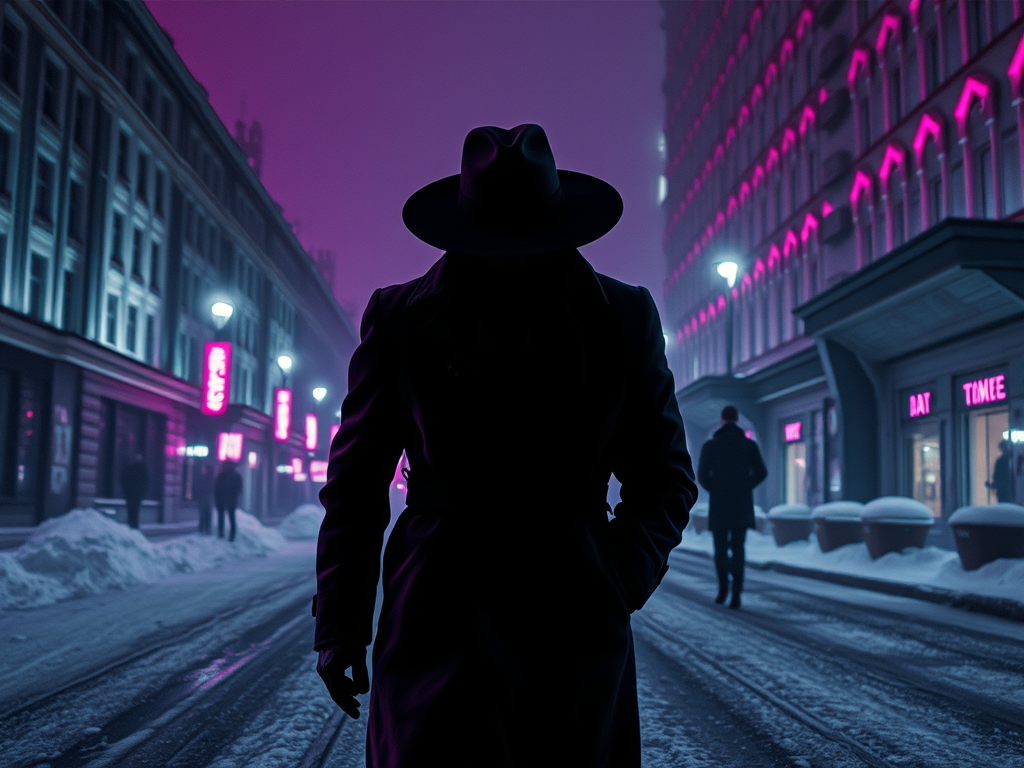

“In Moscow, you didn’t just need eyes in the back of your head. You needed a sixth sense, a seventh passport, and nerves of titanium.”
— An anonymous CIA field officer, 1983
Bhola’s Warning
When Bhola heard I was writing about Cold War spies, he peeked into my study with raised eyebrows and said,
“Will they come after you also, Saab?”
I told him not unless he’s secretly passing broom schematics to the KGB. He looked momentarily guilty. I’m still not sure why.
But his paranoia wasn’t entirely misplaced.
Because if there’s one city that made even the most seasoned spies sweat through their trench coats, it was Moscow.
Not Berlin. Not Havana.
Moscow.
🎭 The Theatre of Paranoia
During the Cold War, this frozen chessboard of a city became the tightest surveillance grid on Earth.
A place where one wrong glance, one sloppy shoe switch, or one too-many pierogis at a safe house could mean exposure—or worse.
Moscow, especially from the 1950s through the 1980s, was not just hostile territory for American and British spies—it was hell with snow. The KGB had practically turned the city into a live-action surveillance opera.
Every street corner had watchers. Every phone line buzzed with a click. Even the walls of the U.S. Embassy, as discovered in the infamous “bugged typewriter” scandal, were listening.
One CIA station chief famously said:
“If you see three men in black coats, one is KGB, one is decoy, and one is the guy fixing your plumbing.”
And yet, intelligence had to be gathered. Defectors had to be contacted. Secrets had to cross borders.
So how did operatives survive?
They made rules.
Not official rules—not printed, not even written down until years later.
Just whispered, learned, lived.
They were called “The Moscow Rules.”
📜 What Are the Moscow Rules?
Unlike the Geneva Conventions, you won’t find these rules in international treaties.
They were never formally issued, only passed down like urban legends among field agents.
But ask any CIA veteran who worked Moscow during the Cold War, and you’ll get a nod.
Then maybe a half-smile.
Then, if you’re lucky, a few gems like:
- “Assume you’re being watched—always.”
- “If it feels wrong, it is wrong.”
- “Don’t look back; they know you’re nervous.”
- “Always carry an escape plan.”
Over time, these mantras were collected—some say in the 1980s by CIA instructors—into an unofficial set of about 40 rules.
Not all were unique to Moscow, but the city made them essential.
They weren’t just survival tips. They were a philosophy.
👤 The Woman Who Walked the Rules
To understand what these rules meant—not just in theory, but in pulse-pounding reality—you have to follow one woman through the snow.
Martha Peterson arrived in Moscow in the mid-1970s, posing as a consular officer.
In truth, she was one of the few female CIA case officers running clandestine operations in the city.
And she was good.
She trained obsessively, rehearsed drops and retrievals under pressure, and followed the rules like scripture.
But even scripture can’t save you when the city itself is your enemy.
In 1977, Martha placed a dead drop for a key Soviet asset codenamed “TRIGON” (real name: Aleksandr Ogorodnik).
It was a small, camouflaged container hidden at a bridge support under Krasnoluzhsky Bridge.
It should have been routine.
It wasn’t.
The KGB had been watching. They moved in, arrested her. Peterson kept her cool even as they tore apart her bag, found the hidden transmitter, the money, the cyanide pill meant for TRIGON.
She invoked diplomatic immunity, and they had to let her go.
But the fallout ran deeper.
TRIGON was already dead—he had swallowed the cyanide capsule provided by the CIA the moment the KGB closed in.
Peterson never got to warn him. She never got to say goodbye. For years, she would carry the guilt of that failed drop—not just as a failed mission, but as a failed bond.
When she returned to the U.S., she continued working for the CIA but rarely spoke about Moscow.
Only decades later did she begin to share the story, revealing not just the tradecraft—but the grief.
Because the rules weren’t just tactics.
They were shields against the weight of what failure meant.
🛠️ Tradecraft in a Pressure Cooker
Imagine having to switch a briefcase with a contact—without speaking, without stopping, and while four different men pretend to tie their shoes across the street.
That was daily life.
Disguises had to be rapid and ridiculous:
wigs stashed in car door panels, reversible jackets, fake mustaches held in by chewing gum.
Safe houses had false walls.
Radios were hidden in umbrellas.
Some agents practiced walking in snow without leaving identifiable footprints.
(Bhola tried this once on our terrace with rice flour and promptly slipped. We now have fewer pigeons.)
And let’s not forget the “Jack-in-the-box”—a spring-loaded dummy that popped up in the backseat of a car, letting a real agent duck and roll while the dummy kept the KGB following.
Yes, a literal spy decoy doll.
Because Rule #14: “Keep them looking the wrong way.”
🧠 The Psychology of Surveillance
The Moscow Rules weren’t just about hiding.
They were about not cracking.
You had to stay calm while being tailed.
You had to smile at your surveillance and sometimes wave.
You had to make yourself boring.
Many rules were mental:
- “Don’t panic. Panic kills.”
- “Trust your gut, not your gadget.”
- “There is no such thing as coincidence.”
The idea was simple:
If the KGB couldn’t be outfoxed physically, they had to be outlasted psychologically.
You didn’t win with speed.
You won with steadiness.
And in the end, the Moscow Rules weren’t just for operatives.
They were for anyone trying to stay sane in a world designed to break you quietly.
🏙️ Moscow: The Waiting Beast
Moscow wasn’t a city.
It was a test—grey, listening, patient.
It didn’t chase you.
It waited for you to forget it was watching.
Even the silence felt engineered.
Even the snow seemed to whisper.
The Moscow Rules weren’t born from books or boardrooms.
They were born from this breathing, listening landscape.
🧩 Puzzle Pieces That Outlived the Game
After the Cold War ended, many of these rules remained embedded in CIA training—even for operations far from Moscow.
Because they weren’t really about Russia.
They were about any place where the walls whisper,
where your coffee might be drugged,
and where a smile might mean you’re marked.
Today, cyber analysts use the same mindset:
Don’t assume safety.
Don’t get lazy.
Always validate your sources.
Rule #1 still applies in the digital world:
“You are never alone.”
Even Bhola, when I explained this, muttered,
“So that’s why my cousin doesn’t trust WhatsApp stickers.”
📚 Footnotes in the Snow
It’s tempting to think of Cold War espionage as all tuxedos and martinis.
But Moscow offered none of that.
No casinos, no car chases.
Just gray buildings, cold stares, and the quiet clack of typewriters hiding betrayals.
The Moscow Rules were born not out of glamour, but out of necessity.
They were forged by real people in real danger—trying to do impossible things in an impossible city.
And they worked. Not always. Not perfectly.
But often enough that secrets got out.
Often enough that TRIGON’s story is known.
Often enough that even today, we’re still learning how much those shadows shaped the world.
🕯️ One Last Glance Behind
When I look at these rules, I don’t just see spy games.
I see the human instinct to survive scrutiny.
To pass truth in hostile lands.
To outwit fear.
And perhaps that’s the real story here—not just how spies escaped surveillance, but how ordinary people carried extraordinary courage in invisible pockets.
Because the most dangerous thing you could do in Moscow… was hope.
Bhola still eyes my bookshelf like it’s bugged.
I haven’t told him he’s right.
🐜 Related Reading
• Ant Bridges: Nature’s Living Architecture
• Why the Universe Might Look Random—But Isn’t
• From Saunas to Ice Baths: Exploring Global Healing Traditions
• Rasputin, Cyanide, and the British Spy Murder
• Absurdity and Espionage: Failed CIA Plots Against Castro
We’d love to hear your thoughts. Let’s chat below!