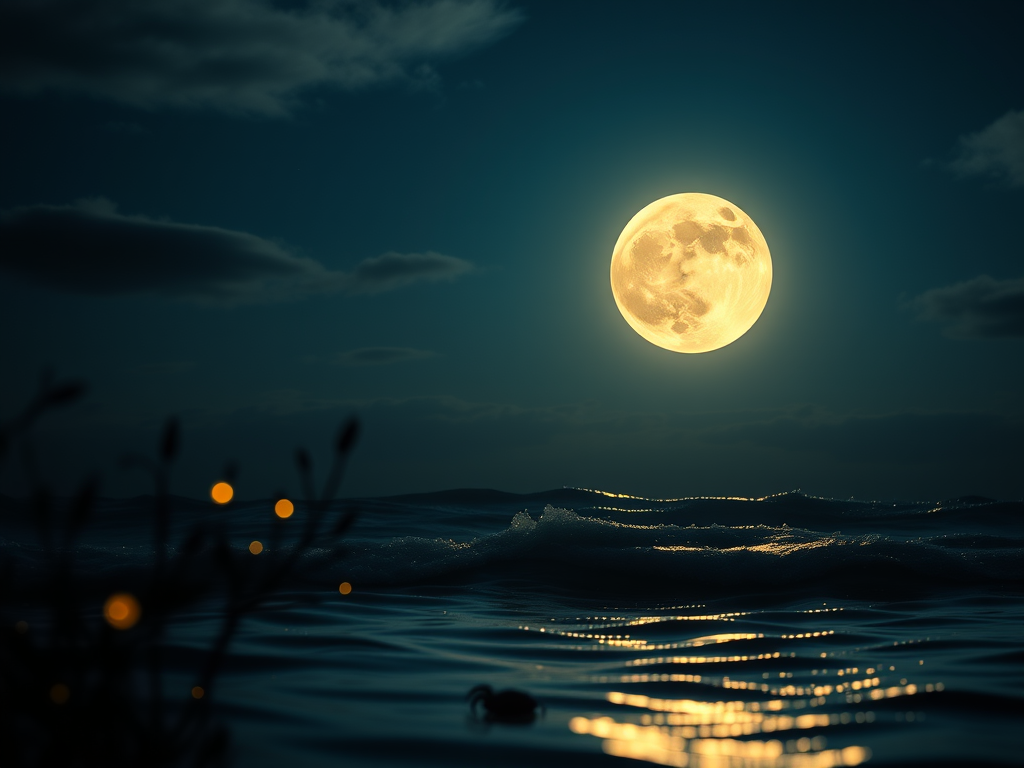

A Moon Above, A Pulse Below
From the lull of tides to the blooming of corals, the moon has always had a quiet influence on Earth. But when it comes to us humans, the science is murkier—and far more fascinating.
We know the basics: the moon’s gravity tugs at Earth’s oceans, creating the rhythmic rise and fall of tides. But did you know it also affects groundwater levels, plant sap flow, and even the behavior of animals like crabs, fish, and fireflies?
And then there’s us—70% water, full of electric impulses, emotional tides, and hormonal rhythms. Surely, we must feel the pull too?
That question has tickled scientists and storytellers alike for centuries. And it’s not just folklore. Police reports show spikes in activity during full moons. ER doctors swear they get more cases. Even sleep researchers have noted strange patterns in human rest cycles across lunar phases.
But let’s not get ahead of ourselves. First, let’s walk through the science… and the magic.
The Tides Within Us
If you’ve ever been to Chennai during a high tide or watched the waves roll in at Gokarna under a full moon, you know the moon’s power is real. Its gravitational pull doesn’t just move oceans—it subtly flexes the Earth’s crust, affects tectonic activity like minor tremors and crustal stress shifts, and yes, nudges the water inside our own bodies.
Now, the skeptic in my head (and occasionally Ravi Uncle from next door) often chimes in: “But Anika, the moon’s pull on a cup of tea is stronger than on your brain!”
True, from a purely physical standpoint, the gravitational force is small. But biology isn’t just physics. Our bodies are delicate ecosystems where even a slight shift—temperature, light, rhythm—can cascade into bigger changes.
Still, some scientists remain unconvinced. I remember reading a blunt critique in a journal: “Lunar influence on human behavior is a classic example of the correlation fallacy. Anecdotes don’t equal evidence.” Fair enough. But here’s the thing—we don’t dismiss the placebo effect just because it’s psychological. Sometimes, perception is part of reality.
Consider melatonin, the hormone that helps regulate sleep. Studies have shown that melatonin production may dip during the full moon, potentially disturbing our sleep. One Swiss study—Cajochen et al., 2013—found that people slept 20 minutes less and had less deep sleep around full moons, even in completely dark, controlled environments.
Coincidence? Maybe. Or maybe we’re tuned into the lunar rhythm in ways we’re only beginning to understand.
The Full Moon Effect
The full moon has always had a reputation—mystical, moody, and occasionally murderous. The word “lunatic” itself comes from luna, the Latin word for moon.
In hospitals, emergency rooms sometimes brace for a full moon like it’s a mini festival. Some claim more births happen, others say more accidents. While the data is often inconsistent (and the placebo effect is real), there’s no denying that many people feel different.
I asked Shalini—my precocious 12-year-old neighbor and resident moon-chaser—if she ever noticed anything. She replied with all the drama of a budding scientist: “Akka, my dreams are SO weird on full moon nights! Like, flying elephants and glittery rain and sometimes… school exams in space!”
Honestly, same.
Whether it’s because of light, hormones, or ancient circadian cues, many of us report vivid dreams, emotional surges, and general restlessness during the full moon. And unlike astrology, this isn’t about belief—it’s about lived, shared experience.
Even plants respond to the moon. Some farmers still swear by lunar calendars for planting, pruning, and harvesting. And in coastal regions, fish behavior changes with moonlight—part of an ancient dance of survival, light, and timing.
The New Moon Dip
Just as the full moon charges us up, the new moon—the dark, invisible phase—often brings a quieter energy. Some people report feeling drained or introspective during this time. It’s a moment of retreat, reflection, and internal reset.
I find this fascinating.
Think about it: Every month, the moon goes through a full cycle of growth and retreat. Waxing, waning. Expanding, contracting. And perhaps—just perhaps—so do we.
During new moons, I’ve noticed I tend to journal more. I sit with my filter coffee, listening to Mr. Murthy’s low hum at the stall, and scribble questions in my notebook: “What do I want to grow this month?” “What needs releasing?”
And it’s not just woo-woo. Studies in chronobiology (the science of internal biological clocks) suggest that humans, like other animals, are affected by lunar cycles—just not always in obvious ways.
The Forgotten Phases
While the full and new moons get all the attention, the in-between phases—the waxing and waning crescents, the gibbous curves—are equally important. These are times of transition.
In fact, I think they mirror our own messy middles—when we’re not quite sure whether we’re starting something or letting it go. Like when you’re halfway through a project or navigating a friendship that’s changing shape. The moon, too, is always in motion, never static, never perfect.
And that’s what I love about it.
Every night, the moon offers us a different face. And in doing so, it reminds us that we’re cyclical creatures too—ever-changing, ever-evolving.
The Moon in Our Lives
In India, the moon isn’t just a sky-rock. It’s sacred, symbolic, woven into our calendars and culture. From Karva Chauth fasts to Eid moon sightings, from Holi’s timing to Sankashti Chaturthi, the moon marks time, meaning, and memory.
Even Bangalore’s street chatter shifts during a full moon. Ameen Bhai, my favorite auto driver, swears by it: “Didi, traffic goes mad on poornima. Even the cows act strange!”
He’s joking. Maybe. But there’s something in his voice—half amusement, half awe.
And honestly, whether through rituals or quiet wonder, we’ve always turned to the moon to make sense of the cycles within us.
So… Does the Moon Really Affect Us?
Here’s what I think.
The moon’s effects may not be massive, measurable forces like gravity or magnetism. But they don’t have to be. Subtle rhythms shape us too. Just like how a song’s tempo can change your heartbeat, or a scent can unlock a memory, the moon may be whispering to us in ways that don’t show up neatly on charts.
And maybe it doesn’t matter if it’s “proven” yet. What matters is that people across cultures, times, and towns—whether in tribal forests or tech parks—feel it.
Sometimes science takes time to catch up with sensation.
Closing Under Moonlight
The next time you find yourself staring up at the moon—whether it’s a shy crescent over Shivajinagar or a golden orb rising behind the Nandi Hills—pause.
Breathe. Listen. Maybe the moon isn’t changing your hormones or nudging your dreams.
Maybe it’s just reminding you that you’re part of something vast, rhythmic, and beautifully ancient.
Like the tides. Like sleep. Like stories whispered under silver skies.
And if you’re still wondering—yes, I slept just fine the next night. But that full moon? It stayed with me like a question in the back of my head. Or the lingering scent of filter coffee on a rainy Bangalore morning.
We’d love to hear your thoughts. Let’s chat below!