
Last week, I got food poisoning.
Not the dramatic kind. Just enough to keep me glued to the floor fan and a bottle of ORS, swearing off reheated biryani and googling things like “how long does leftover chicken survive a Kerala summer?”
By Day 2, as my stomach slowly negotiated peace, I found myself reading about the bacteria behind it—Salmonella, E. coli, their weird cousins. But somewhere down that rabbit hole, I ended up on a page about extremophiles—bacteria that live in acid, ice, and even radioactive sludge.
That’s when something clicked.
What if these weren’t just tiny troublemakers or primitive leftovers from Earth’s early days?
What if bacteria were something else entirely?
Not just life’s origin…
But its reset button.
📜 The Bacteria That Remember
Let’s start with the basics: bacteria are old. Like, old-old. Some of the earliest bacterial fossils are over 3.5 billion years old. That’s older than oxygen in the atmosphere, older than the moon having tides, older than the idea of breakfast.
They’ve survived mass extinctions, solar flares, meteorite impacts, and teenagers microwaving forks.
They don’t file patents. They just ooze their way into Nobel-worthy tricks and pretend it’s Tuesday.
And here’s where it gets freaky—they don’t just survive. They adapt, evolve, and even pass on molecular “memories” in the form of genetic code.
CRISPR—the gene-editing tool rewriting biology? Bacteria invented it.
It’s basically their immune system—a genetic mugshot gallery of past viral attackers. They store invader DNA so they can recognize and destroy it later.
Still think bacteria are boring? Wait till you meet the ones that eat radiation.
Let that sink in. Bacteria were building genetic databases before humans even figured out how to tie knots.
🦠 Civilization, Version 0.0000001
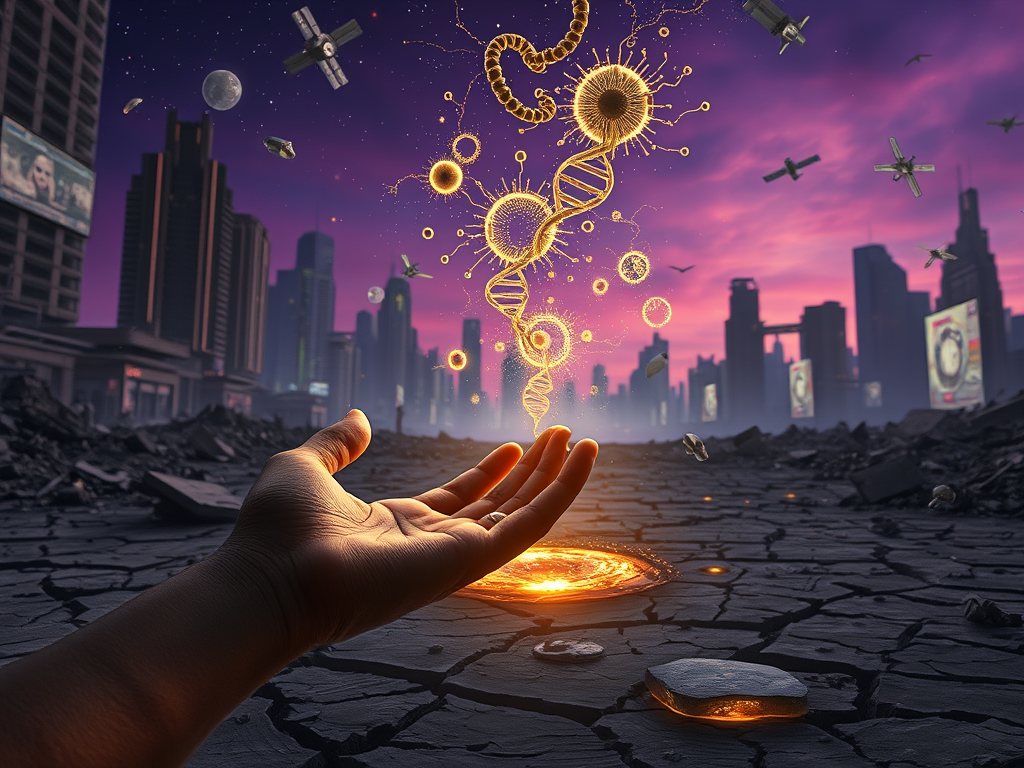
Now imagine a post-apocalyptic Earth. Ash everywhere. The power grid’s gone. No Wi-Fi, no Netflix, no banana chips. Just scorched soil and silence.
What’s still alive?
Cockroaches, maybe. A few mushrooms. And—bet your burnt dosa—bacteria.
But here’s the kicker: bacteria wouldn’t just survive that world.
They’d quietly begin rebooting the planet in ways we wouldn’t even notice.
Picture ancient bacteria setting up shop under a cracked satellite dish, stirring oxygen into ruined air like invisible chefs at the end of the world.
Nitrogen fixers like Azotobacter would recondition the soil—kneading nitrogen into dead land like a street vendor folding dough.
Cyanobacteria would photosynthesize and pump oxygen back into the air. Extremophiles—those insane bugs that live in boiling acid or radioactive sludge—would set up shop in places even Elon Musk wouldn’t touch.
In a way, they’re like the ultimate preppers. But instead of hoarding canned food, they hoard blueprints—for ecosystems, for metabolism, for rebuilding the chemistry of life from scratch.
I started wondering—if humans were wiped out tomorrow, what would bacteria remember?
Turns out… quite a bit.
🔄 Rebuilding, the Microbial Way
Here’s a wild thought I had while waiting for a Venuettan auto stuck behind a temple elephant parade:
What if we built our future technologies bacteria-first?
What if instead of silicon chips and data centers, we used living logic?
Think of bio-computers where bacterial colonies process information using quorum sensing—basically, molecular gossip.
Or decentralized networks where each node is a self-healing microbe.
It sounds ridiculous until you realize synthetic biologists are already tinkering with this.
MIT has engineered E. coli that can solve basic logic puzzles.
By programming DNA like code, they got the microbes to act like “wetware”—solving problems with gene switches instead of wires.
DARPA’s playing with engineered microbes to sniff out landmines.
And don’t even get me started on bioluminescent bacteria—tiny glow bugs that might one day light our streets without a single watt of electricity.
Even our infrastructure could learn from them.
Biofilms—those slimy layers bacteria build—are master architects.
They’re like microbial cities—dense, resilient, and surprisingly well-governed.
There’s flow, communication, recycling.
It’s like they’ve cracked urban planning at the molecular level.
They’re the squatters of evolution—showing up uninvited, staying forever, and somehow fixing the plumbing.
They don’t pay rent. But they remodel the place while you’re not looking.
Ambili Chechi once said while pouring me chai:
“Monay, the small ones always know how to survive. They don’t have a choice.”
Maybe that’s wisdom we forgot while chasing skyscrapers.
In a world falling apart, maybe the smallest things are already running silent systems that could hold it together.
💽 Bacteria as Time Capsules
Here’s another bizarre-but-true fact:
Bacteria can enter a state called viable but non-culturable (VBNC).
That’s science-speak for “still alive, just napping very hard.”
Some can hibernate for centuries, frozen in glaciers or trapped in salt crystals, and then wake up like nothing happened.
Like sleepy time-travelers in lab coats made of salt.
In 2000, scientists revived 250-million-year-old bacteria from deep underground brine pockets.
No food. No light. No Spotify. Just… pause… for a quarter of a billion years.
To me, that’s more than cool science.
It’s a whisper from the deep timeline.
These are not just survivors—they’re archivists.
Vaults of DNA storing recipes for life in all its conditions.
If I were designing a post-human civilization blueprint, I’d bury a few terabytes in silicon, sure—but I’d also seed the soil with bacteria.
Because even if your chips fry and your satellites fall, those microbial scripts will boot up eventually.
🧬 The Original Networked Intelligence?
Now hold up—here’s a really trippy detour.
Some scientists argue that bacterial colonies think.
Not with neurons, of course, but with chemical signaling—responding to stress, sharing resources, even coordinating attack or defense.
When food runs out or toxins show up, they coordinate responses—like fleeing or huddling—using chemical pulses.
It’s survival by committee.
There’s a theory called bacterial cognition, suggesting that collective behavior can mimic decision-making.
It’s like a distributed intelligence system.
No central command. Just millions of agents whispering and reacting in elegant, emergent harmony.
Sounds a lot like ant colonies, blockchain… or even the early internet.
But here’s the deeper question I can’t shake:
If consciousness emerges from complexity—if thought is something that rises from patterns of interaction—then how far back can this go?
Could the seeds of cognition exist at the bacterial level?
Chew on that the next time you’re wiping a kitchen counter.
🧪 Bacteria and the Simulation Save-File
Alright, stay with me. Let’s say the simulation theory is true—that we’re all running inside some cosmic software.
Now imagine you’re the sysadmin of this reality, and things go haywire.
Earth melts down. Civilizations collapse. Human progress gets Ctrl+Z-ed.
How do you reboot?
You don’t start from humans or cities or smartphones.
You start from the basics—from subroutines that can survive entropy.
You start from bacteria.
Because they’re stable. Adaptable. Redundant. Modular.
They’re the core script you never delete—even when the whole system crashes.
Kind of like how Word autosaves your document right before your laptop hangs.
Except instead of a paragraph about your weekend trip to Munnar, it’s the recipe for oxygenic photosynthesis.
Maybe bacteria are our backup files.
🔄 Closing the Loop
What struck me the most this week—between all this bacterial rabbit-holing and chai-stall pondering—is how linear we think.
We imagine civilization as this upward slope.
First fire, then wheels, then smartphones, then Mars.
But bacteria remind us that time isn’t a straight road—it’s a spiral staircase.
You climb, thinking it’s new, but each step echoes the ones before.
They’ve done it before. They’ll do it again.
And maybe—just maybe—our job isn’t to dominate them or eliminate them.
Maybe it’s to learn from them.
To treat bacteria not as the bottom rung of life’s ladder, but as its scaffolding.
Its original codebase. Its most loyal archivist.
Maybe our temples crumble, our languages vanish, our cities turn to moss.
But the bacteria? Still trading chemical gossip under a leaf.
I don’t know what comes next for our species.
Maybe we go extinct.
Maybe we become posthuman data streams surfing black holes.
Maybe we go full fungus.
But I’ll tell you one thing.
If I ever had to rebuild civilization from scratch, I wouldn’t start with concrete or code.
Not a server farm. Not a lab.
Just a slick patch near the drain.
The kind you usually scrub without looking—maybe the last place holding the plan for tomorrow.
Next time you clean without looking, pause.
What if it’s smarter than the sponge in your hand?
Because what survives the end of us might not be our monuments—
but our microbes.
🧠 Got a theory of your own?
Drop it below—or share this with someone who thinks bacteria are just bathroom villains.
You never know which microbe is holding the blueprint for tomorrow.
📚 Related Reading
🔗 Ethics in the Age of Artificial Companions
🔗 Elon Musk, Mars, and the Myth of Cosmic Escape
🔗 What If Earth’s Magnetic Poles Flipped Overnight?
🔗 Evolving in Zero Gravity: Future Humans in Space
🔗 Unveiling Golden Milk: The Journey of Haldi Doodh
We’d love to hear your thoughts. Let’s chat below!