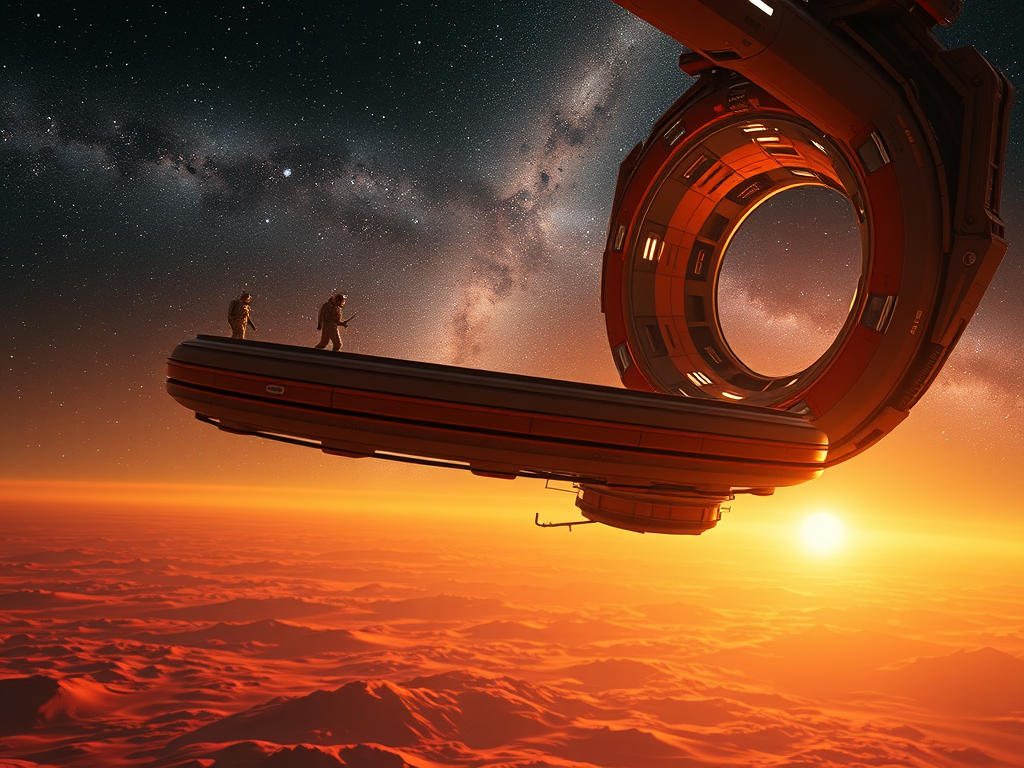

I once met an astronaut.
Not in real life, sadly.
She was a character in a forgotten Malayalam sci-fi comic I found at a railway station bookstall near Kottayam.
She had this line:
“In space, I don’t float. I fall very slowly. Forever.”
That sentence haunted me.
I didn’t understand it at the time.
I was ten, with zero grasp of orbital mechanics and a backpack full of banana chips.
But something about it stuck.
Like… what do you mean, fall forever?
Fall where?
Years later—somewhere between a physics textbook and a conversation with Venuettan about autorickshaw balance points—I finally got it.
In space, you’re not weightless because gravity disappears.
You’re weightless because you’re always falling, perfectly, around a planet.
Like chasing a floor that always slips away.
But here’s the twist.
That fall—beautiful as it is—comes at a price.
Bones start forgetting they’re bones.
Hearts grow lazy.
Even time seems to lose its rhythm.
And that’s where the question begins:
Can we fake gravity?
Not just simulate it with a harness or throw in a few magnetic boots.
But build it.
Weave it into the architecture of a spaceship.
Spin it. Shape it.
Make gravity happen… where there is none.
Because if we ever want to walk on Mars without stumbling like drunk baby giraffes—
we’re going to need more than courage.
We’ll need a force that reminds the body where down is.
Even when there’s no down left.
And that’s where artificial gravity comes in—not as a fantasy, but as an engineering puzzle we’ve been circling for decades.
🌍 The Gravity of the Situation
Let’s start with why we need gravity in the first place.
On Earth, gravity is like that one friend who doesn’t say much but always has your back.
It keeps your bones dense, your organs in place, your drinks in cups, and your food heading in the right direction.
Remove it, and weird things start happening.
Blood pools in your head.
Your eyeballs squish.
Your spine stretches like a soggy churro.
Astronauts returning from just six months aboard the ISS often have trouble walking.
Imagine what a two-year trip to Mars might do.
So the obvious fix? Bring gravity with us.
But, here’s the twist: we don’t know how.
At least, not yet.
🌀 Newton, Einstein, and a Spinning Chai Cup
Now, before we start inventing gravity machines like we’re in a Christopher Nolan film, let’s clear one thing up:
Gravity isn’t a force you can pack in your suitcase.
You can’t just scoop up a few kilograms of gravity and duct-tape it to a wall.
Gravity is the warping of spacetime itself, as Uncle Einstein taught us.
You need mass—big, planet-sized mass—or acceleration to mimic its effects.
And acceleration? That’s where it gets interesting.
Imagine stirring your chai in a cup.
If you drop a cardamom pod into the center and spin the cup, the pod slides out toward the edge.
That outward “push” is what we call centrifugal force—a fake force, but a useful one.
It’s how you can simulate gravity without actually bending spacetime.
Now scale that up to a spaceship. Make it spin.
Boom. Artificial gravity.
Imagine standing on the inner wall of a spinning wheel—the faster it turns, the more the floor presses up against your feet. That sensation? Feels like gravity.
🛰️ Enter the Rotating Space Habitats
This is the golden child of artificial gravity theory: rotation.
Instead of floating around like lost laundry, what if your spacecraft spun like a giant wheel?
If the radius is large enough, and the rotation just right, the floor would push up against your feet, and you’d feel weight again.
Your chai would stay in the cup.
Your bones would remember their job.
In fact, we’ve been dreaming this since the 1950s—Wernher von Braun’s wheel-shaped stations, Stanley Kubrick’s spinning hotel corridors in 2001: A Space Odyssey.
But here’s the thing…
Nobody’s built one. Not even close.
Why?
Because spinning huge structures in space is hard.
Like, “balancing a spinning coconut on your nose during a thunderstorm” hard.
You need massive structural integrity, perfect rotational balance, and enough room to avoid nausea-inducing Coriolis effects—those strange dizzy lurches you get when you turn your head in a spinning room and your brain lags behind.
Turns out, if you spin too small or too fast, the gravity might work—but your breakfast won’t stay down.
🔗 But What If We Didn’t Spin the Whole Thing?
Some engineers propose a partial fix: tethered habitats.
Picture this: two modules connected by a long cable.
They spin around a central point like a cosmic dumbbell.
The outward centrifugal force creates “gravity” in each module.
Each end becomes its own floor as the spin pulls outward—kind of like swinging a bucket of water and keeping it from spilling.
Bonus? You don’t need to spin the whole station. Just the ends.
But again—cables snap. Tensions wobble. Physics has no chill in zero-G.
We haven’t yet tested this at scale.
Still, the math is sound.
Even at 1g (Earth gravity), you’d only need a rotation radius of about 224 meters if you’re spinning at 2 rotations per minute.
That’s big—but not impossible. Especially if we’re building space habitats from lunar or asteroid-mined materials.
🧲 Magnetic Gravity? Tractor Beams? Nope.
Some of my late-night Reddit wanderings have unearthed wild ideas.
Can we magnetize our suits and use magnetic floors?
Sure, but that won’t help your bones or your cardiovascular system.
It just holds you down like Velcro sandals at a beach wedding.
Stylish? Maybe. Good for your bones? Not even a little.
Could we simulate gravity using constant linear acceleration?
Yes, but it’s fuel-hungry.
You’d need a spacecraft accelerating non-stop at 9.8 m/s²—essentially a rocket that never turns off.
To keep 1g for months, you’d need a rocket that accelerates like a drag racer—without ever letting off the gas.
Not very efficient, unless we invent fusion drives or harness solar sails at Jupiter-scale.
And no, we don’t have tractor beams.
Yet.
🚂 My Favorite Thought Experiment: The Gravity Train
One night, during a Vishu festival firecracker lull, I scribbled something on the back of a banana leaf while chatting with Rakesh at Ambili Chechi’s chai stall.
What if we made a gravity train?
Picture a narrow treadmill wrapped around the inside of a hoop, slowly rotating under your feet while the rest of the spacecraft stays still.
The crew walks “inside” the ring while the central body remains still.
You’d get gravity where you need it—at your feet—but avoid nausea and simplify engineering.
Sort of like walking on a sideways escalator that never ends.
Rakesh looked at me, half-impressed, half-annoyed.
“Great, machane. Now how do you power it without making the tea boil on the ceiling?”
Fair point.
🚀 Will We See Artificial Gravity in Our Lifetime?
If I had to bet my last piece of jackfruit halwa—I’d say yes.
Not because the tech is easy, but because the problem is unavoidable.
The moment we decide to send humans to Mars—or beyond—we’ll have no choice but to solve it.
You can’t expect people to arrive on a new planet and immediately build a colony if they’ve spent 7 months floating like noodles in soup.
NASA, ESA, SpaceX—someone will test a rotating module within the next two decades.
Probably modular, tethered, or slowly scaling up from lunar orbit stations.
And maybe, just maybe, we’ll start building habitats where gravity is optional.
Turn it on or off like a light switch.
Now that would be a sci-fi dream worth chasing.
🧠 A Thought to Leave You With
Sometimes I wonder…
If gravity is the curve in spacetime that keeps us grounded—what keeps our minds from floating off?
Is it routines? Memories? Love?
Maybe it’s a metaphor—for how we anchor ourselves in the void.
Maybe it’s about the invisible routines and relationships that keep us human when everything else slips away.
Next time you drop a spoon or catch a falling fruit mid-air, take a second to marvel.
That’s gravity.
And one day, we’ll build it ourselves.
Machane, imagine that.
🪐 If this sparked a new thought—or made you want to build a spinning chai stall in space—drop a comment below.
Or pass it along to someone who dreams with their feet off the ground.
Let’s keep questioning.
Let’s keep spinning.
And maybe the next time I spill my tea, I’ll blame it on low gravity. Or at least pretend I’m training for Mars.
📚 Related Reading
🔗 Ethics in the Age of Artificial Companions
🔗 Elon Musk, Mars, and the Myth of Cosmic Escape
🔗 What If Earth’s Magnetic Poles Flipped Overnight?
🔗 Evolving in Zero Gravity: Future Humans in Space
🔗 Unveiling Golden Milk: The Journey of Haldi Doodh
We’d love to hear your thoughts. Let’s chat below!