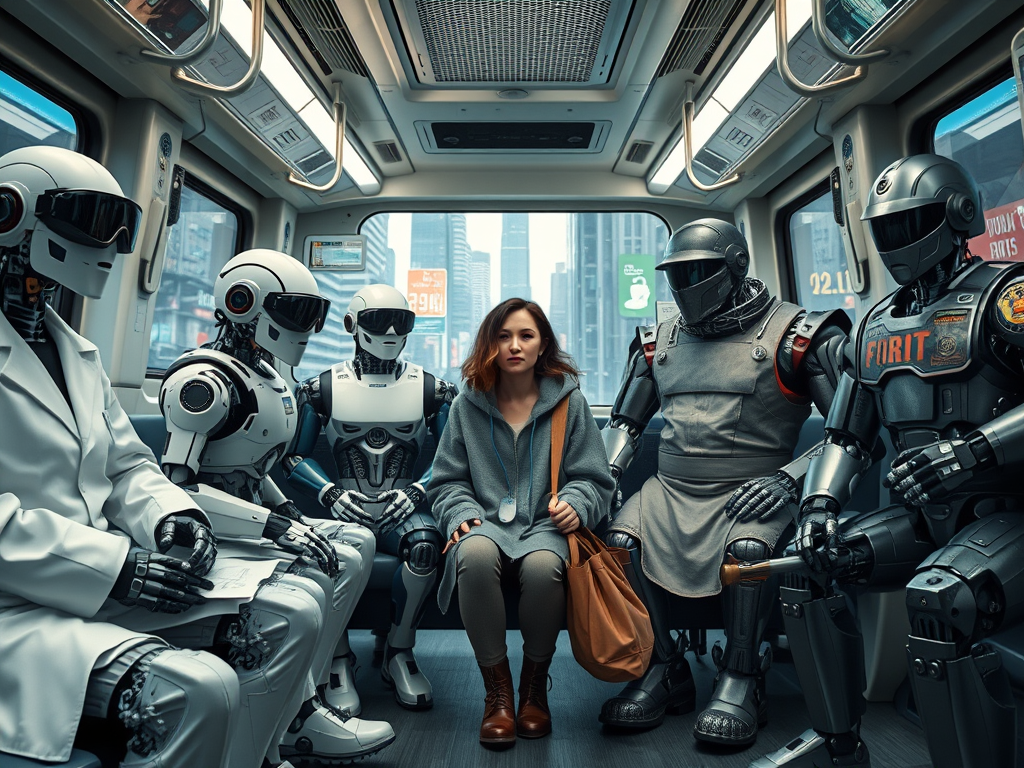

The other day, while sipping chai from a cracked clay cup at Ambili Chechi’s stall (the one near the post office where the gossip is spicier than the chutney), I had this bizarre thought.
What if one day, no one needed Ambili Chechi?
Not because her tea got worse (impossible), but because a perfectly calibrated AI chai-bot set up shop next door. It could remember your sugar level, recommend teas based on your serotonin drop, and never, ever forget your birthday.
But here’s the catch: what if, by the time all these robots took over, none of us could afford chai anymore?
Just like that, I slipped into a thought spiral—as if I’d fallen through a black hole of automation.
Let me walk you through it.
☕ The Automation Illusion: Who’s It Really For?
We keep hearing about automation as this miracle of productivity.
Assembly lines with zero defects.
Warehouses that never sleep.
Chatbots that handle millions of queries without blinking (if they had eyes, that is).
It’s all so slick, so efficient.
But there’s a lurking contradiction.
Who exactly are we optimizing for… if jobs disappear?
You can automate farming, delivery, even art.
But if humans are no longer earning, who’s left to consume all this machine-made abundance?
A system that replaces its workers faster than it empowers them isn’t scaling—it’s self-cannibalizing.
I once joked with Rakesh at the tea stall—he’s a software engineer by day and philosopher by caffeine—that if AI kept advancing at this rate, the only thing we’d be left doing is watching ads for products we can’t buy.
He nodded, squinting at his screen, and muttered,
“Soon we’ll have a recommendation engine suggesting dreams we can’t afford to have.”
Dark. But not entirely wrong.
Imagine a world where every chai stall is replaced with a vending bot—but no one has the money, or the mood, to buy tea.
🤖 The Uselessness Problem
This isn’t just about poverty.
It’s deeper.
It’s about meaning.
See, we’re not wired to just survive.
We’re wired to matter.
Strip away jobs, and you don’t just take away paychecks—you erase routines, identities, purpose.
You unplug people from the story they’ve been writing their whole lives.
And here’s where it gets weird.
When machines do everything better, we don’t just feel poor—we feel… irrelevant.
What happens when we’re no longer contributors, just passive observers?
Do we become like those background characters in video games—forever watering the same plant, never looking up?
(Those are called NPCs—non-playable characters—designed to do one thing, over and over, with no awareness of the story unfolding around them.)
Or do we become audience members in a show we no longer write?
That’s the existential plot twist no one’s talking about.
🎭 Post-Work Humans: What Could We Be?
I don’t buy the dystopia where humans just rot in VR pods, addicted to synthetic dopamine while robots manage the planet.
That’s lazy storytelling.
And quite frankly, un-Keralite.
We don’t sit quietly—we adapt, rebel, create new roles.
So I started imagining:
What could we become?
Let’s dream a little.
1. Cultural Stewards
Think of the elders in your village who still remember the songs sung during Vishu or the proper way to fold a mundu at a funeral.
In a machine-run world, preserving culture might become one of the most human—and essential—roles.
Not as curators of the past, but as translators of soul.
I remember once hearing my grandmother hum a lullaby in Malayalam that no recording ever captured properly.
It wasn’t just the tune—it was the way her voice cracked on the last line.
No AI will ever recreate that.
2. Curators of Chaos
You know who machines can’t predict?
Comedians.
Rebels.
Artists.
People who break patterns, not follow them.
There’s power in being unpredictable—injecting randomness into an overly optimized world.
Maybe that’s what keeps the system honest.
Last month in Ernakulam, I saw a street comic interrupt a sleek robot demo by imitating its movements—badly.
The crowd was in stitches.
It was silly.
It was human.
It was perfect.
3. Healers & Witnesses
Grief, joy, shame, transformation—these aren’t codeable.
Imagine humans whose primary role is to hold space for each other.
Not as therapists with clipboards, but as sacred mirrors.
This isn’t woo-woo. It’s survival.
Sometimes the most powerful thing we do is sit next to someone and say nothing.
Just be there.
That’s not something a bot can do—not yet, and maybe not ever.
4. Entropy Whispers
Okay this one’s weird, but hear me out.
Entropy is the natural drift toward disorder.
No system, no matter how perfect, escapes it.
That’s where we come in.
What if some of us live at the edge—not fixing the system, but nudging it just enough to stay alive?
Injecting disorder so the machine doesn’t get too perfect.
Like cosmic anti-virus agents.
Or poetic saboteurs.
5. Choice-Makers
Here’s a job that’ll always need a human:
Deciding between two equally optimal outcomes.
Because AI can weigh cost, time, and outcome—but it can’t feel.
It can’t choose the messier option just because it’s more beautiful.
Or tragic.
Or worth it.
Like keeping a failing bookstore open—not because it’s profitable, but because generations of readers fell in love there.
Try explaining that to an algorithm.
🧠 New Economies of Meaning
Let’s assume, for a moment, that material needs are handled.
(That’s the basic idea behind Universal Basic Income—imagine a world where your rent, food, and medicines are covered—no job required.)
Then what?
What becomes valuable in a world where everything is already made for us?
My guess?
Attention. Care. Story. Mystery.
I once spent an entire evening watching Lachamms the vegetable seller dance in the rain while trying to protect her okra with a banana leaf.
It was absurd.
Beautiful.
Pointless.
And it meant more to me than a thousand algorithm-curated videos.
Maybe value in the post-AI world isn’t measured in efficiency, but in resonance.
Not what gets done, but what makes us feel alive.
💭 The Machine That Needs a Reason
We keep saying AI will replace us.
But I think that’s missing the point.
A machine can compose a symphony.
But only a human can ask—should we?
Only a human knows what it feels like to grieve the smell of their grandmother’s cooking.
Or to carry the ache of a goodbye for years.
Or to stare at a full moon and feel a kind of homesickness they can’t explain.
You can’t code that.
Or maybe you can.
But it’ll be mimicry. Not meaning.
I think—no, I believe—that AI needs us.
Not to code it.
Not to fix it.
But to be the reason it exists at all.
Because what’s the point of intelligence without wonder?
🌍 The Final Loop
Last week, I was in Vypin, visiting Sukumar the fisherman.
He was cleaning his nets, talking about how the tides had changed again—blaming it on cosmic laziness, as usual.
I asked him what he’d do if a drone could fish better than him.
He just grinned and said,
“Then I’ll teach it how to wait,” he said, like he was passing down a family secret.
That line hit me like a lightning bolt.
Because waiting isn’t inefficiency.
It’s ritual.
It’s presence.
It’s poetry.
Maybe that’s the clue.
Maybe our future isn’t to outsmart the machines…
…but to remind them who they’re building the world for.
☁️ A Beat. A Breath.
Maybe one day, I’ll be gone.
And so will Ambili Chechi.
But maybe—just maybe—someone will read an old post, sip hot chai, and remember we once asked beautiful questions.
And if a vending bot ever does replace Ambili Chechi—
I hope it still leaves one cracked clay cup out in the sun, just to remember what warmth used to feel like.
If we must be something…
Let’s be poetic saboteurs.
Rakesh would probably call that inefficient.
I’d call it human.
If this sparked a question, a chill, or even just a smile—drop a comment.
I’d love to hear your version of what comes after.
Maybe together, we’ll map a future the machines can’t quite predict. Yet.
📚 Related Reading
🔗 Could an AI Accidentally Become a God?
🔗 Harnessing Black Holes: The Future of Cosmic Energy
🔗 Smiling Buddha: How India Outsmarted the CIA
🔗 AI as the Ideal Space Companion: A New Perspective
🔗 Ethics in the Age of Artificial Companions


We’d love to hear your thoughts. Let’s chat below!