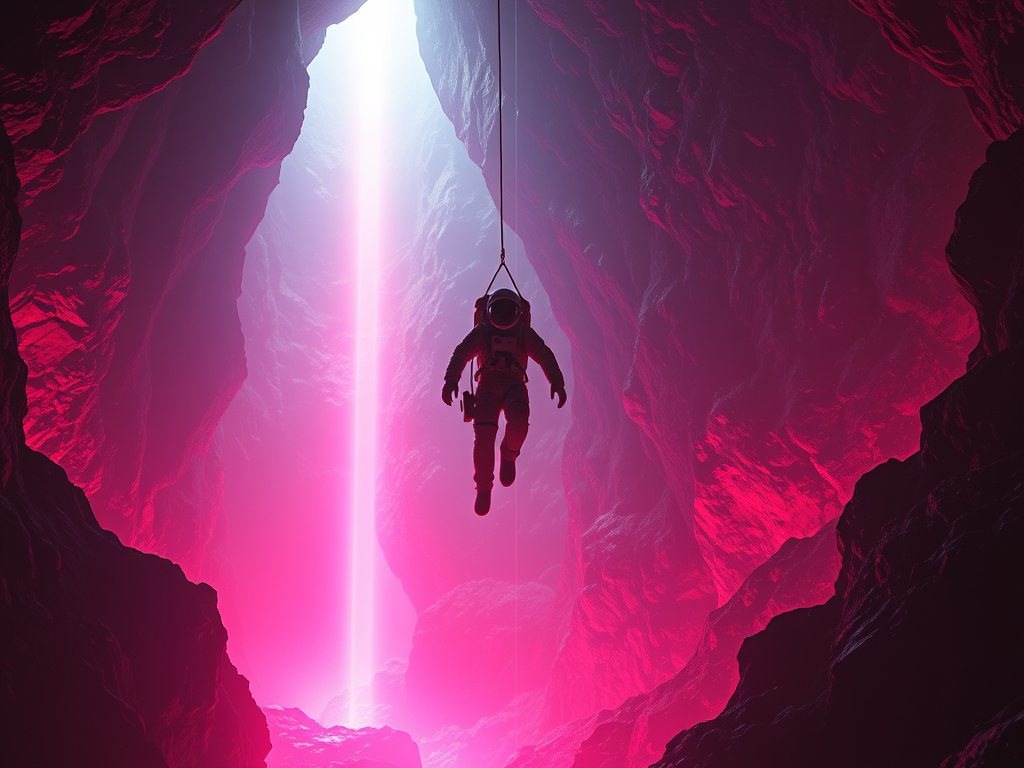

It began—not with a textbook, but with a pothole.
I was walking near Fort Kochi after a late-night chai session with Rakesh, pondering wormholes and latency issues in the fabric of space-time (as one does), when I stepped into a crater the size of a small universe.
As my ankle twisted and I flailed dramatically, a ridiculous thought zipped through my brain:
What if I just kept falling?
Through the soil, the bedrock, the molten mantle—past everything—straight to the Earth’s core. Could I survive it?
Spoiler alert: no.
But also… maybe?
Let me explain.
⛏️ First, What’s Down There Anyway?
We walk on a surface that’s basically the planetary equivalent of onion skin.
Dig about 40 km (which is like two auto rides from Kochi to Alappuzha stacked vertically), and you’ve hit the end of the crust.
Beneath that? The mantle—a thick, churning layer of semi-solid rock that flows over geological timescales.
Then comes the outer core, a swirling ocean of liquid iron and nickel, and finally the inner core, a solid ball of metal as hot as the surface of the sun.
That’s 6,371 kilometers of descent.
And no, you can’t just tunnel through like some bored Minecraft player.
The deepest hole we’ve ever drilled—the Kola Superdeep Borehole in Russia—only got 12.3 km down.
After that, things got weird. The rock became plastic-like. Temperatures soared to 180°C. Equipment began to break.
And that was just 0.2% of the way to the center.
If the Earth were a gulab jamun, we’ve only tasted the sugar glaze.
We’re wanderers on a crust no thicker, proportionally, than the skin of a soap bubble.
☠️ Death by Degrees: Let’s Count the Ways You’d Die
Let’s assume, for fun (and foolishness), that you somehow begin a freefall toward the center of the Earth—like a reverse skydiver.
1. Heat
The temperature at the core is estimated to be 5,400°C—hotter than a pizza oven, the surface of the sun, or Ambili Chechi’s tandoor when she’s angry.
That kind of heat doesn’t just roast you; it vaporizes you.
Before you get close, your cells would unravel into atomic soup.
2. Pressure
The pressure at the core? Over 3.6 million atmospheres.
That’s like stacking 10,000 elephants on your head while you’re inside a pressure cooker.
Your lungs? Imploded.
Blood? Crushed into plasma.
You’d collapse into a puddle before you even had time to say “ente daivame!”
Pressure at the core reaches 360 gigapascals—about 3.6 million times what we feel at sea level. That’s enough to crush Mount Everest into a bowling ball.
3. Lava’s Cousins
While the mantle isn’t classic lava, it’s made of superheated silicate rock that behaves like honey when viewed over centuries.
Walking or tunneling through it is like trying to swim through boiling cement.
4. Magnetism
The outer core generates Earth’s magnetic field, thanks to the “geodynamo effect.”
If you had electronics, navigation tools—or even thoughts that depend on neural electrochemical flow—they might just freak out.
Ever tried meditating in a malfunctioning MRI machine?
🤯 But What If You Could?
Let’s cheat a bit.
Say you’re inside an indestructible sci-fi capsule.
Some kind of futuristic heat-proof, pressure-proof, magnetism-shielding pod designed by… I don’t know, Rakesh during one of his manic coding sessions while sipping Ambili Chechi’s fifth chai of the night.
Could you observe the center of the Earth?
Yes.
Survive? Technically.
But it’d be weirdly lonely.
Why?
Because time behaves strangely when you’re that deep.
Not in the Interstellar black-hole way, but due to gravitational time dilation.
Gravity warps time.
Clocks closer to massive objects tick slower.
That means your watch might run a teensy bit slower than your friend’s on the surface.
Not enough to notice unless you’re tracking microseconds—but enough that if you lived there, you’d technically age a fraction of a second slower than the rest of humanity.
A literal underground anti-aging spa.
For corpses.
🌐 Gravity Flip: The Wild Bit Most People Forget
Here’s a twist that blows my mind more than Sukumar’s fish-gutting knife after a few Old Monks:
Gravity wouldn’t pull you “down” forever.
The deeper you go, the more mass is behind you rather than below you.
By the time you’re halfway to the core, the gravity pulling you downward weakens.
At the exact center, gravity is zero.
It cancels out from all directions.
So you’d just… float.
Suspended in the center of Earth like some cosmic dal particle in a pressure cooker.
No up. No down. Just there.
Which, if you think about it, is an oddly spiritual image.
A perfect stillness. No motion. No pull.
Just you, in the heart of a planet.
What’s the Malayalam word? Sthitha prajna.
Absolute inner peace—right before being cooked alive and squished like banana chips under a bus tire.
🛠️ Could We Build a Tunnel?
I mean, science fiction has tried.
Remember Jules Verne’s Journey to the Center of the Earth?
That book was like eating a banana leaf meal of imagination—with a side of outdated science.
But in reality? We’d need:
- A material stronger than anything on Earth.
- Cooling systems that can withstand lava-level heat.
- Navigation tech that doesn’t fry in a magnetic soup.
- A way to not die instantly from pressure.
Also, seismic waves—the ones scientists use to “x-ray” the Earth—would bounce around like a thousand angry elephants every time a small earthquake hits.
Your tunnel would collapse. Or melt. Or vibrate into oblivion.
But if we could do it, the physics is fun.
You’d oscillate—falling to the center, speeding up due to gravity, then slowing down as you pass it, only to reverse and fall back again.
Like a pendulum.
You’d yo-yo forever—unless you stopped at the center.
Now imagine that on a public transport timetable:
“Bus to Ernakulam: Departure 8:00 AM. Arrival: Gravitational midpoint. Float for eternity. No return.”
🧠 So Why Bother Thinking About This?
Because it makes us wonder.
Wonder is a rare species now.
We’ve got gigabytes of data, reels, and reactions—but how often do we sit under a jackfruit tree, stare at a pothole, and ask “What if I fell through the world?”
These absurd questions lead to real science.
Studying Earth’s layers has helped us understand plate tectonics, which explain earthquakes, mountain formation, and even why Lachamms’ tomatoes are juicier this year (hint: volcanic soil from past eruptions).
Also, the core is what generates the magnetic field that shields us from solar radiation.
Without it?
No GPS, no auroras, no protection from cosmic particles.
Basically, a very bad beach holiday.
💫 From Physics to Philosophy
But let’s step out of the capsule for a second—because not all journeys need pressure suits.
Some just need perspective.
Even if our bodies can’t survive the center, what about our thoughts?
Could we imagine, simulate, or dream our way there?
After all, physics is increasingly becoming a dance between reality and thought.
The observer effect. Quantum weirdness.
Maybe the center of the Earth is more than just molten metal.
Maybe it’s a metaphor—a symbol for digging into the self.
A journey inward, through layers of ego, memory, and instinct, until we reach something core.
Something… still.
And maybe that center—unlike the fiery core of the planet—is the one place we can survive.
A place beyond pull and pressure.
A place where time, space, and fear dissolve.
Or maybe not.
Maybe I just need better shoes.
📩 Your Turn
If this made your brain swirl like Ambili Chechi’s chai spoon, drop a thought in the comments.
Would you take the plunge?
Or are some journeys better left to imagination?
🚀 And if it gave you a new way to look at the world—or the dirt beneath your feet—share it with someone who still believes the Earth is flat.
Let’s dig deeper.
Maybe I didn’t fall through the Earth that night.
Maybe I just fell into a better question.
And that—like most deep journeys—starts with a pothole.
Rakesh later said,
“Bro, even the pothole had better signal than your apartment.”
🌍 Related Reading
• Evolving in Zero Gravity: Future Humans in Space
• From Saunas to Ice Baths: Exploring Global Healing Traditions
• The Thermodynamics of Filter Coffee: Why It Cools Just Right
• The Lunar Pull: How Moon Phases Affect Us
We’d love to hear your thoughts. Let’s chat below!