
🛶 A Houseboat and a Thought
It moved like it remembered something we didn’t.
That’s how the houseboat floated past me in Alappuzha one dusky evening. Untethered. Unbothered. Moving not with purpose—but persistence. Its lanterns were unlit. Its ropes curled neatly, like it had slipped away unnoticed. For a moment, I wondered if it even belonged to this world—or if it had been drifting for years, forgotten.
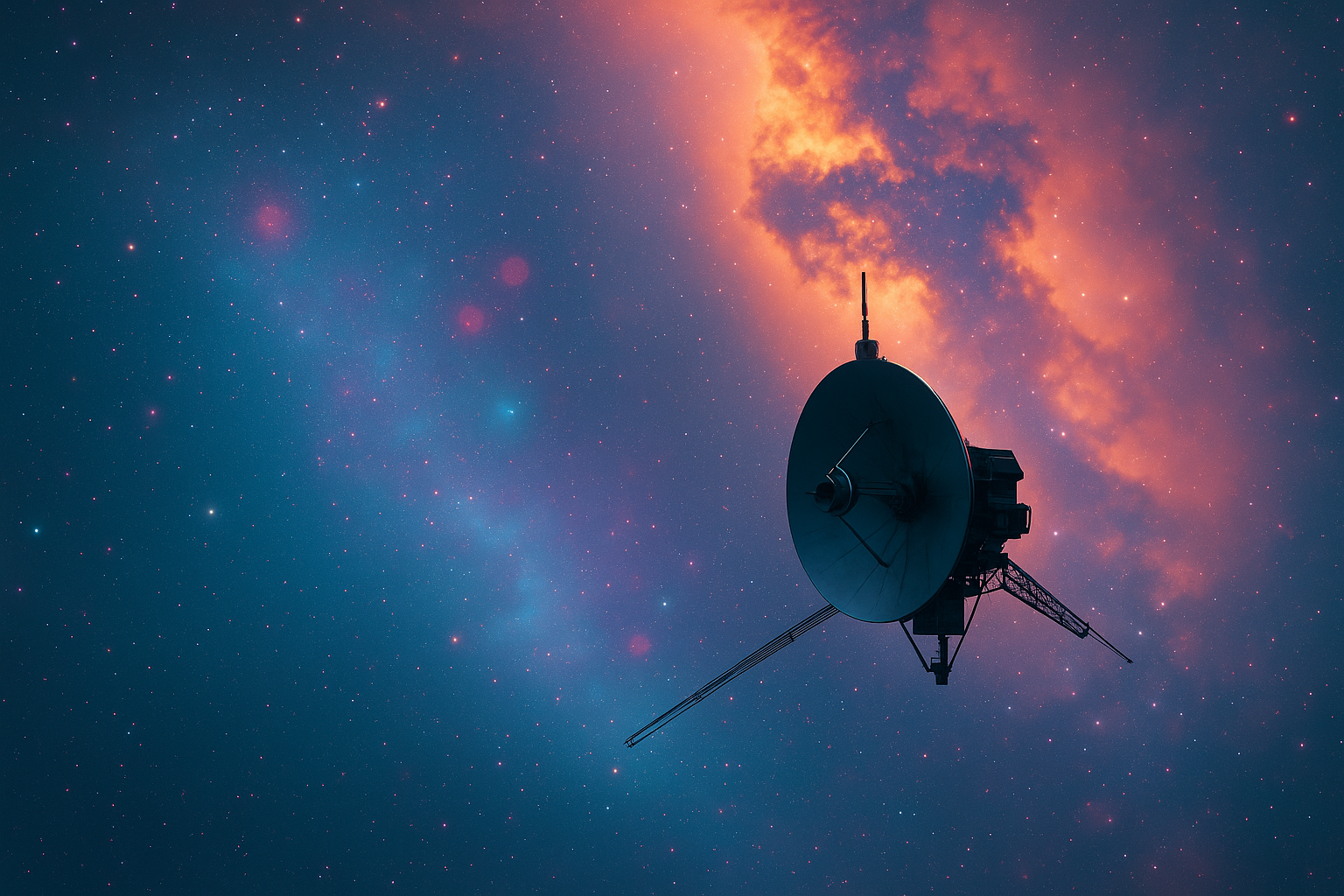
That’s when I thought of Voyager.
Not as a machine. Not as a science project.
But as a being.
A quiet, relentless wanderer.
Launched with no promise of return.
Sent into the void—simply because we had to know.
And isn’t that the most human thing ever?
Sometimes I think of Voyager as someone I knew. A friend who went abroad and never came back. Who used to send voice notes—crackly, warm—but now just leaves them on read. We still look at the last timestamp. We still hope.
⚙️ A Soul Cast in Circuitry
I know it’s metal and wires and radiation-hardened parts. I know it doesn’t feel, doesn’t ache, doesn’t hope. But sometimes, when I imagine Voyager drifting alone through interstellar space, I can’t help but see it as… a kind of soul. Maybe not alive—but alive enough.
Launched in 1977, Voyager wasn’t built to return. It was built to leave. To say hello to Jupiter, Saturn, Uranus, Neptune—and then keep going. Past the last gravitational whisper of the Sun. Past Pluto. Past memory.
To get there, it borrowed the gravity of giants.
There were two of them.
Voyager 1 and Voyager 2—twins, but not identical.
Launched weeks apart, flung in slightly different directions.
One took the fast track toward deep space. The other stayed back just long enough to visit all four outer giants.
And like siblings at a train station, they waved to each other once—and then went their separate ways.
Jupiter gave it a friendly slap on the back. Saturn handed it a train ticket. Uranus raised a sleepy eyebrow. Neptune didn’t say much—just waved. Like uncles at a railway platform—lingering just long enough to send you off, but never stepping onto the train.
And then it was alone.
Right now, as I write this, Voyager 1 is hurtling away from us at over 17 kilometers per second. That’s 61,000 kilometers an hour. And you know what it’s doing?
Still listening. To particle hums. Star winds. Silence.
📸 The Pale Blue Dot
Before it shut its camera forever, Voyager turned around—just once.
From 6 billion kilometers away, it looked back at Earth and took a photo.
A faint dot. Suspended in a shaft of light.
So small you could cover it with a speck of dust.
And yet—everything we know was on that dot:
our homes and temples, our songs and silences,
every kiss, every battlefield, every whispered prayer.
Our gods lived there. Our pride marched there.
Every dream we dared, and every heart we broke—
all of it, spinning on that fragile, pale world.
Carl Sagan called it the Pale Blue Dot.
A photo so faint, you could miss it—but so powerful, it became scripture for dreamers.
It’s the kind of silence you don’t get on Earth—the kind that doesn’t need permission to exist.
And Voyager? It doesn’t interrupt. It just… receives. Records. Remembers.
A quiet traveler, passing through without leaving footprints.

🌍 We Sent Our Dreamer Into the Cold
You know what else we sent with Voyager? A record.
A literal golden record.
It has greetings in 55 languages. Music from Bach and Blind Willie Johnson. Sounds of birds and thunder. The laughter of a child. And a kiss—yes, a kiss encoded in analog form.
Why?
Because we’re ridiculous. And beautiful. And lonely.
Not because anyone was watching—but because the silence was too much to bear.
We etched a map of where we live onto a fragile disk and taped it to the side of a machine that would never come home.
We lit a flare in the dark, not to signal conquest, but to confess presence. Because somewhere deep down, we knew Voyager wouldn’t find anything.
But we hoped something might find it.
🛫 A Testament to the Ones Who Leave
In Kerala, when someone migrates to the Gulf for work, we don’t say they “moved away.” We say they went. As in: avan poyi—he went. That’s it. Not where. Not why. Just: he left.
And Voyager left.
Not to find aliens. Not to plant flags. Not to collect samples. But simply to go.
In that way, Voyager is us—at our most primal.
The part of us that leaves the village. The continent. The solar system.
The part that doesn’t know what it’s looking for—but knows it must look.
It left the warmth of sunlight. The chatter of Earth. The chance to ever be held again—not because it misses being held, but because we do. Because it’s easier to send something into the dark than to admit we’re scared of not being remembered.

🌌 Through the Wastelands Between Suns
Space isn’t a place. It’s a silence with no walls.
The Voyager probes are now in what we call “interstellar space.” But that’s just a name we invented to feel less alone. There’s no welcome mat. No signboard saying, “Congratulations, you’ve exited the Solar System.”
There’s just… less Sun.
It’s like walking into a room where the warmth has quietly vanished, but the furniture is still there—just colder, quieter, and strangely unfamiliar.
The particles are different. The magnetic fields are weird. The radiation is higher. But mostly, there’s a sense of distance that doesn’t fit into kilometers.
The kind of distance that makes you realize: Voyager isn’t just far from us. It’s far from everything.
And still—it keeps moving.
No brakes. No destination. Just inertia, and a sense of direction that isn’t really direction anymore.
🐟 Sukumar’s Theory of Cosmic Fish
Last week, I asked Sukumar—the fisherman who sometimes sells me mussels—what he thought about Voyager.
He said, “Some fish leave the shore and never come back. Maybe they don’t find food. Maybe they find something better.”
That’s it. That was his whole explanation. Then he offered me a discount on squid.
But that stuck with me. Maybe Voyager is a kind of cosmic fish—one that left the planetary reef and just kept swimming into the black, searching for currents we’ll never know.
And unlike our satellites or space stations, it didn’t circle.
It departed. That’s a rare thing.
📡 It’s Still Talking. Are We Still Listening?
You’d think something launched 48 years ago would’ve stopped by now. But no. Voyager still whispers home, like an old man sending postcards from a forgotten exile.
Its signals are faint—about a billionth of a billionth of a watt when they reach us.
That’s like trying to hear a whisper across a galaxy—or catching the glow of a firefly from Pluto.
But we have dishes big enough to catch them.
We lean in. We strain to hear.
Why?
Because it’s the last thread.
The last direct conversation we’re having with the physical universe at that edge.
Once Voyager goes silent, it’ll be the first time in history we have something out there—beyond the Sun’s breath—that isn’t saying anything at all.
🪞 A Tiny Mirror of Who We Are
Sometimes I think Voyager isn’t a spacecraft—it’s a mirror. A reminder that we are the species that asks, “What’s beyond?” Not for profit. Not for survival. Just… curiosity.
Rakesh once said over chai, “Voyager is the ‘read receipt’ we sent to the cosmos.”
Maybe. But I think it’s more like a paper boat we let go during Onam—drifting into the river, carrying our hopes even when we know it won’t come back.
Or like when my grandmother, years ago, lit a small diya and set it afloat down the river during Vishu. She didn’t pray out loud. Didn’t ask for anything. She just watched it go—tiny, flickering—until the light vanished around a bend. I never asked her why. But now I think I understand.
We do these things not to be seen, but to feel seen.
Even if only by the dark.
🔋 And One Day, It Will Go Silent
The plutonium powering Voyager’s instruments is running out. Slowly. Like a candle guttering before it dies—flickering once, then twice—before the wick forgets how to burn.
Eventually, the instruments will turn off one by one. The tape recorders will stop. The transmitters will go mute.
And it will still be out there. Blind. Deaf. Alone.
But not forgotten.
Because long after humanity is gone—long after our cities are dust and our languages extinct—Voyager will still be drifting.
Maybe past a rogue planet. Maybe brushing the edges of a brown dwarf. Maybe into a gravity well that slings it toward the next galaxy.
And maybe, just maybe, something will find it.
Rub the dust off that golden record.
Play the heartbeat of Earth.
And whisper: “You were not alone.”
That’s what Voyager is.
Not a probe. Not a relic.
But our bravest whisper into the void.
And if that’s not poetry, I don’t know what is.
👽 And If They Hear Us…
Maybe, just maybe, something will find it.
Rub the dust off that golden record.
Run fingers—tentacles, sensors, who knows—across its grooves.
Hear the heartbeat of Earth.
And pause.
And in some language we will never know—through vibrations or vision or something beyond our physics—they will send back a single message:
We heard you.
And then, the signal will end.
No follow-up.
No explanation.
Just proof that the dark was listening all along.
✨ The Last Whisper
If this made you pause, even for a moment, leave a like—or pass it on to someone who dreams big under small skies.
Let’s keep listening.
Just in case Voyager still has one last story to tell.
📚 Related Reading
🔗 The Fermi Paradox: Are We Really Alone in the Universe?
🔗 Black Holes: The Universe’s Recycling Bins
🔗 Smiling Buddha: How India Outsmarted the CIA
🔗 Understanding Hemocyanin: The Science Behind Blue Blood
🔗 Ancient Cave Paintings and the First Scientists of Wonder


We’d love to hear your thoughts. Let’s chat below!